

New Developments in EnantioselectiveBrønsted Acid Catalysis
237
In the first step of this reaction a proton transfer from the chiral Brønsted acid 5 to the aldimine 26 will result in the formation of a chiral
ion-pair which is now activated to react with the nucleophile 25a. The
subsequent Mannich reaction will then result in the corresponding βamino ketone 27. The fundamental requirement for the successful development of such a Brønsted acid assisted, asymmetric Brønsted acid
catalyzed direct Mannich reaction (Rueping et al. 2007b) must be that
the achiral Brønsted acid BH is not able to activate the aldimine 26.
Following this concept we were able to develop the first direct Mannich
reaction of acetophenone and derivatives with aldimines to obtain the
corresponding β-amino ketones in excellent enantioselectivities given
that there is no alternative procedure which results in these products in
such an efficient manner (Rueping et al. 2007b). For instance, direct
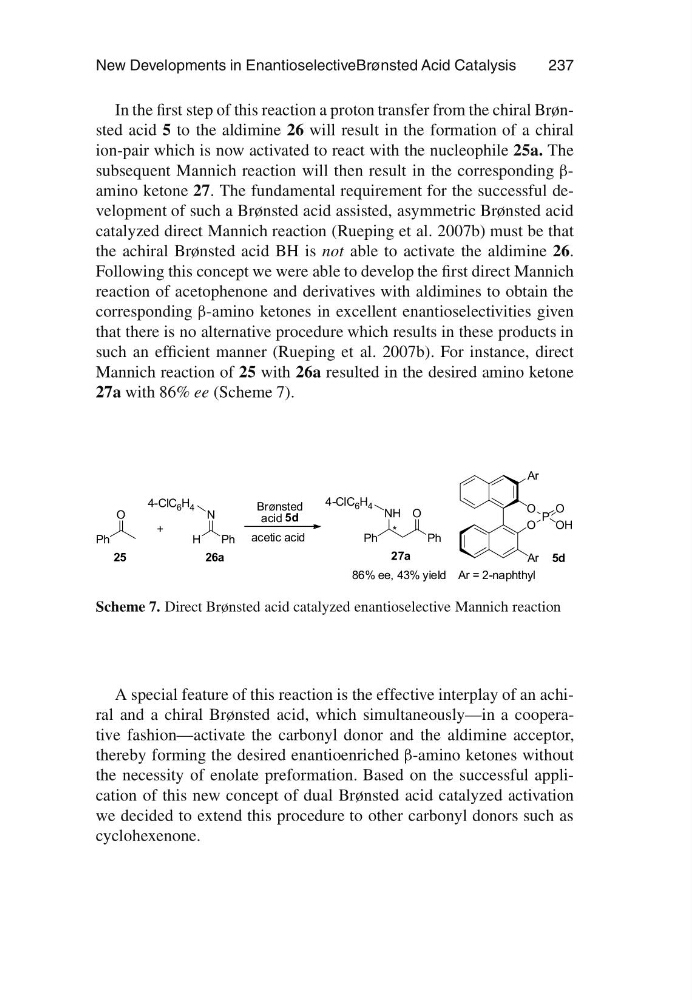
Mannich reaction of 25 with 26a resulted in the desired amino ketone
27a with 86% ee (Scheme 7).
Scheme 7. Direct Brønsted acid catalyzed enantioselective Mannich reaction
A special feature of this reaction is the effective interplay of an achiral and a chiral Brønsted acid, which simultaneously—in a cooperative fashion—activate the carbonyl donor and the aldimine acceptor,
thereby forming the desired enantioenriched β-amino ketones without
the necessity of enolate preformation. Based on the successful application of this new concept of dual Brønsted acid catalyzed activation
we decided to extend this procedure to other carbonyl donors such as
cyclohexenone.