

186
K. Zeitler
In general, the three most common, major classes of NHC carbenes
can be accessed by deprotonation of their corresponding heterazolium
precursors
2 , i.e. thiazolium, imidazol(in)ium and triazolium salts, which
comprise differences in both the electronic and steric nature for the respective carbenes.
With respect to the application of asymmetric carbene catalysis as
a tool for enantioselective synthesis, the last decade’s major success is
based on substantial improvements in catalyst development. Early reports dealt with implementing chirality in thiazolium scaffolds (Sheehan and Hunneman 1966; Sheehan and Hara 1974; Dvorak and Rawal
1998), but their catalytic performance suffered from either low yields or
low ee-values. In this regard, the investigation of triazole heterocycles
as an alternative core structure (Enders et al. 1995) has played a crucial
role to provide heterazolium precatalysts improving both asymmetric
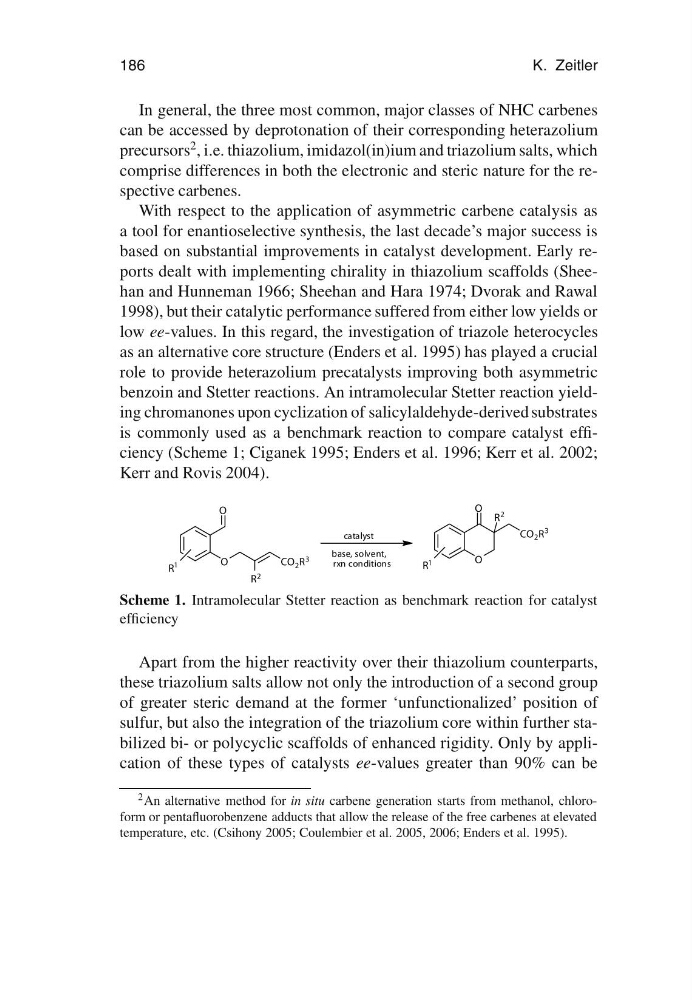
benzoin and Stetter reactions. An intramolecular Stetter reaction yielding chromanones upon cyclization of salicylaldehyde-derived substrates
is commonly used as a benchmark reaction to compare catalyst efficiency (Scheme 1; Ciganek 1995; Enders et al. 1996; Kerr et al. 2002;
Kerr and Rovis 2004).
Scheme 1. Intramolecular Stetter reaction as benchmark reaction for catalyst
efficiency
Apart from the higher reactivity over their thiazolium counterparts,
these triazolium salts allow not only the introduction of a second group
of greater steric demand at the former ‘unfunctionalized’ position of
sulfur, but also the integration of the triazolium core within further stabilized bi- or polycyclic scaffolds of enhanced rigidity. Only by application of these types of catalysts ee-values greater than 90% can be
2 An alternative method for in situ carbene generation starts from methanol, chloroform or pentafluorobenzene adducts that allow the release of the free carbenes at elevated
temperature, etc. (Csihony 2005; Coulembier et al. 2005, 2006; Enders et al. 1995).