

NHCs – Highly Versatile Organocatalysts
187
achieved indicating the importance of this additional conformational
fixation.
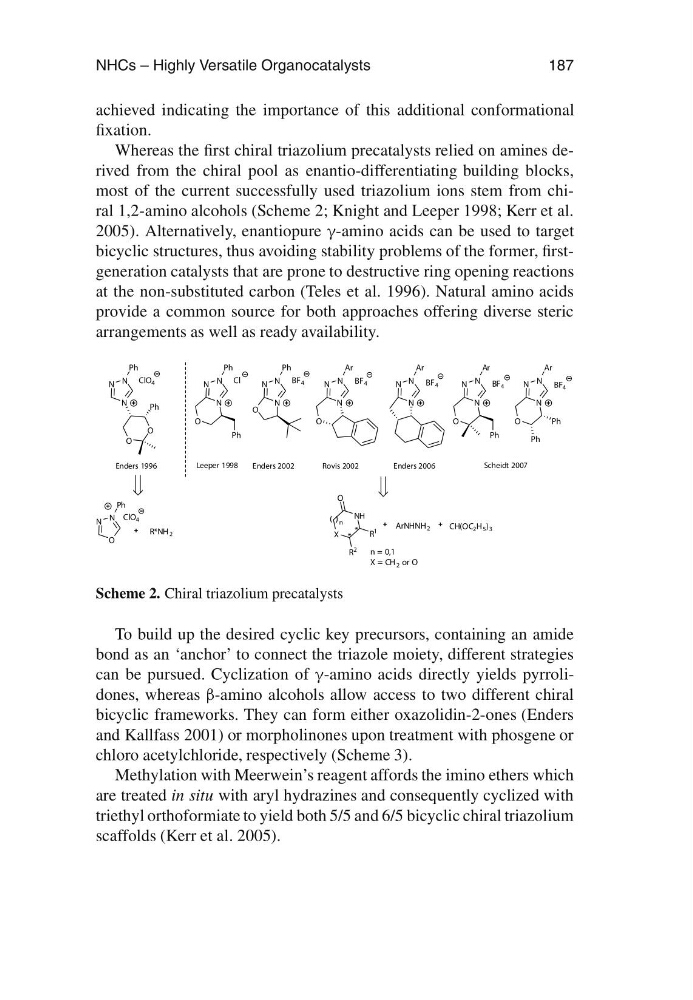
Whereas the first chiral triazolium precatalysts relied on amines derived from the chiral pool as enantio-differentiating building blocks,
most of the current successfully used triazolium ions stem from chiral 1,2-amino alcohols (Scheme 2; Knight and Leeper 1998; Kerr et al.
2005). Alternatively, enantiopure γ-amino acids can be used to target
bicyclic structures, thus avoiding stability problems of the former, firstgeneration catalysts that are prone to destructive ring opening reactions
at the non-substituted carbon (Teles et al. 1996). Natural amino acids
provide a common source for both approaches offering diverse steric
arrangements as well as ready availability.
Scheme 2. Chiral triazolium precatalysts
To build up the desired cyclic key precursors, containing an amide
bond as an ‘anchor’ to connect the triazole moiety, different strategies
can be pursued. Cyclization of γ-amino acids directly yields pyrrolidones, whereas β-amino alcohols allow access to two different chiral
bicyclic frameworks. They can form either oxazolidin-2-ones (Enders
and Kallfass 2001) or morpholinones upon treatment with phosgene or
chloro acetylchloride, respectively (Scheme 3).
Methylation with Meerwein’s reagent affords the imino ethers which
are treated in situ with aryl hydrazines and consequently cyclized with
triethyl orthoformiate to yield both 5/5 and 6/5 bicyclic chiral triazolium
scaffolds (Kerr et al. 2005).