

NHCs – Highly Versatile Organocatalysts
185
tional reactivity patterns by pursuing the concept of umpolung (polarity
reversal) (Seebach 1979) and thus exemplifies the power of organocatalysis in terms of the development and application of novel retrosynthetic
bond disconnections.
In this chapter, an overview of the different modes of action of NHC
carbenes and their impact on the catalytic availability of certain classes
of reactive intermediates will be provided, prefaced by a short discussion of the current state of the art concerning the preparation of (chiral)
heterazolium catalysts including methods for the immobilization of this
versatile class of organocatalyst.
2
Catalyst Structures and Preparation
Since Breslow’s seminal paper (Breslow 1958) proposing a mechanistic model for the catalytic activity of coenzyme thiamine via an in situ
formed carbene species by deprotonation of the thiazolium salt, and
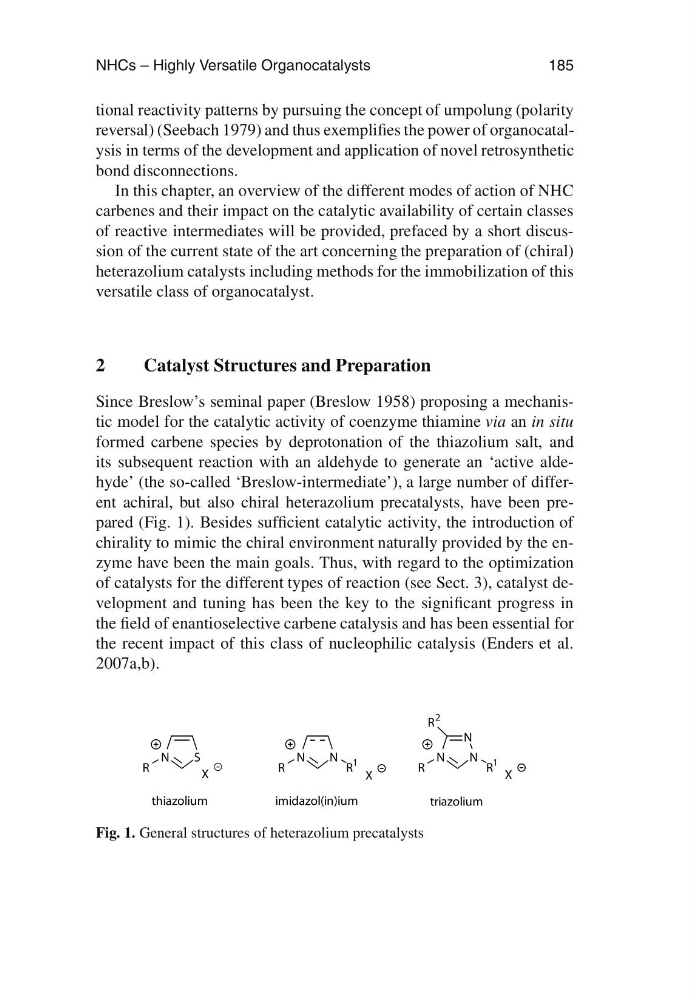
its subsequent reaction with an aldehyde to generate an ‘active aldehyde’ (the so-called ‘Breslow-intermediate’), a large number of different achiral, but also chiral heterazolium precatalysts, have been prepared (Fig. 1). Besides sufficient catalytic activity, the introduction of
chirality to mimic the chiral environment naturally provided by the enzyme have been the main goals. Thus, with regard to the optimization
of catalysts for the different types of reaction (see Sect. 3), catalyst development and tuning has been the key to the significant progress in
the field of enantioselective carbene catalysis and has been essential for
the recent impact of this class of nucleophilic catalysis (Enders et al.
2007a,b).
Fig. 1. General structures of heterazolium precatalysts