

Nucleophilic Carbenes as Organocatalysts
175
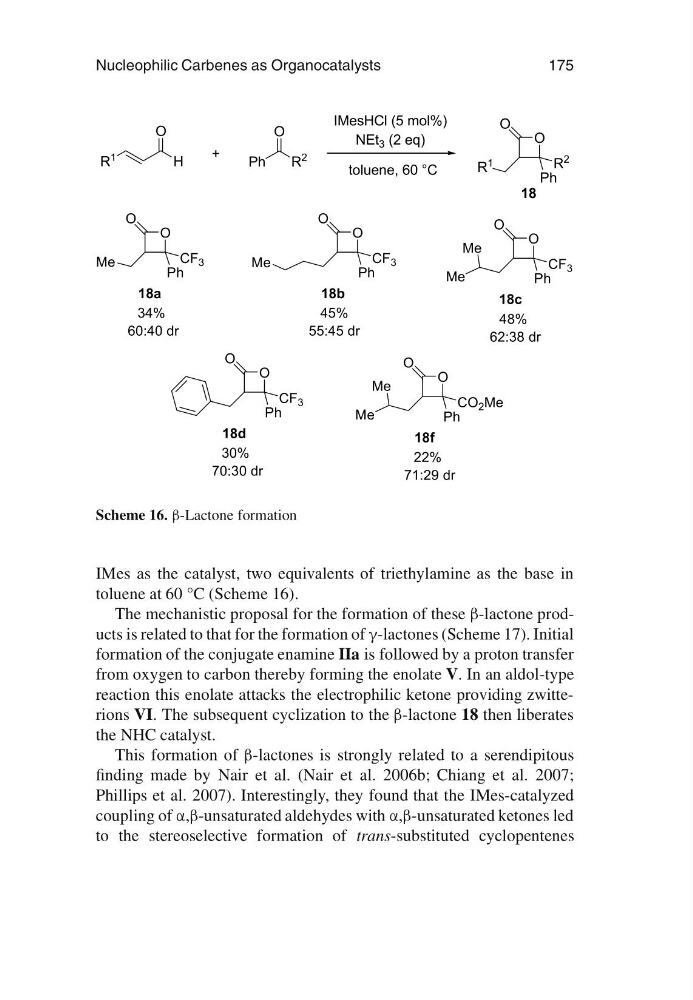
Scheme 16. β-Lactone formation
IMes as the catalyst, two equivalents of triethylamine as the base in
toluene at 60 °C (Scheme 16).
The mechanistic proposal for the formation of these β-lactone products is related to that for the formation of γ-lactones (Scheme 17). Initial
formation of the conjugate enamine IIa is followed by a proton transfer
from oxygen to carbon thereby forming the enolate V. In an aldol-type
reaction this enolate attacks the electrophilic ketone providing zwitterions VI. The subsequent cyclization to the β-lactone 18 then liberates
the NHC catalyst.
This formation of β-lactones is strongly related to a serendipitous
finding made by Nair et al. (Nair et al. 2006b; Chiang et al. 2007;
Phillips et al. 2007). Interestingly, they found that the IMes-catalyzed
coupling of α,β-unsaturated aldehydes with α,β-unsaturated ketones led
to the stereoselective formation of trans-substituted cyclopentenes