

Nucleophilic Carbenes as Organocatalysts
163
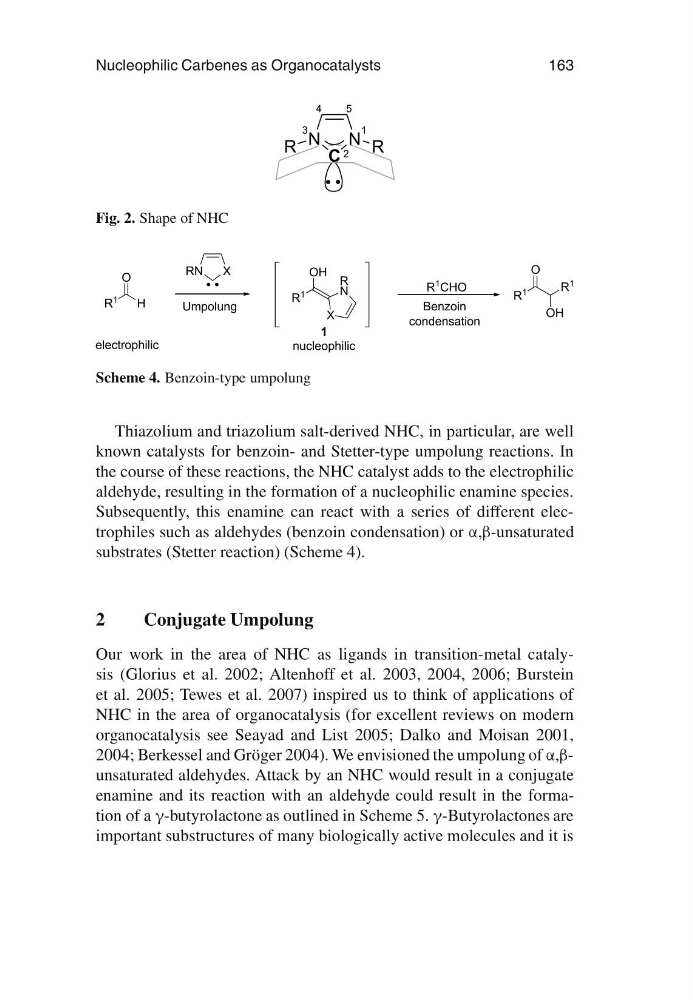
Fig. 2. Shape of NHC
Scheme 4. Benzoin-type umpolung
Thiazolium and triazolium salt-derived NHC, in particular, are well
known catalysts for benzoin- and Stetter-type umpolung reactions. In
the course of these reactions, the NHC catalyst adds to the electrophilic
aldehyde, resulting in the formation of a nucleophilic enamine species.
Subsequently, this enamine can react with a series of different electrophiles such as aldehydes (benzoin condensation) or α,β-unsaturated
substrates (Stetter reaction) (Scheme 4).
2
Conjugate Umpolung
Our work in the area of NHC as ligands in transition-metal catalysis (Glorius et al. 2002; Altenhoff et al. 2003, 2004, 2006; Burstein
et al. 2005; Tewes et al. 2007) inspired us to think of applications of
NHC in the area of organocatalysis (for excellent reviews on modern
organocatalysis see Seayad and List 2005; Dalko and Moisan 2001,
2004; Berkessel and Gröger 2004). We envisioned the umpolung of α,βunsaturated aldehydes. Attack by an NHC would result in a conjugate
enamine and its reaction with an aldehyde could result in the formation of a γ-butyrolactone as outlined in Scheme 5. γ-Butyrolactones are
important substructures of many biologically active molecules and it is