

164
F. Glorius, K. Hirano
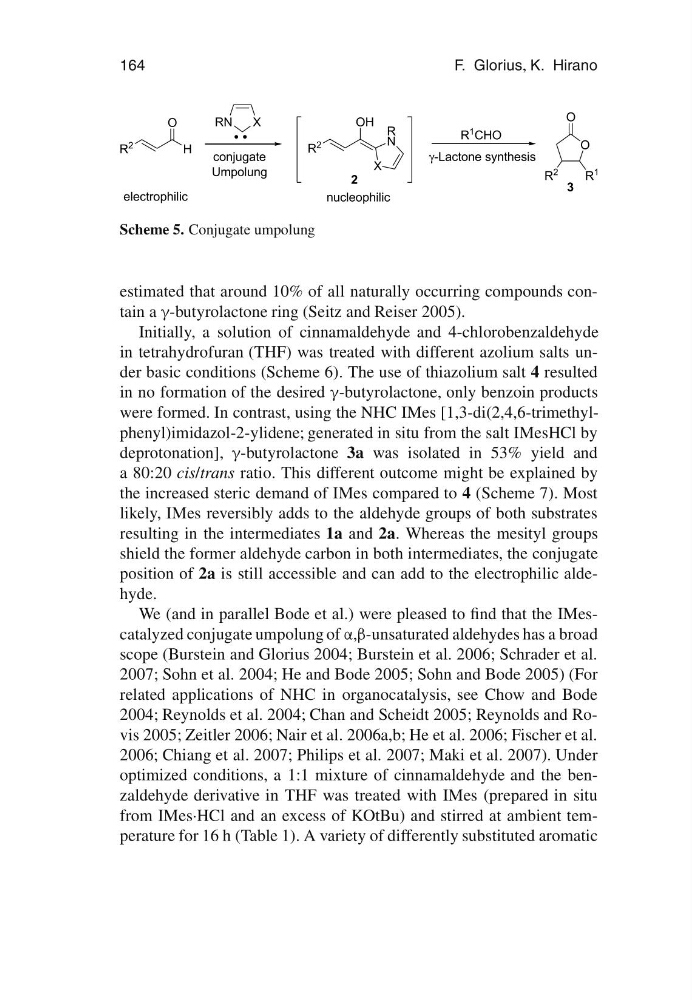
Scheme 5. Conjugate umpolung
estimated that around 10% of all naturally occurring compounds contain a γ-butyrolactone ring (Seitz and Reiser 2005).
Initially, a solution of cinnamaldehyde and 4-chlorobenzaldehyde
in tetrahydrofuran (THF) was treated with different azolium salts under basic conditions (Scheme 6). The use of thiazolium salt 4 resulted
in no formation of the desired γ-butyrolactone, only benzoin products
were formed. In contrast, using the NHC IMes [1,3-di(2,4,6-trimethylphenyl)imidazol-2-ylidene; generated in situ from the salt IMesHCl by
deprotonation], γ-butyrolactone 3a was isolated in 53% yield and
a 80:20 cis/trans ratio. This different outcome might be explained by
the increased steric demand of IMes compared to 4 (Scheme 7). Most
likely, IMes reversibly adds to the aldehyde groups of both substrates
resulting in the intermediates 1a and 2a. Whereas the mesityl groups
shield the former aldehyde carbon in both intermediates, the conjugate
position of 2a is still accessible and can add to the electrophilic aldehyde.
We (and in parallel Bode et al.) were pleased to find that the IMescatalyzed conjugate umpolung of α,β-unsaturated aldehydes has a broad
scope (Burstein and Glorius 2004; Burstein et al. 2006; Schrader et al.
2007; Sohn et al. 2004; He and Bode 2005; Sohn and Bode 2005) (For
related applications of NHC in organocatalysis, see Chow and Bode
2004; Reynolds et al. 2004; Chan and Scheidt 2005; Reynolds and Rovis 2005; Zeitler 2006; Nair et al. 2006a,b; He et al. 2006; Fischer et al.
2006; Chiang et al. 2007; Philips et al. 2007; Maki et al. 2007). Under
optimized conditions, a 1:1 mixture of cinnamaldehyde and the benzaldehyde derivative in THF was treated with IMes (prepared in situ
from IMes·HCl and an excess of KOtBu) and stirred at ambient temperature for 16 h (Table 1). A variety of differently substituted aromatic