

Nucleophilic Carbenes as Organocatalysts
161
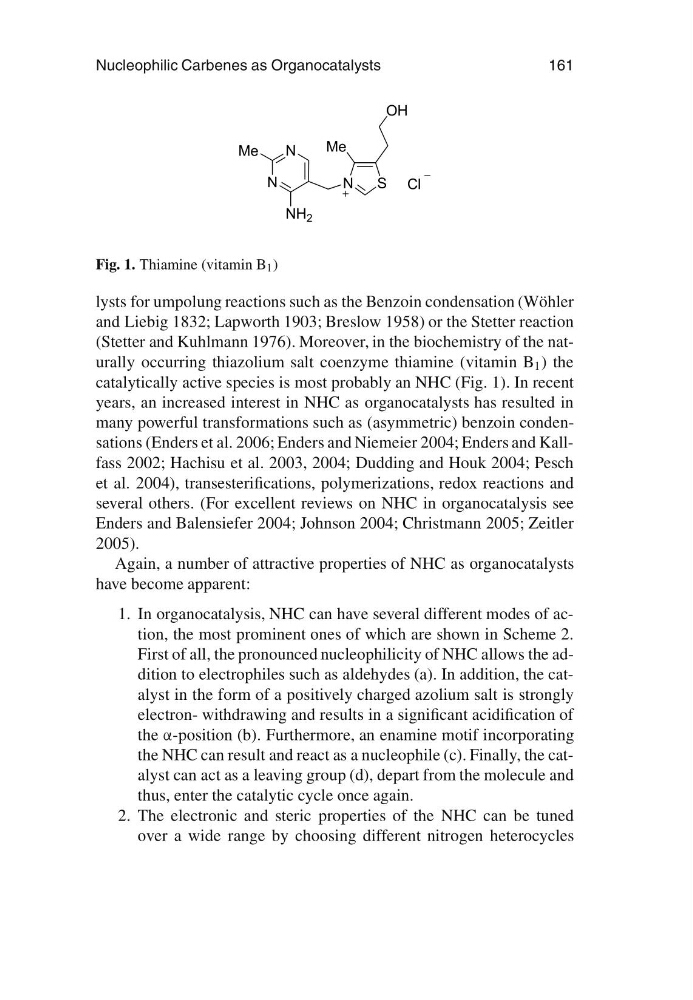
Fig. 1. Thiamine (vitamin B 1 )
lysts for umpolung reactions such as the Benzoin condensation (Wöhler
and Liebig 1832; Lapworth 1903; Breslow 1958) or the Stetter reaction
(Stetter and Kuhlmann 1976). Moreover, in the biochemistry of the naturally occurring thiazolium salt coenzyme thiamine (vitamin B 1 ) the
catalytically active species is most probably an NHC (Fig. 1). In recent
years, an increased interest in NHC as organocatalysts has resulted in
many powerful transformations such as (asymmetric) benzoin condensations (Enders et al. 2006; Enders and Niemeier 2004; Enders and Kallfass 2002; Hachisu et al. 2003, 2004; Dudding and Houk 2004; Pesch
et al. 2004), transesterifications, polymerizations, redox reactions and
several others. (For excellent reviews on NHC in organocatalysis see
Enders and Balensiefer 2004; Johnson 2004; Christmann 2005; Zeitler
2005).
Again, a number of attractive properties of NHC as organocatalysts
have become apparent:
1. In organocatalysis, NHC can have several different modes of action, the most prominent ones of which are shown in Scheme 2.
First of all, the pronounced nucleophilicity of NHC allows the addition to electrophiles such as aldehydes (a). In addition, the catalyst in the form of a positively charged azolium salt is strongly
electron- withdrawing and results in a significant acidification of
the α-position (b). Furthermore, an enamine motif incorporating
the NHC can result and react as a nucleophile (c). Finally, the catalyst can act as a leaving group (d), depart from the molecule and
thus, enter the catalytic cycle once again.
2. The electronic and steric properties of the NHC can be tuned
over a wide range by choosing different nitrogen heterocycles