

144
H. Gröger
up already or which represent process technology solutions ready to be
scaled up.
These examples underline the potential of organocatalytic reactions
for commercial scale applications. The scale up of the corresponding
reactions ranges from L-scale applications to applications on a (pilot)
production scale. In the following, several types of these reactions are
discussed.
3.2
Intramolecular Aldol Reaction:
Hajos–Parrish–Eder–Wiechert–Sauer Reaction
The Hajos–Parrish–Eder–Wiechert–Sauer reaction certainly represents
a historical landmark in the field of (asymmetric) organocatalysis. This
asymmetric intramolecular aldol reaction was developed in the early
1970s independently by two industrial groups at Schering and
Hoffmann-LaRoche, being one of the first major contributions to organocatalysis in general (Hajos and Parrish 1971, 1974a,b; Eder et al.
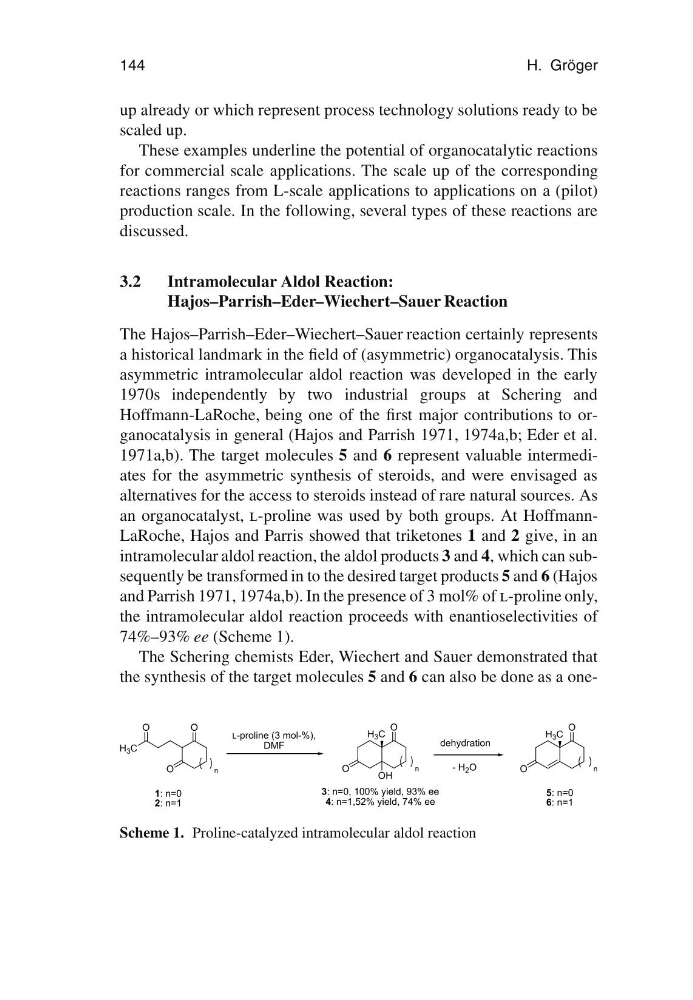
1971a,b). The target molecules 5 and 6 represent valuable intermediates for the asymmetric synthesis of steroids, and were envisaged as
alternatives for the access to steroids instead of rare natural sources. As
an organocatalyst, l-proline was used by both groups. At HoffmannLaRoche, Hajos and Parris showed that triketones 1 and 2 give, in an
intramolecular aldol reaction, the aldol products 3 and 4, which can subsequently be transformed in to the desired target products 5 and 6 (Hajos
and Parrish 1971, 1974a,b). In the presence of 3 mol% of l-proline only,
the intramolecular aldol reaction proceeds with enantioselectivities of
74%–93% ee (Scheme 1).
The Schering chemists Eder, Wiechert and Sauer demonstrated that
the synthesis of the target molecules 5 and 6 can also be done as a oneScheme 1. Proline-catalyzed intramolecular aldol reaction