

Asymmetric Organocatalysis on a Technical Scale
143
immobilized by forming covalent bonds with the solid support. Several
immobilized organocatalysts have already been recycled efficiently.
Furthermore, many organocatalytic reactions are already known that
proceed with both high conversion and enantioselectivity. There is
a range of organocatalytic reactions known to give the desired products with excellent enantioselectivities of more than 99% ee (Berkessel
and Gröger 2005).
3
Organocatalytic Transformations
of Industrial Relevance
3.1
Overview
The suitability of organocatalytic reactions for larger-scale production
processes of chiral building blocks has also already been demonstrated
in some cases. Notably, different types of bond formation have been
reported, comprising several carbon-carbon bond formations as well
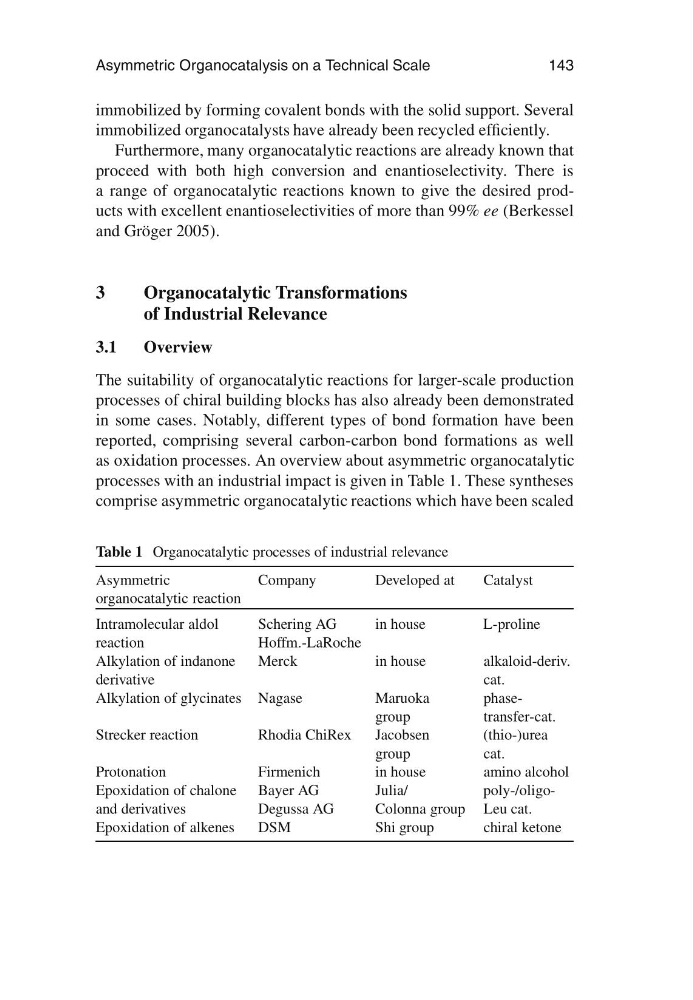
as oxidation processes. An overview about asymmetric organocatalytic
processes with an industrial impact is given in Table 1. These syntheses
comprise asymmetric organocatalytic reactions which have been scaled
Table 1 Organocatalytic processes of industrial relevance
Asymmetric
Company
Developed at
Catalyst
organocatalytic reaction
Intramolecular aldol
Schering AG
in house
L-proline
reaction
Hoffm.-LaRoche
Alkylation of indanone Merck
in house
alkaloid-deriv.
derivative
cat.
Alkylation of glycinates Nagase
Maruoka
phasegroup
transfer-cat.
Strecker reaction
Rhodia ChiRex
Jacobsen
(thio-)urea
group
cat.
Protonation
Firmenich
in house
amino alcohol
Epoxidation of chalone Bayer AG
Julia/
poly-/oligoand derivatives
Degussa AG
Colonna group Leu cat.
Epoxidation of alkenes
DSM
Shi group
chiral ketone