

Biomimetic Organocatalytic C–C-Bond Formations
101
(R = Bn). Furthermore, a favorable pre-arrangement for the formation
of the C–C bond might be caused by the activation of the ketone function by an intramolecular H bridge. Thus, the S configuration of the new
stereocenter would be preferred, which in fact is observed.
Investigations to widen the scope of the asymmetric intramolecular
benzoin reaction by utilizing aldehyde-ketone 108a, where the aldehyde
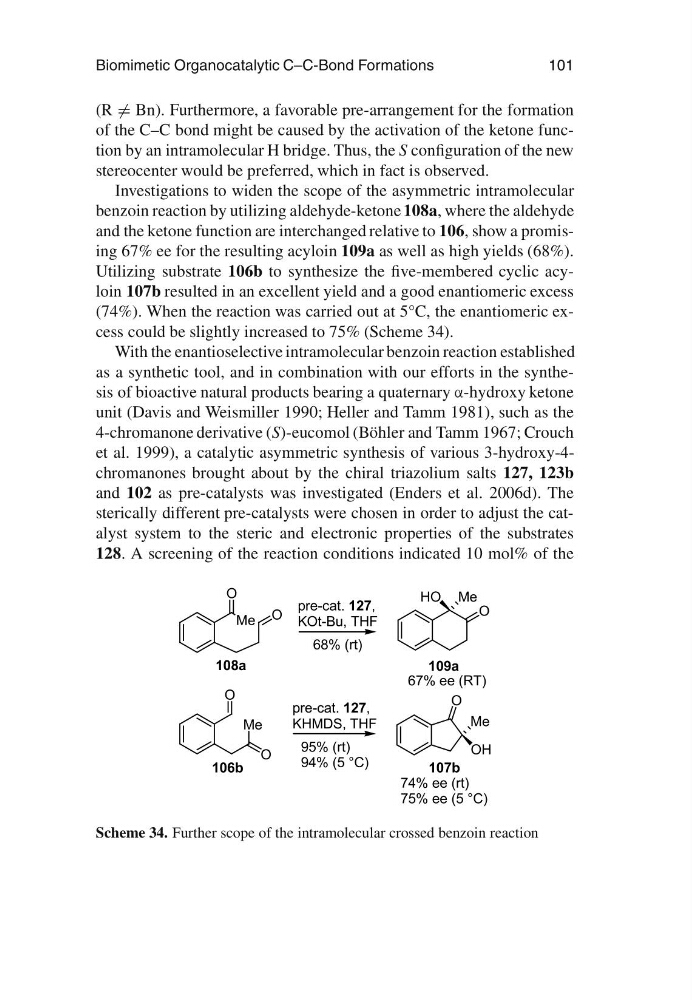
and the ketone function are interchanged relative to 106, show a promising 67% ee for the resulting acyloin 109a as well as high yields (68%).
Utilizing substrate 106b to synthesize the five-membered cyclic acyloin 107b resulted in an excellent yield and a good enantiomeric excess
(74%). When the reaction was carried out at 5°C, the enantiomeric excess could be slightly increased to 75% (Scheme 34).
With the enantioselective intramolecular benzoin reaction established
as a synthetic tool, and in combination with our efforts in the synthesis of bioactive natural products bearing a quaternary α-hydroxy ketone
unit (Davis and Weismiller 1990; Heller and Tamm 1981), such as the
4-chromanone derivative (S)-eucomol (Böhler and Tamm 1967; Crouch
et al. 1999), a catalytic asymmetric synthesis of various 3-hydroxy-4chromanones brought about by the chiral triazolium salts 127, 123b
and 102 as pre-catalysts was investigated (Enders et al. 2006d). The
sterically different pre-catalysts were chosen in order to adjust the catalyst system to the steric and electronic properties of the substrates
128. A screening of the reaction conditions indicated 10 mol% of the
Scheme 34. Further scope of the intramolecular crossed benzoin reaction