

102
D. Enders, M.R.M. Hüttl, O. Niemeier
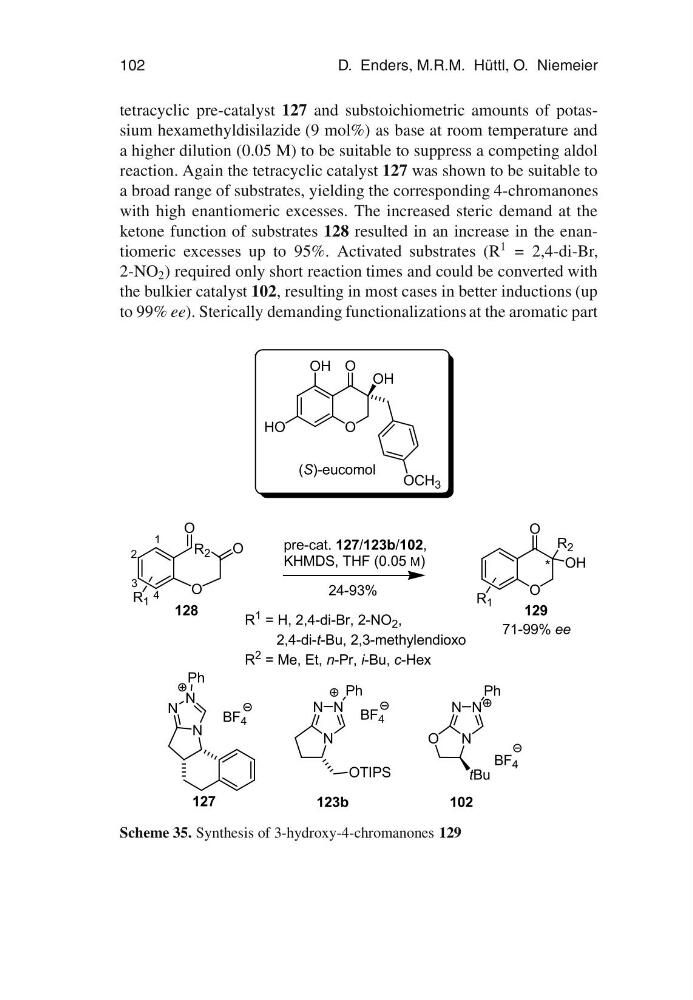
tetracyclic pre-catalyst 127 and substoichiometric amounts of potassium hexamethyldisilazide (9 mol%) as base at room temperature and
a higher dilution (0.05 M) to be suitable to suppress a competing aldol
reaction. Again the tetracyclic catalyst 127 was shown to be suitable to
a broad range of substrates, yielding the corresponding 4-chromanones
with high enantiomeric excesses. The increased steric demand at the
ketone function of substrates 128 resulted in an increase in the enantiomeric excesses up to 95%. Activated substrates (R
1 = 2,4-di-Br,
2-NO 2 ) required only short reaction times and could be converted with
the bulkier catalyst 102, resulting in most cases in better inductions (up
to 99% ee). Sterically demanding functionalizations at the aromatic part
Scheme 35. Synthesis of 3-hydroxy-4-chromanones 129