

94
D. Enders, M.R.M. Hüttl, O. Niemeier
In order to develop a general method, we started investigations on
simple aldehyde ketones 106 as substrates for the carbene catalyzed
crossed intramolecular benzoin condensation. Independently both our
group and Suzuki et al. reported that indeed various five- and six-membered cyclic acyloins 107/109/111 can be obtained as their racemic
mixtures by using commercially available thiazolium salts 10 as precatalysts (Scheme 29) (Enders and Niemeier 2004; Suzuki et al. 2004;
Niemeier 2006). The tetralone 107a was obtained in significantly higher
yield than that of tetralone 109a with interchanged functionalities. This
may be due to activating effect of the aromatic aldehyde in the precursor of 107a. Substrates lacking the obviously favorable benzannulation
in the resulting acyloin (111) showed only moderate yields as the competing intermolecular reaction was also observed. The quinone 115 was
isolated starting from the corresponding dialdehyde. The α-hydroxy ketone 114 is only formed as an intermediate and undergoes air oxidation
to the quinone 115 during work-up.
Unfortunately the bicyclic triazolium salt that had successfully been
used in our research group for the enantioselective intermolecular benzoin condensation (Enders and Kallfass 2002) did not show any catalytic activity in the intramolecular reaction. We thus searched for alternative, easily accessible enantiopure polycyclic γ-lactams as precursors
for the synthesis of novel triazolium salts (Enders et al. 2006c; for a related study see: Takikawa et al. 2006). The rigid polycyclic structure
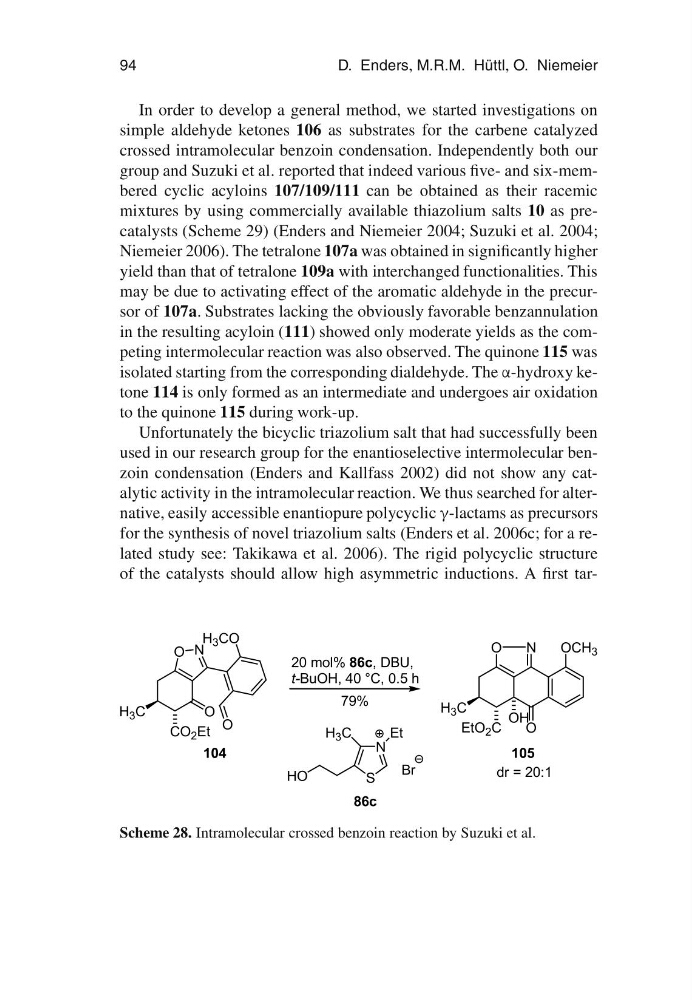
of the catalysts should allow high asymmetric inductions. A first tarScheme 28. Intramolecular crossed benzoin reaction by Suzuki et al.
D. Enders, M.R.M. Hüttl, O. Niemeier
In order to develop a general method, we started investigations on
simple aldehyde ketones 106 as substrates for the carbene catalyzed
crossed intramolecular benzoin condensation. Independently both our
group and Suzuki et al. reported that indeed various five- and six-membered cyclic acyloins 107/109/111 can be obtained as their racemic
mixtures by using commercially available thiazolium salts 10 as precatalysts (Scheme 29) (Enders and Niemeier 2004; Suzuki et al. 2004;
Niemeier 2006). The tetralone 107a was obtained in significantly higher
yield than that of tetralone 109a with interchanged functionalities. This
may be due to activating effect of the aromatic aldehyde in the precursor of 107a. Substrates lacking the obviously favorable benzannulation
in the resulting acyloin (111) showed only moderate yields as the competing intermolecular reaction was also observed. The quinone 115 was
isolated starting from the corresponding dialdehyde. The α-hydroxy ketone 114 is only formed as an intermediate and undergoes air oxidation
to the quinone 115 during work-up.
Unfortunately the bicyclic triazolium salt that had successfully been
used in our research group for the enantioselective intermolecular benzoin condensation (Enders and Kallfass 2002) did not show any catalytic activity in the intramolecular reaction. We thus searched for alternative, easily accessible enantiopure polycyclic γ-lactams as precursors
for the synthesis of novel triazolium salts (Enders et al. 2006c; for a related study see: Takikawa et al. 2006). The rigid polycyclic structure
of the catalysts should allow high asymmetric inductions. A first tarScheme 28. Intramolecular crossed benzoin reaction by Suzuki et al.