

Biomimetic Organocatalytic C–C-Bond Formations
93
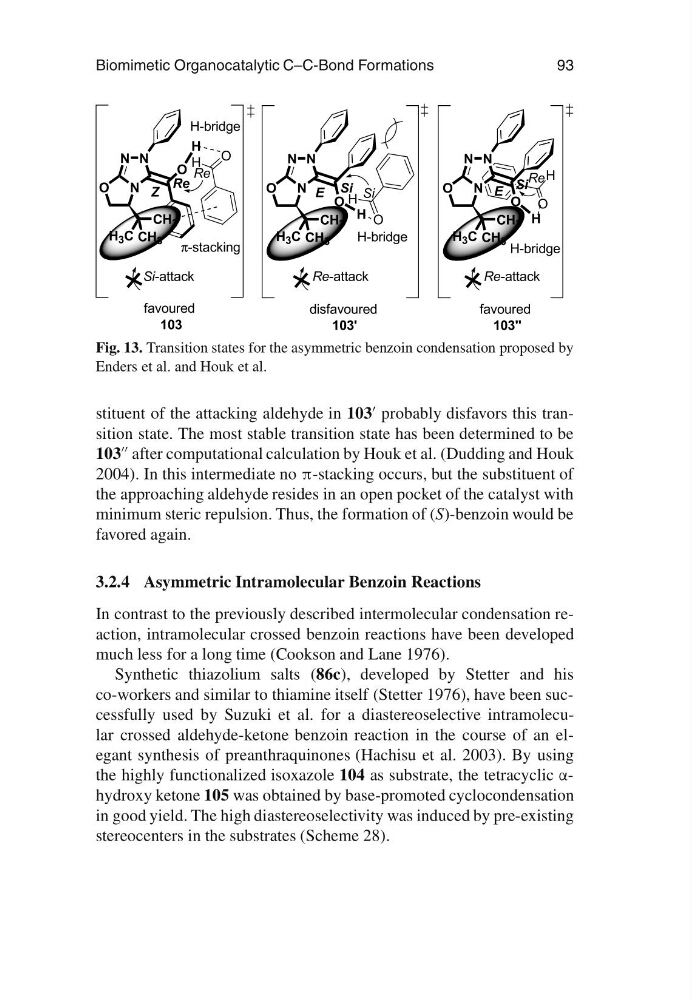
Fig. 13. Transition states for the asymmetric benzoin condensation proposed by
Enders et al. and Houk et al.
stituent of the attacking aldehyde in 103
probably disfavors this transition state. The most stable transition state has been determined to be
103
after computational calculation by Houk et al. (Dudding and Houk
2004). In this intermediate no π-stacking occurs, but the substituent of
the approaching aldehyde resides in an open pocket of the catalyst with
minimum steric repulsion. Thus, the formation of (S)-benzoin would be
favored again.
3.2.4 Asymmetric Intramolecular Benzoin Reactions
In contrast to the previously described intermolecular condensation reaction, intramolecular crossed benzoin reactions have been developed
much less for a long time (Cookson and Lane 1976).
Synthetic thiazolium salts (86c), developed by Stetter and his
co-workers and similar to thiamine itself (Stetter 1976), have been successfully used by Suzuki et al. for a diastereoselective intramolecular crossed aldehyde-ketone benzoin reaction in the course of an elegant synthesis of preanthraquinones (Hachisu et al. 2003). By using
the highly functionalized isoxazole 104 as substrate, the tetracyclic αhydroxy ketone 105 was obtained by base-promoted cyclocondensation
in good yield. The high diastereoselectivity was induced by pre-existing
stereocenters in the substrates (Scheme 28).
93
Fig. 13. Transition states for the asymmetric benzoin condensation proposed by
Enders et al. and Houk et al.
stituent of the attacking aldehyde in 103
probably disfavors this transition state. The most stable transition state has been determined to be
103
after computational calculation by Houk et al. (Dudding and Houk
2004). In this intermediate no π-stacking occurs, but the substituent of
the approaching aldehyde resides in an open pocket of the catalyst with
minimum steric repulsion. Thus, the formation of (S)-benzoin would be
favored again.
3.2.4 Asymmetric Intramolecular Benzoin Reactions
In contrast to the previously described intermolecular condensation reaction, intramolecular crossed benzoin reactions have been developed
much less for a long time (Cookson and Lane 1976).
Synthetic thiazolium salts (86c), developed by Stetter and his
co-workers and similar to thiamine itself (Stetter 1976), have been successfully used by Suzuki et al. for a diastereoselective intramolecular crossed aldehyde-ketone benzoin reaction in the course of an elegant synthesis of preanthraquinones (Hachisu et al. 2003). By using
the highly functionalized isoxazole 104 as substrate, the tetracyclic αhydroxy ketone 105 was obtained by base-promoted cyclocondensation
in good yield. The high diastereoselectivity was induced by pre-existing
stereocenters in the substrates (Scheme 28).