

92
D. Enders, M.R.M. Hüttl, O. Niemeier
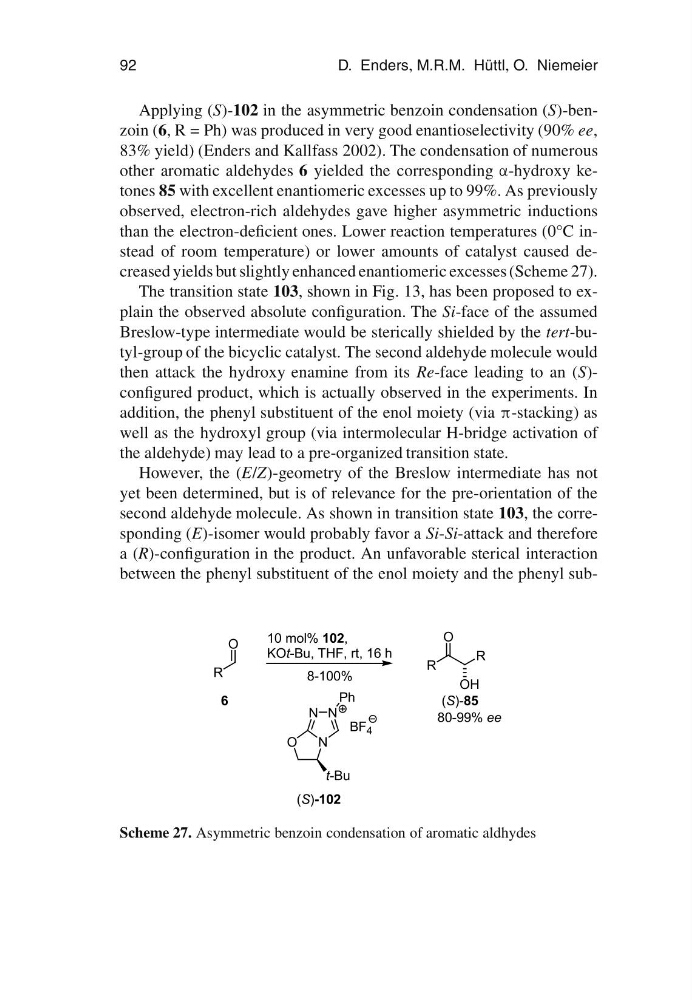
Applying (S)-102 in the asymmetric benzoin condensation (S)-benzoin (6, R = Ph) was produced in very good enantioselectivity (90% ee,
83% yield) (Enders and Kallfass 2002). The condensation of numerous
other aromatic aldehydes 6 yielded the corresponding α-hydroxy ketones 85 with excellent enantiomeric excesses up to 99%. As previously
observed, electron-rich aldehydes gave higher asymmetric inductions
than the electron-deficient ones. Lower reaction temperatures (0°C instead of room temperature) or lower amounts of catalyst caused decreased yields but slightly enhanced enantiomeric excesses (Scheme 27).
The transition state 103, shown in Fig. 13, has been proposed to explain the observed absolute configuration. The Si-face of the assumed
Breslow-type intermediate would be sterically shielded by the tert-butyl-group of the bicyclic catalyst. The second aldehyde molecule would
then attack the hydroxy enamine from its Re-face leading to an (S)configured product, which is actually observed in the experiments. In
addition, the phenyl substituent of the enol moiety (via π-stacking) as
well as the hydroxyl group (via intermolecular H-bridge activation of
the aldehyde) may lead to a pre-organized transition state.
However, the (E/Z)-geometry of the Breslow intermediate has not
yet been determined, but is of relevance for the pre-orientation of the
second aldehyde molecule. As shown in transition state 103, the corresponding (E)-isomer would probably favor a Si-Si-attack and therefore
a (R)-configuration in the product. An unfavorable sterical interaction
between the phenyl substituent of the enol moiety and the phenyl subScheme 27. Asymmetric benzoin condensation of aromatic aldhydes
D. Enders, M.R.M. Hüttl, O. Niemeier
Applying (S)-102 in the asymmetric benzoin condensation (S)-benzoin (6, R = Ph) was produced in very good enantioselectivity (90% ee,
83% yield) (Enders and Kallfass 2002). The condensation of numerous
other aromatic aldehydes 6 yielded the corresponding α-hydroxy ketones 85 with excellent enantiomeric excesses up to 99%. As previously
observed, electron-rich aldehydes gave higher asymmetric inductions
than the electron-deficient ones. Lower reaction temperatures (0°C instead of room temperature) or lower amounts of catalyst caused decreased yields but slightly enhanced enantiomeric excesses (Scheme 27).
The transition state 103, shown in Fig. 13, has been proposed to explain the observed absolute configuration. The Si-face of the assumed
Breslow-type intermediate would be sterically shielded by the tert-butyl-group of the bicyclic catalyst. The second aldehyde molecule would
then attack the hydroxy enamine from its Re-face leading to an (S)configured product, which is actually observed in the experiments. In
addition, the phenyl substituent of the enol moiety (via π-stacking) as
well as the hydroxyl group (via intermolecular H-bridge activation of
the aldehyde) may lead to a pre-organized transition state.
However, the (E/Z)-geometry of the Breslow intermediate has not
yet been determined, but is of relevance for the pre-orientation of the
second aldehyde molecule. As shown in transition state 103, the corresponding (E)-isomer would probably favor a Si-Si-attack and therefore
a (R)-configuration in the product. An unfavorable sterical interaction
between the phenyl substituent of the enol moiety and the phenyl subScheme 27. Asymmetric benzoin condensation of aromatic aldhydes