

8
S.C. Pan, B. List
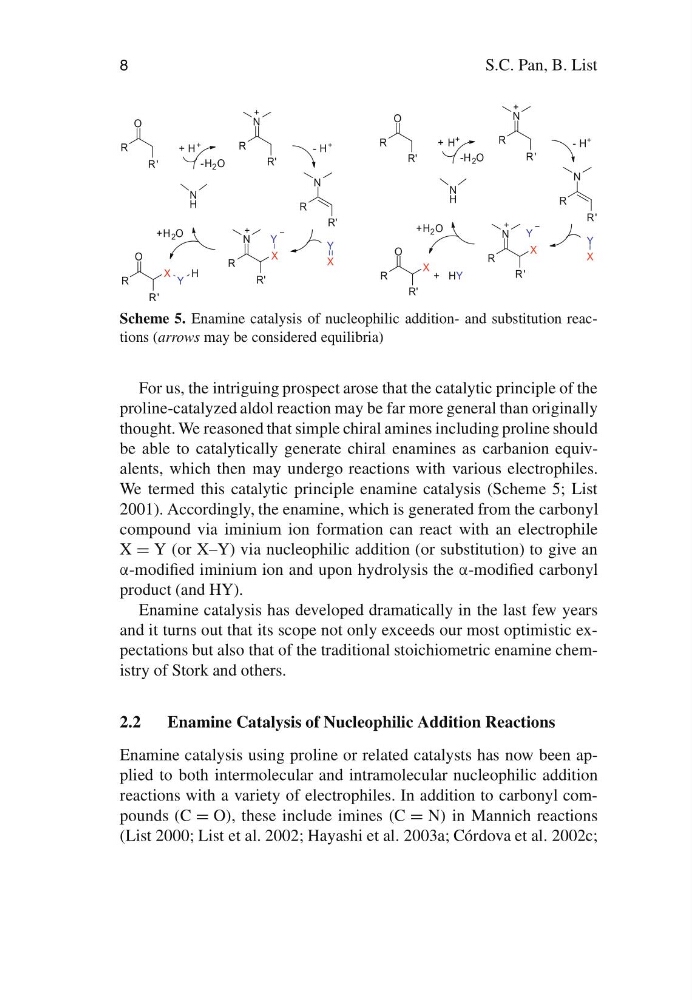
Scheme 5. Enamine catalysis of nucleophilic addition- and substitution reactions (arrows may be considered equilibria)
For us, the intriguing prospect arose that the catalytic principle of the
proline-catalyzed aldol reaction may be far more general than originally
thought. We reasoned that simple chiral amines including proline should
be able to catalytically generate chiral enamines as carbanion equivalents, which then may undergo reactions with various electrophiles.
We termed this catalytic principle enamine catalysis (Scheme 5; List
2001). Accordingly, the enamine, which is generated from the carbonyl
compound via iminium ion formation can react with an electrophile
X = Y (or X–Y) via nucleophilic addition (or substitution) to give an
α-modified iminium ion and upon hydrolysis the α-modified carbonyl
product (and HY).
Enamine catalysis has developed dramatically in the last few years
and it turns out that its scope not only exceeds our most optimistic expectations but also that of the traditional stoichiometric enamine chemistry of Stork and others.
2.2
Enamine Catalysis of Nucleophilic Addition Reactions
Enamine catalysis using proline or related catalysts has now been applied to both intermolecular and intramolecular nucleophilic addition
reactions with a variety of electrophiles. In addition to carbonyl compounds (C = O), these include imines (C = N) in Mannich reactions
(List 2000; List et al. 2002; Hayashi et al. 2003a; Córdova et al. 2002c;
S.C. Pan, B. List
Scheme 5. Enamine catalysis of nucleophilic addition- and substitution reactions (arrows may be considered equilibria)
For us, the intriguing prospect arose that the catalytic principle of the
proline-catalyzed aldol reaction may be far more general than originally
thought. We reasoned that simple chiral amines including proline should
be able to catalytically generate chiral enamines as carbanion equivalents, which then may undergo reactions with various electrophiles.
We termed this catalytic principle enamine catalysis (Scheme 5; List
2001). Accordingly, the enamine, which is generated from the carbonyl
compound via iminium ion formation can react with an electrophile
X = Y (or X–Y) via nucleophilic addition (or substitution) to give an
α-modified iminium ion and upon hydrolysis the α-modified carbonyl
product (and HY).
Enamine catalysis has developed dramatically in the last few years
and it turns out that its scope not only exceeds our most optimistic expectations but also that of the traditional stoichiometric enamine chemistry of Stork and others.
2.2
Enamine Catalysis of Nucleophilic Addition Reactions
Enamine catalysis using proline or related catalysts has now been applied to both intermolecular and intramolecular nucleophilic addition
reactions with a variety of electrophiles. In addition to carbonyl compounds (C = O), these include imines (C = N) in Mannich reactions
(List 2000; List et al. 2002; Hayashi et al. 2003a; Córdova et al. 2002c;