

New Concepts for Organocatalysis
7
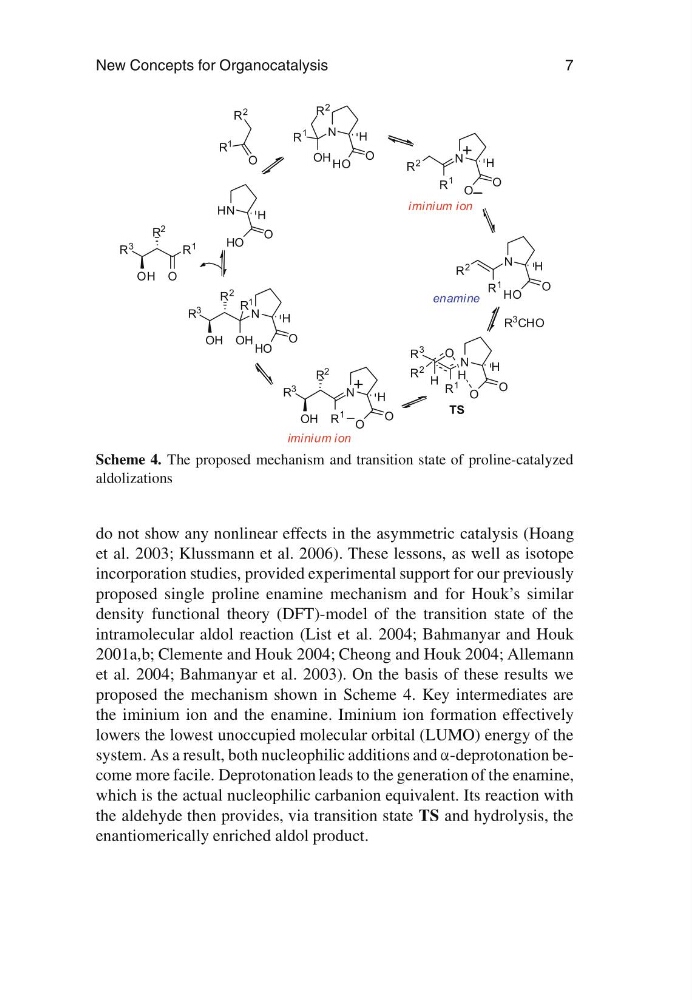
Scheme 4. The proposed mechanism and transition state of proline-catalyzed
aldolizations
do not show any nonlinear effects in the asymmetric catalysis (Hoang
et al. 2003; Klussmann et al. 2006). These lessons, as well as isotope
incorporation studies, provided experimental support for our previously
proposed single proline enamine mechanism and for Houk’s similar
density functional theory (DFT)-model of the transition state of the
intramolecular aldol reaction (List et al. 2004; Bahmanyar and Houk
2001a,b; Clemente and Houk 2004; Cheong and Houk 2004; Allemann
et al. 2004; Bahmanyar et al. 2003). On the basis of these results we
proposed the mechanism shown in Scheme 4. Key intermediates are
the iminium ion and the enamine. Iminium ion formation effectively
lowers the lowest unoccupied molecular orbital (LUMO) energy of the
system. As a result, both nucleophilic additions and α-deprotonation become more facile. Deprotonation leads to the generation of the enamine,
which is the actual nucleophilic carbanion equivalent. Its reaction with
the aldehyde then provides, via transition state TS and hydrolysis, the
enantiomerically enriched aldol product.
7
Scheme 4. The proposed mechanism and transition state of proline-catalyzed
aldolizations
do not show any nonlinear effects in the asymmetric catalysis (Hoang
et al. 2003; Klussmann et al. 2006). These lessons, as well as isotope
incorporation studies, provided experimental support for our previously
proposed single proline enamine mechanism and for Houk’s similar
density functional theory (DFT)-model of the transition state of the
intramolecular aldol reaction (List et al. 2004; Bahmanyar and Houk
2001a,b; Clemente and Houk 2004; Cheong and Houk 2004; Allemann
et al. 2004; Bahmanyar et al. 2003). On the basis of these results we
proposed the mechanism shown in Scheme 4. Key intermediates are
the iminium ion and the enamine. Iminium ion formation effectively
lowers the lowest unoccupied molecular orbital (LUMO) energy of the
system. As a result, both nucleophilic additions and α-deprotonation become more facile. Deprotonation leads to the generation of the enamine,
which is the actual nucleophilic carbanion equivalent. Its reaction with
the aldehyde then provides, via transition state TS and hydrolysis, the
enantiomerically enriched aldol product.