

CHAPTER 2 • Marine Organic Geochemistry: A General Overview
Protein
Extracellular
hydrolysis
Peptides
Extracellular
hydrolysis
----+. Amino acids
(+ Dipeptides?)
59
Mineralization
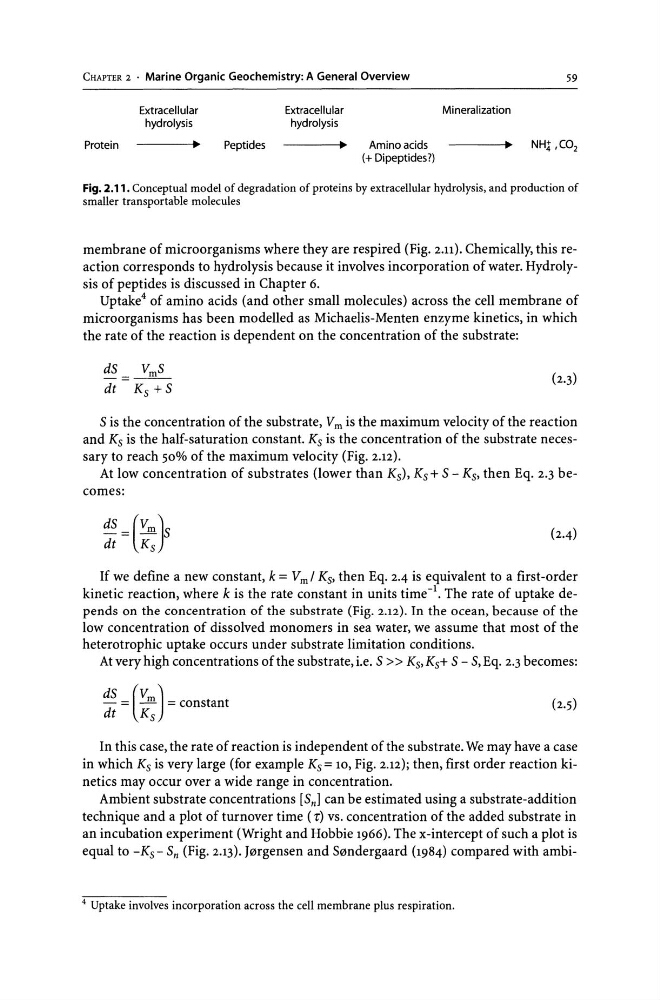
Fig. 2.11. Conceptual model of degradation of proteins by extracellular hydrolysis, and production of
smaller transportable molecules
membrane of microorganisms where they are respired (Fig. 2.11). Chemically, this reaction corresponds to hydrolysis because it involves incorporation of water. Hydrolysis of peptides is discussed in Chapter 6.
Uptake 4 of amino acids (and other small molecules) across the cell membrane of
microorganisms has been modelled as Michaelis-Menten enzyme kinetics, in which
the rate of the reaction is dependent on the concentration of the substrate:
dS
VmS
- = - - -
dt Ks + S
S is the concentration of the substrate, V m is the maximum velocity of the reaction
and Ks is the half-saturation constant. Ks is the concentration of the substrate necessary to reach 50% of the maximum velocity (Fig. 2.12).
At low concentration of substrates (lower than Ks), Ks + S - Ks, then Eq. 2.3 becomes:
dS = (Vm)s
dt
Ks
If we define a new constant, k = V ml Ks, then Eq. 2.4 is equivalent to a first-order
kinetic reaction, where k is the rate constant in units time-I. The rate of uptake depends on the concentration of the substrate (Fig. 2.12). In the ocean, because of the
low concentration of dissolved monomers in sea water, we assume that most of the
heterotrophic uptake occurs under substrate limitation conditions.
At very high concentrations of the substrate, i.e. S > > Ks, Ks+ S - S, Eq. 2.3 becomes:
dS (v:)
dt = K: = constant
In this case, the rate of reaction is independent of the substrate. We may have a case
in which Ks is very large (for example Ks= 10, Fig. 2.12); then, first order reaction kinetics may occur over a wide range in concentration.
Ambient substrate concentrations [Snl can be estimated using a substrate-addition
technique and a plot of turnover time ( -r) vs. concentration of the added substrate in
an incubation experiment (Wright and Hobbie 1966). The x-intercept of such a plot is
equal to -Ks- Sn (Fig. 2.13). J0rgensen and S0ndergaard (1984) compared with ambi4 Uptake involves incorporation across the cell membrane plus respiration.
Protein
Extracellular
hydrolysis
Peptides
Extracellular
hydrolysis
----+. Amino acids
(+ Dipeptides?)
59
Mineralization
Fig. 2.11. Conceptual model of degradation of proteins by extracellular hydrolysis, and production of
smaller transportable molecules
membrane of microorganisms where they are respired (Fig. 2.11). Chemically, this reaction corresponds to hydrolysis because it involves incorporation of water. Hydrolysis of peptides is discussed in Chapter 6.
Uptake 4 of amino acids (and other small molecules) across the cell membrane of
microorganisms has been modelled as Michaelis-Menten enzyme kinetics, in which
the rate of the reaction is dependent on the concentration of the substrate:
dS
VmS
- = - - -
dt Ks + S
S is the concentration of the substrate, V m is the maximum velocity of the reaction
and Ks is the half-saturation constant. Ks is the concentration of the substrate necessary to reach 50% of the maximum velocity (Fig. 2.12).
At low concentration of substrates (lower than Ks), Ks + S - Ks, then Eq. 2.3 becomes:
dS = (Vm)s
dt
Ks
If we define a new constant, k = V ml Ks, then Eq. 2.4 is equivalent to a first-order
kinetic reaction, where k is the rate constant in units time-I. The rate of uptake depends on the concentration of the substrate (Fig. 2.12). In the ocean, because of the
low concentration of dissolved monomers in sea water, we assume that most of the
heterotrophic uptake occurs under substrate limitation conditions.
At very high concentrations of the substrate, i.e. S > > Ks, Ks+ S - S, Eq. 2.3 becomes:
dS (v:)
dt = K: = constant
In this case, the rate of reaction is independent of the substrate. We may have a case
in which Ks is very large (for example Ks= 10, Fig. 2.12); then, first order reaction kinetics may occur over a wide range in concentration.
Ambient substrate concentrations [Snl can be estimated using a substrate-addition
technique and a plot of turnover time ( -r) vs. concentration of the added substrate in
an incubation experiment (Wright and Hobbie 1966). The x-intercept of such a plot is
equal to -Ks- Sn (Fig. 2.13). J0rgensen and S0ndergaard (1984) compared with ambi4 Uptake involves incorporation across the cell membrane plus respiration.