

60
S. Pantoja . S. Wakeham
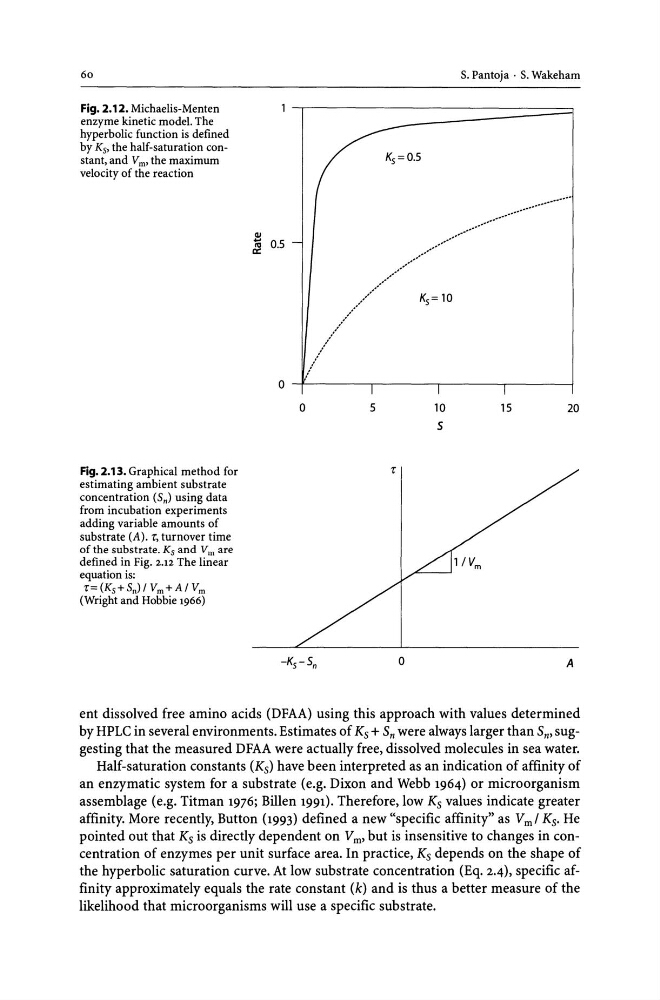
Fig. 2.12. Michaelis-Menten
enzyme kinetic model. The
hyperbolic function is defined
by Ks, the half-saturation constant, and V m' the maximum
Ks = 0.5
velocity of the reaction
Fig. 2.13. Graphical method for
estimating ambient substrate
concentration (Sn) using data
from incubation experiments
adding variable amounts of
substrate (A). T, turnover time
of the substrate. Ks and V mare
defined in Fig. 2.12 The linear
equation is:
T= (Ks+Sn)1 Vm+AI Vrn
(Wright and Hobbie 1966)
o ~-------'-I------I'-----~I------~
o
5
10
15
S
20
ent dissolved free amino acids (DFAA) using this approach with values determined
by HPLC in several environments. Estimates of Ks + Sn were always larger than Sn> suggesting that the measured DFAA were actually free, dissolved molecules in sea water.
Half-saturation constants (Ks) have been interpreted as an indication of affinity of
an enzymatic system for a substrate (e.g. Dixon and Webb 1964) or microorganism
assemblage (e.g. Titman 1976; Billen 1991). Therefore, low Ks values indicate greater
affinity. More recently, Button (1993) defined a new "specific affinity" as V ml Ks. He
pointed out that Ks is directly dependent on V m' but is insensitive to changes in concentration of enzymes per unit surface area. In practice, Ks depends on the shape of
the hyperbolic saturation curve. At low substrate concentration (Eq. 2.4), specific affinity approximately equals the rate constant (k) and is thus a better measure of the
likelihood that microorganisms will use a specific substrate.
S. Pantoja . S. Wakeham
Fig. 2.12. Michaelis-Menten
enzyme kinetic model. The
hyperbolic function is defined
by Ks, the half-saturation constant, and V m' the maximum
Ks = 0.5
velocity of the reaction
Fig. 2.13. Graphical method for
estimating ambient substrate
concentration (Sn) using data
from incubation experiments
adding variable amounts of
substrate (A). T, turnover time
of the substrate. Ks and V mare
defined in Fig. 2.12 The linear
equation is:
T= (Ks+Sn)1 Vm+AI Vrn
(Wright and Hobbie 1966)
o ~-------'-I------I'-----~I------~
o
5
10
15
S
20
ent dissolved free amino acids (DFAA) using this approach with values determined
by HPLC in several environments. Estimates of Ks + Sn were always larger than Sn> suggesting that the measured DFAA were actually free, dissolved molecules in sea water.
Half-saturation constants (Ks) have been interpreted as an indication of affinity of
an enzymatic system for a substrate (e.g. Dixon and Webb 1964) or microorganism
assemblage (e.g. Titman 1976; Billen 1991). Therefore, low Ks values indicate greater
affinity. More recently, Button (1993) defined a new "specific affinity" as V ml Ks. He
pointed out that Ks is directly dependent on V m' but is insensitive to changes in concentration of enzymes per unit surface area. In practice, Ks depends on the shape of
the hyperbolic saturation curve. At low substrate concentration (Eq. 2.4), specific affinity approximately equals the rate constant (k) and is thus a better measure of the
likelihood that microorganisms will use a specific substrate.