

CHAPTER 2 • Marine Organic Geochemistry: A General Overview
57
CH 3
CH 3
I
- H+
I
-w
+NH 3 CHCOOH
• +NH 3 CHCOO.. +w
+H+
pH
~
B
Conjugated acid
Dipolar ion
Conjugated base
"zwitterion"
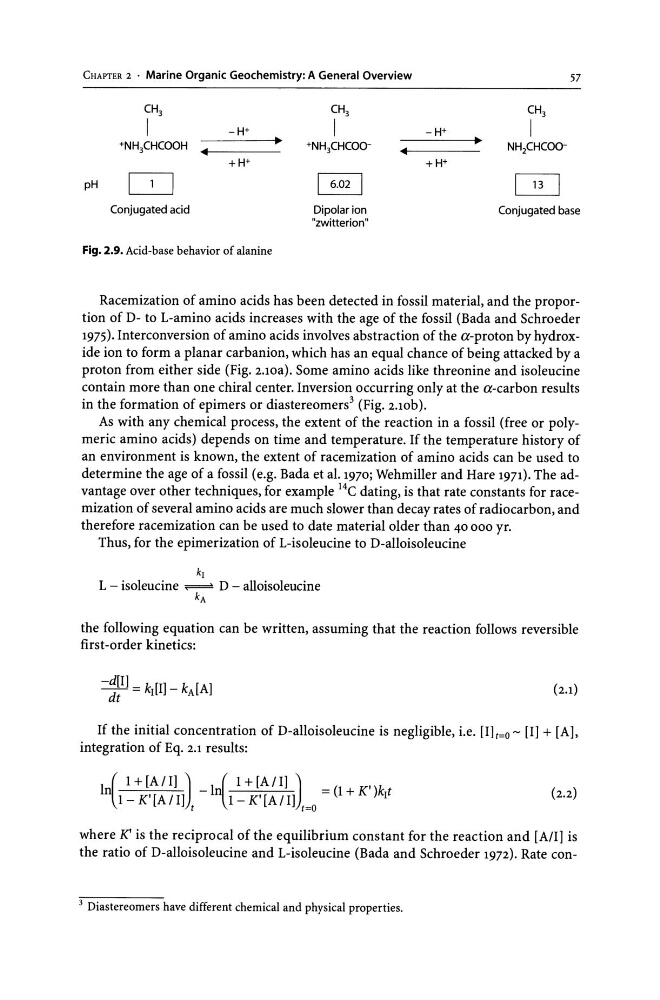
Fig. 2.9. Acid-base behavior of alanine
Racemization of amino acids has been detected in fossil material, and the proportion of D- to L-amino acids increases with the age of the fossil (Bada and Schroeder
1975). Interconversion of amino acids involves abstraction of the a-proton by hydroxide ion to form a planar carbanion, which has an equal chance of being attacked by a
proton from either side (Fig. 2.lOa). Some amino acids like threonine and isoleucine
contain more than one chiral center. Inversion occurring only at the a-carbon results
in the formation of epimers or diastereomers 3 (Fig. 2.lOb).
As with any chemical process, the extent of the reaction in a fossil (free or polymeric amino acids) depends on time and temperature. If the temperature history of
an environment is known, the extent of racemization of amino acids can be used to
determine the age of a fossil (e.g. Bada et al. 1970; Wehmiller and Hare 1971). The advantage over other techniques, for example 14C dating, is that rate constants for racemization of several amino acids are much slower than decay rates of radiocarbon, and
therefore racemization can be used to date material older than 40 000 yr.
Thus, for the epimerization of L-isoleucine to D-alloisoleucine
kr
L - isoleucine ~ D - alloisoleucine
kA
the following equation can be written, assuming that the reaction follows reversible
first -order kinetics:
If the initial concentration of D-alloisoleucine is negligible, i.e. [I) t=O - [I] + [A],
integration of Eq. 2.1 results:
In( 1 + [AlI] ) -In( l+[AII]) =(l+K')kt
l-K'[AII]
l-K'[AII]
I
t
t=O
where K' is the reciprocal of the equilibrium constant for the reaction and [A/I] is
the ratio of D-alloisoleucine and L-isoleucine (Bada and Schroeder 1972). Rate con3 Diastereomers have different chemical and physical properties.
57
CH 3
CH 3
I
- H+
I
-w
+NH 3 CHCOOH
• +NH 3 CHCOO.. +w
+H+
pH
~
B
Conjugated acid
Dipolar ion
Conjugated base
"zwitterion"
Fig. 2.9. Acid-base behavior of alanine
Racemization of amino acids has been detected in fossil material, and the proportion of D- to L-amino acids increases with the age of the fossil (Bada and Schroeder
1975). Interconversion of amino acids involves abstraction of the a-proton by hydroxide ion to form a planar carbanion, which has an equal chance of being attacked by a
proton from either side (Fig. 2.lOa). Some amino acids like threonine and isoleucine
contain more than one chiral center. Inversion occurring only at the a-carbon results
in the formation of epimers or diastereomers 3 (Fig. 2.lOb).
As with any chemical process, the extent of the reaction in a fossil (free or polymeric amino acids) depends on time and temperature. If the temperature history of
an environment is known, the extent of racemization of amino acids can be used to
determine the age of a fossil (e.g. Bada et al. 1970; Wehmiller and Hare 1971). The advantage over other techniques, for example 14C dating, is that rate constants for racemization of several amino acids are much slower than decay rates of radiocarbon, and
therefore racemization can be used to date material older than 40 000 yr.
Thus, for the epimerization of L-isoleucine to D-alloisoleucine
kr
L - isoleucine ~ D - alloisoleucine
kA
the following equation can be written, assuming that the reaction follows reversible
first -order kinetics:
If the initial concentration of D-alloisoleucine is negligible, i.e. [I) t=O - [I] + [A],
integration of Eq. 2.1 results:
In( 1 + [AlI] ) -In( l+[AII]) =(l+K')kt
l-K'[AII]
l-K'[AII]
I
t
t=O
where K' is the reciprocal of the equilibrium constant for the reaction and [A/I] is
the ratio of D-alloisoleucine and L-isoleucine (Bada and Schroeder 1972). Rate con3 Diastereomers have different chemical and physical properties.