

52
S. Pantoja· S. Wakeham
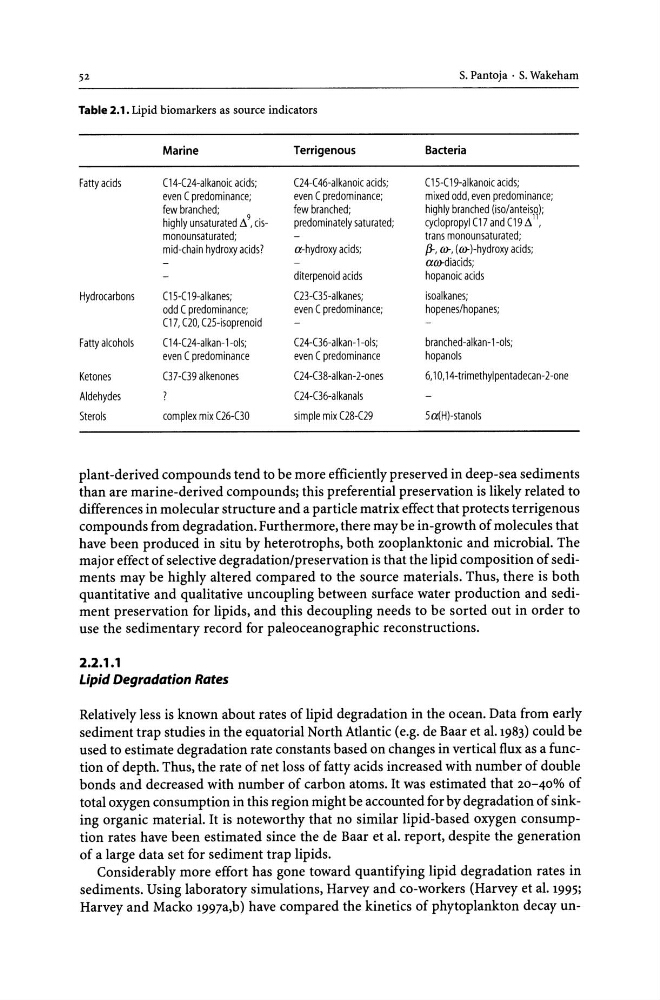
Table 2.1. Lipid biomarkers as source indicators
Marine
Terrigenous
Bacteria
Fatty acids
(14-04-alkanoic acids;
04-(46-alkanoic acids;
(lS-(19-alkanoic acids;
even (predominance;
even (predominance;
mixed odd, even predominance;
few branched;
few branched;
highly branched (iso/anteisg);
highly unsaturated 1:0,9, cispredominately saturated;
cyclopropyl C17 and C19 Ll ,
monounsaturated;
trans monounsaturated;
mid-chain hydroxy acids?
a-hydroxy acids;
~,(J)-, ({J)-)-hydroxy acids;
a{J)-diacids;
diterpenoid acids
hopanoic acids
Hydrocarbons
Cl5-C19-alkanes;
C23-C3S-alkanes;
isoalkanes;
odd ( predominance;
even C predominance;
hopenes/hopanes;
C17, 00, OS-isoprenoid
Fatty alcohols
Cl4-C24-alkan-l-ols;
04-C36-alkan-l-ols;
branched-alkan-l-ols;
even (predominance
even C predominance
hopanols
Ketones
C37-C39 alkenones
(2 4-C38-a I ka n-2-ones
6,10,14-trimethylpentadecan-2-one
Aldehydes
04-C36-alkanals
Sterols
complex mix 06-C30
simple mix 08-C29
Sa(H)-stanols
plant -derived compounds tend to be more efficiently preserved in deep-sea sediments
than are marine-derived compounds; this preferential preservation is likely related to
differences in molecular structure and a particle matrix effect that protects terrigenous
compounds from degradation. Furthermore, there may be in -growth of molecules that
have been produced in situ by heterotrophs, both zooplanktonic and microbial. The
major effect of selective degradation/preservation is that the lipid composition of sediments may be highly altered compared to the source materials. Thus, there is both
quantitative and qualitative uncoupling between surface water production and sediment preservation for lipids, and this decoupling needs to be sorted out in order to
use the sedimentary record for paleoceanographic reconstructions.
2.2.1.1
Lipid Degradation Rates
Relatively less is known about rates of lipid degradation in the ocean. Data from early
sediment trap studies in the equatorial North Atlantic (e.g. de Baar et al. 1983) could be
used to estimate degradation rate constants based on changes in vertical flux as a function of depth. Thus, tlIe rate of net loss of fatty acids increased with number of double
bonds and decreased with number of carbon atoms. It was estimated that 20-40% of
total oxygen consumption in this region might be accounted for by degradation of sinking organic material. It is noteworthy that no similar lipid-based oxygen consumption rates have been estimated since the de Baar et al. report, despite the generation
of a large data set for sediment trap lipids.
Considerably more effort has gone toward quantifying lipid degradation rates in
sediments. Using laboratory simulations, Harvey and co-workers (Harvey et al. 1995;
Harvey and Macko 1997a,b) have compared the kinetics of phytoplankton decay un-
S. Pantoja· S. Wakeham
Table 2.1. Lipid biomarkers as source indicators
Marine
Terrigenous
Bacteria
Fatty acids
(14-04-alkanoic acids;
04-(46-alkanoic acids;
(lS-(19-alkanoic acids;
even (predominance;
even (predominance;
mixed odd, even predominance;
few branched;
few branched;
highly branched (iso/anteisg);
highly unsaturated 1:0,9, cispredominately saturated;
cyclopropyl C17 and C19 Ll ,
monounsaturated;
trans monounsaturated;
mid-chain hydroxy acids?
a-hydroxy acids;
~,(J)-, ({J)-)-hydroxy acids;
a{J)-diacids;
diterpenoid acids
hopanoic acids
Hydrocarbons
Cl5-C19-alkanes;
C23-C3S-alkanes;
isoalkanes;
odd ( predominance;
even C predominance;
hopenes/hopanes;
C17, 00, OS-isoprenoid
Fatty alcohols
Cl4-C24-alkan-l-ols;
04-C36-alkan-l-ols;
branched-alkan-l-ols;
even (predominance
even C predominance
hopanols
Ketones
C37-C39 alkenones
(2 4-C38-a I ka n-2-ones
6,10,14-trimethylpentadecan-2-one
Aldehydes
04-C36-alkanals
Sterols
complex mix 06-C30
simple mix 08-C29
Sa(H)-stanols
plant -derived compounds tend to be more efficiently preserved in deep-sea sediments
than are marine-derived compounds; this preferential preservation is likely related to
differences in molecular structure and a particle matrix effect that protects terrigenous
compounds from degradation. Furthermore, there may be in -growth of molecules that
have been produced in situ by heterotrophs, both zooplanktonic and microbial. The
major effect of selective degradation/preservation is that the lipid composition of sediments may be highly altered compared to the source materials. Thus, there is both
quantitative and qualitative uncoupling between surface water production and sediment preservation for lipids, and this decoupling needs to be sorted out in order to
use the sedimentary record for paleoceanographic reconstructions.
2.2.1.1
Lipid Degradation Rates
Relatively less is known about rates of lipid degradation in the ocean. Data from early
sediment trap studies in the equatorial North Atlantic (e.g. de Baar et al. 1983) could be
used to estimate degradation rate constants based on changes in vertical flux as a function of depth. Thus, tlIe rate of net loss of fatty acids increased with number of double
bonds and decreased with number of carbon atoms. It was estimated that 20-40% of
total oxygen consumption in this region might be accounted for by degradation of sinking organic material. It is noteworthy that no similar lipid-based oxygen consumption rates have been estimated since the de Baar et al. report, despite the generation
of a large data set for sediment trap lipids.
Considerably more effort has gone toward quantifying lipid degradation rates in
sediments. Using laboratory simulations, Harvey and co-workers (Harvey et al. 1995;
Harvey and Macko 1997a,b) have compared the kinetics of phytoplankton decay un-