

CHAPTER 2 • Marine Organic Geochemistry: A General Overview
53
der oxic and anoxic conditions: in addition to lipids, their study examined organic
carbon, nitrogen, carbohydrates and amino acids. Among the major biochemical fractions, carbohydrates were most rapidly degraded under oxic conditions, followed by
protein and lipid. Degradation rates for all components were significantly lower under anoxic conditions. Similar comparisons of degradation of various organic matter
pools in oxic and anoxic regimes have been made in the water column (Lee 1992) and
sediments (Sun et al. 1993, 1997). There is still considerable controversy as to the role
of oxygen in ilie degradation of organic matter (Henrichs and Reeburgh 1987; Emerson
and Hedges 1988; Canfield 1994; Pedersen and Calvert 1990; Lee 1992). Noneilieless,
degradation of organic constituents in sediments behaves in a manner consistent with
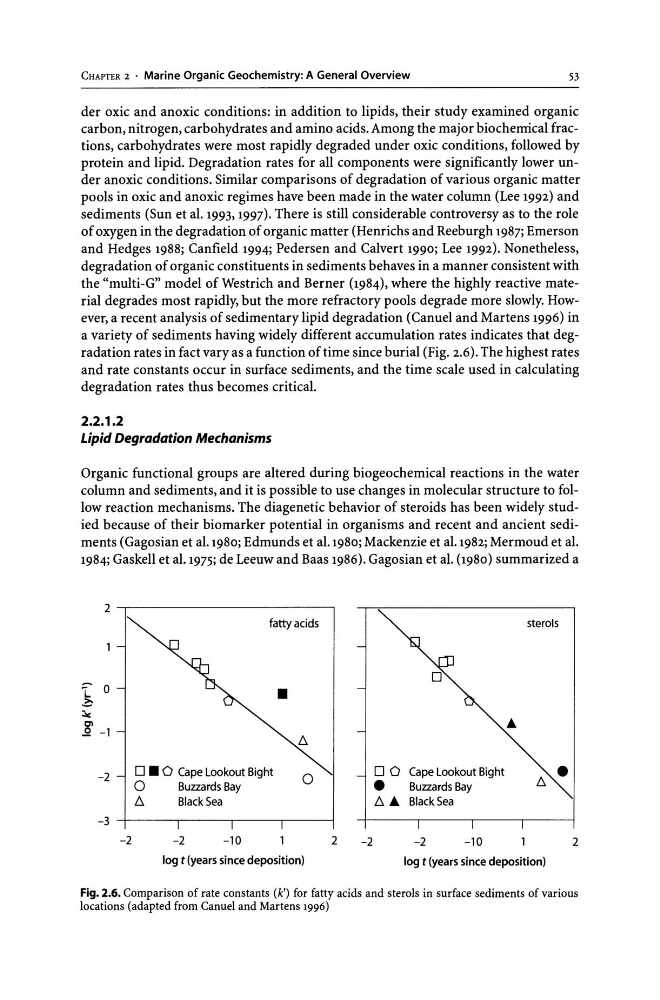
the "multi-G" model of Westrich and Berner (1984), where the highly reactive material degrades most rapidly, but the more refractory pools degrade more slowly. However, a recent analysis of sedimentary lipid degradation (Canuel and Martens 1996) in
a variety of sediments having widely different accumulation rates indicates that degradation rates in fact vary as a function of time since burial (Fig. 2.6). The highest rates
and rate constants occur in surface sediments, and the time scale used in calculating
degradation rates thus becomes critical.
2.2.1.2
Lipid Degradation Mechanisms
Organic functional groups are altered during biogeochemical reactions in the water
column and sediments, and it is possible to use changes in molecular structure to follow reaction mechanisms. The diagenetic behavior of steroids has been widely studied because of ilieir biomarker potential in organisms and recent and ancient sediments (Gagosian et al. 1980; Edmunds et al. 1980; Mackenzie et al. 1982; Mermoud et al.
1984; Gaskell et al. 1975; de Leeuw and Baas 1986). Gagosian et al. (1980) summarized a
2 -,-------------------------,
1 0
:>c
CI
.2 -1
-2
fatty acids
o • 0 Cape Lookout Bight
o
Buzzards Bay
b.
Black Sea
•
-3 ~----_r-----.----_r----~
-2
-2
-10
2
log t (years since deposition)
sterols
o 0 Cape Lookout Bight
•
Buzzards Bay
b. .. Blacksea
-2
-2
-10
2
log t (years since deposition)
Fig. 2.6. Comparison of rate constants (k') for fatty acids and sterols in surface sediments of various
locations (adapted from Canuel and Martens 1996)
53
der oxic and anoxic conditions: in addition to lipids, their study examined organic
carbon, nitrogen, carbohydrates and amino acids. Among the major biochemical fractions, carbohydrates were most rapidly degraded under oxic conditions, followed by
protein and lipid. Degradation rates for all components were significantly lower under anoxic conditions. Similar comparisons of degradation of various organic matter
pools in oxic and anoxic regimes have been made in the water column (Lee 1992) and
sediments (Sun et al. 1993, 1997). There is still considerable controversy as to the role
of oxygen in ilie degradation of organic matter (Henrichs and Reeburgh 1987; Emerson
and Hedges 1988; Canfield 1994; Pedersen and Calvert 1990; Lee 1992). Noneilieless,
degradation of organic constituents in sediments behaves in a manner consistent with
the "multi-G" model of Westrich and Berner (1984), where the highly reactive material degrades most rapidly, but the more refractory pools degrade more slowly. However, a recent analysis of sedimentary lipid degradation (Canuel and Martens 1996) in
a variety of sediments having widely different accumulation rates indicates that degradation rates in fact vary as a function of time since burial (Fig. 2.6). The highest rates
and rate constants occur in surface sediments, and the time scale used in calculating
degradation rates thus becomes critical.
2.2.1.2
Lipid Degradation Mechanisms
Organic functional groups are altered during biogeochemical reactions in the water
column and sediments, and it is possible to use changes in molecular structure to follow reaction mechanisms. The diagenetic behavior of steroids has been widely studied because of ilieir biomarker potential in organisms and recent and ancient sediments (Gagosian et al. 1980; Edmunds et al. 1980; Mackenzie et al. 1982; Mermoud et al.
1984; Gaskell et al. 1975; de Leeuw and Baas 1986). Gagosian et al. (1980) summarized a
2 -,-------------------------,
1 0
:>c
CI
.2 -1
-2
fatty acids
o • 0 Cape Lookout Bight
o
Buzzards Bay
b.
Black Sea
•
-3 ~----_r-----.----_r----~
-2
-2
-10
2
log t (years since deposition)
sterols
o 0 Cape Lookout Bight
•
Buzzards Bay
b. .. Blacksea
-2
-2
-10
2
log t (years since deposition)
Fig. 2.6. Comparison of rate constants (k') for fatty acids and sterols in surface sediments of various
locations (adapted from Canuel and Martens 1996)