

CHAPTER 1 • The Carbonate System in Marine Environments
37
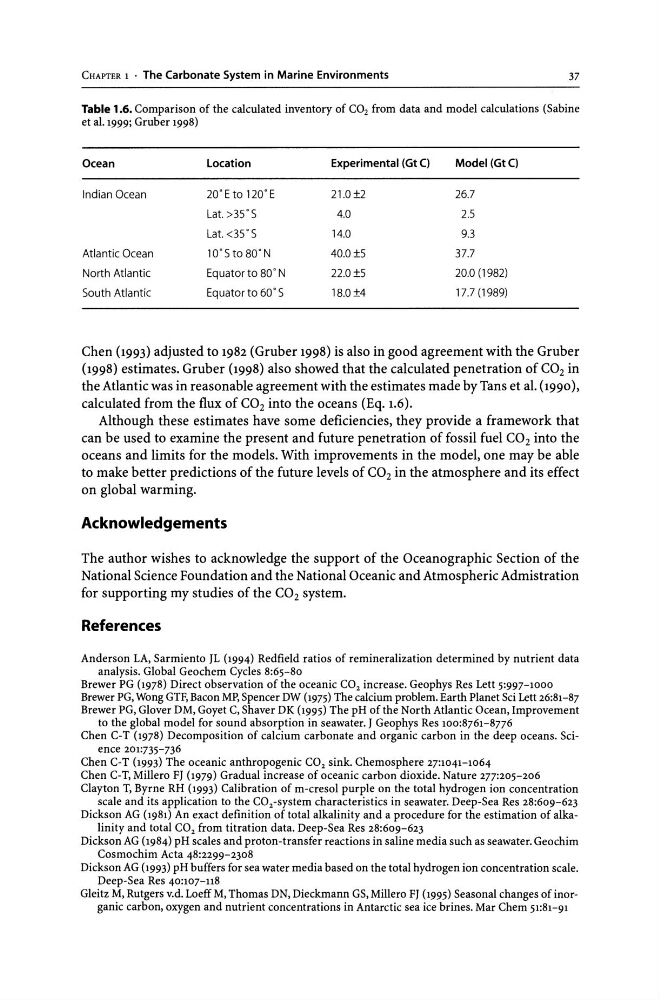
Table 1.6. Comparison of the calculated inventory of CO2 from data and model calculations (Sabine
et al.1999; Gruber 1998)
Ocean
Indian Ocean
Atlantic Ocean
North Atlantic
50uth Atlantic
Location
20· E to 120· E
Lat. >35·5
Lat. <35·5
10·5to80·N
Equator to 80· N
Equator to 60· 5
Experimental (Gt C)
Model (GtC)
21.0 ±2
26.7
4.0
2.5
14.0
9.3
40.0±5
37.7
22.0±5
20.0 (1982)
18.0±4
17.7 (1989)
Chen (1993) adjusted to 1982 (Gruber 1998) is also in good agreement with the Gruber
(1998) estimates. Gruber (1998) also showed that the calculated penetration of CO2 in
the Atlantic was in reasonable agreement with the estimates made by Tans et al. (1990),
calculated from the flux of CO 2 into the oceans (Eq. 1.6).
Although these estimates have some deficiencies, they provide a framework that
can be used to examine the present and future penetration of fossil fuel CO2 into the
oceans and limits for the models. With improvements in the model, one may be able
to make better predictions of the future levels of CO2 in the atmosphere and its effect
on global warming.
Acknowledgements
The author wishes to acknowledge the support of the Oceanographic Section of the
National Science Foundation and the National Oceanic and Atmospheric Admistration
for supporting my studies of the CO2 system.
References
Anderson LA, Sarmiento JL (1994) Redfield ratios of remineralization determined by nutrient data
analysis. Global Geochem Cycles 8:65-80
Brewer PG (1978) Direct observation of the oceanic CO2 increase. Geophys Res Lett 5:997-1000
Brewer PG, Wong GTF, Bacon MP, Spencer DW (1975) The calcium problem. Earth Planet Sci Lett 26:81-87
Brewer PG, Glover DM, Goyet C, Shaver DK (1995) The pH of the North Atlantic Ocean, Improvement
to the global model for sound absorption in seawater. J Geophys Res 100:8761-8776
Chen C-T (1978) Decomposition of calcium carbonate and organic carbon in the deep oceans. Science 201:735-736
Chen C-T (1993) The oceanic anthropogenic CO2 sink. Chemosphere 27:1041-1064
Chen C-T, Millero FJ (1979) Gradual increase of oceanic carbon dioxide. Nature 277:205-206
Clayton T, Byrne RH (1993) Calibration of m-cresol purple on the total hydrogen ion concentration
scale and its application to the CO2-system characteristics in seawater. Deep-Sea Res 28:609-623
Dickson AG (1981) An exact definition of total alkalinity and a procedure for the estimation of alkalinity and total CO2 from titration data. Deep-Sea Res 28:609-623
Dickson AG (1984) pH scales and proton-transfer reactions in saline media such as seawater. Geochim
Cosmochim Acta 48:2299-2308
Dickson AG (1993) pH buffers for sea water media based on the total hydrogen ion concentration scale.
Deep-Sea Res 40:l07-118
Gleitz M, Rutgers v.d. Loeff M, Thomas DN, Dieckmann GS, Millero FJ (1995) Seasonal changes of inorganic carbon, oxygen and nutrient concentrations in Antarctic sea ice brines. Mar Chern 51:81-91
37
Table 1.6. Comparison of the calculated inventory of CO2 from data and model calculations (Sabine
et al.1999; Gruber 1998)
Ocean
Indian Ocean
Atlantic Ocean
North Atlantic
50uth Atlantic
Location
20· E to 120· E
Lat. >35·5
Lat. <35·5
10·5to80·N
Equator to 80· N
Equator to 60· 5
Experimental (Gt C)
Model (GtC)
21.0 ±2
26.7
4.0
2.5
14.0
9.3
40.0±5
37.7
22.0±5
20.0 (1982)
18.0±4
17.7 (1989)
Chen (1993) adjusted to 1982 (Gruber 1998) is also in good agreement with the Gruber
(1998) estimates. Gruber (1998) also showed that the calculated penetration of CO2 in
the Atlantic was in reasonable agreement with the estimates made by Tans et al. (1990),
calculated from the flux of CO 2 into the oceans (Eq. 1.6).
Although these estimates have some deficiencies, they provide a framework that
can be used to examine the present and future penetration of fossil fuel CO2 into the
oceans and limits for the models. With improvements in the model, one may be able
to make better predictions of the future levels of CO2 in the atmosphere and its effect
on global warming.
Acknowledgements
The author wishes to acknowledge the support of the Oceanographic Section of the
National Science Foundation and the National Oceanic and Atmospheric Admistration
for supporting my studies of the CO2 system.
References
Anderson LA, Sarmiento JL (1994) Redfield ratios of remineralization determined by nutrient data
analysis. Global Geochem Cycles 8:65-80
Brewer PG (1978) Direct observation of the oceanic CO2 increase. Geophys Res Lett 5:997-1000
Brewer PG, Wong GTF, Bacon MP, Spencer DW (1975) The calcium problem. Earth Planet Sci Lett 26:81-87
Brewer PG, Glover DM, Goyet C, Shaver DK (1995) The pH of the North Atlantic Ocean, Improvement
to the global model for sound absorption in seawater. J Geophys Res 100:8761-8776
Chen C-T (1978) Decomposition of calcium carbonate and organic carbon in the deep oceans. Science 201:735-736
Chen C-T (1993) The oceanic anthropogenic CO2 sink. Chemosphere 27:1041-1064
Chen C-T, Millero FJ (1979) Gradual increase of oceanic carbon dioxide. Nature 277:205-206
Clayton T, Byrne RH (1993) Calibration of m-cresol purple on the total hydrogen ion concentration
scale and its application to the CO2-system characteristics in seawater. Deep-Sea Res 28:609-623
Dickson AG (1981) An exact definition of total alkalinity and a procedure for the estimation of alkalinity and total CO2 from titration data. Deep-Sea Res 28:609-623
Dickson AG (1984) pH scales and proton-transfer reactions in saline media such as seawater. Geochim
Cosmochim Acta 48:2299-2308
Dickson AG (1993) pH buffers for sea water media based on the total hydrogen ion concentration scale.
Deep-Sea Res 40:l07-118
Gleitz M, Rutgers v.d. Loeff M, Thomas DN, Dieckmann GS, Millero FJ (1995) Seasonal changes of inorganic carbon, oxygen and nutrient concentrations in Antarctic sea ice brines. Mar Chern 51:81-91