

402
M. Forina . S. Lanteri . R. Todeschini
21.3.2
Example 2 - Polycyclic Aromatic Hydrocarbons (PAHs)
The polluting effect of PARs is closely related to their mutagenic and carcinogenic
activity, so they can be used as indexes of pollution able to differentiate several environmental settings: urban, industrial and suburban.
Airborne particulate samples, used to assess the environmental contamination by
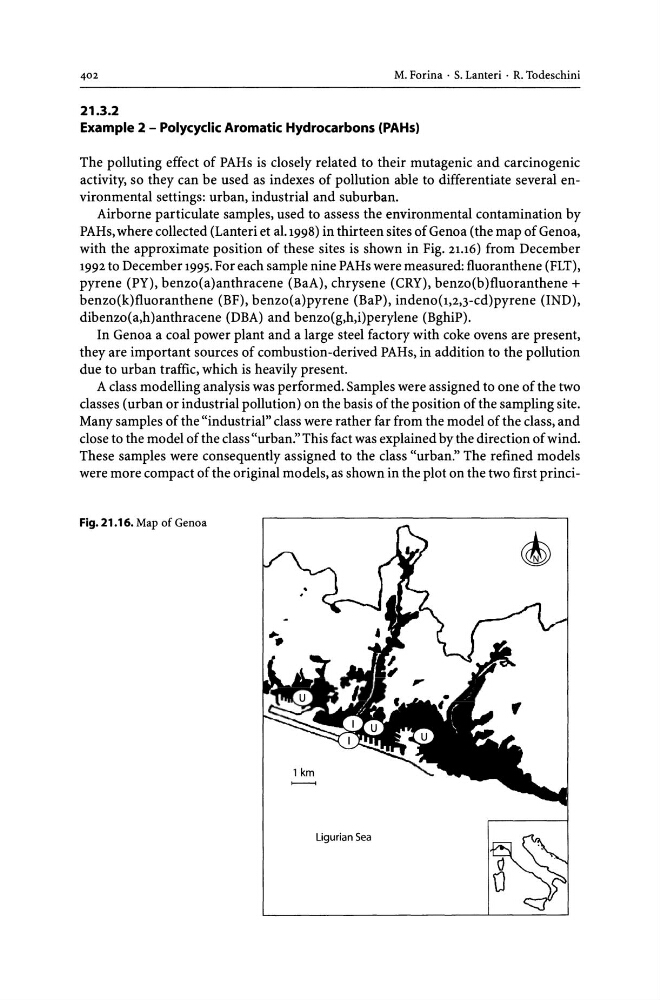
PARs, where collected (Lanteri et al.1998) in thirteen sites of Genoa (the map of Genoa,
with the approximate position of these sites is shown in Fig. 21.16) from December
1992 to December 1995. For each sample nine PARs were measured: fluoranthene (FLT),
pyrene (PY), benzo(a)anthracene (BaA), chrysene (CRY), benzo(b)fluoranthene +
benzo(k)fluoranthene (BF), benzo(a)pyrene (BaP), indeno(1,2,3-cd)pyrene (IND),
dibenzo(a,h)anthracene (DBA) and benzo(g,h,i)perylene (BghiP).
In Genoa a coal power plant and a large steel factory with coke ovens are present,
they are important sources of combustion-derived PARs, in addition to the pollution
due to urban traffic, which is heavily present.
A class modelling analysis was performed. Samples were assigned to one of the two
classes (urban or industrial pollution) on the basis of the position of the sampling site.
Many samples of the "industrial" class were rather far from the model of the class, and
close to the model of the class "urban:' This fact was explained by the direction of wind.
These samples were consequently assigned to the class "urban." The refined models
were more compact of the original models, as shown in the plot on the two first princiFig. 21.16. Map of Genoa
1 km
>----<
Ligurian Sea
M. Forina . S. Lanteri . R. Todeschini
21.3.2
Example 2 - Polycyclic Aromatic Hydrocarbons (PAHs)
The polluting effect of PARs is closely related to their mutagenic and carcinogenic
activity, so they can be used as indexes of pollution able to differentiate several environmental settings: urban, industrial and suburban.
Airborne particulate samples, used to assess the environmental contamination by
PARs, where collected (Lanteri et al.1998) in thirteen sites of Genoa (the map of Genoa,
with the approximate position of these sites is shown in Fig. 21.16) from December
1992 to December 1995. For each sample nine PARs were measured: fluoranthene (FLT),
pyrene (PY), benzo(a)anthracene (BaA), chrysene (CRY), benzo(b)fluoranthene +
benzo(k)fluoranthene (BF), benzo(a)pyrene (BaP), indeno(1,2,3-cd)pyrene (IND),
dibenzo(a,h)anthracene (DBA) and benzo(g,h,i)perylene (BghiP).
In Genoa a coal power plant and a large steel factory with coke ovens are present,
they are important sources of combustion-derived PARs, in addition to the pollution
due to urban traffic, which is heavily present.
A class modelling analysis was performed. Samples were assigned to one of the two
classes (urban or industrial pollution) on the basis of the position of the sampling site.
Many samples of the "industrial" class were rather far from the model of the class, and
close to the model of the class "urban:' This fact was explained by the direction of wind.
These samples were consequently assigned to the class "urban." The refined models
were more compact of the original models, as shown in the plot on the two first princiFig. 21.16. Map of Genoa
1 km
>----<
Ligurian Sea