

CHAPTER 21 . (hemometries for Sampling and Analysis: Theory and Environmental Applications
403
Q
~
~
•
\ \
QQ
\ \
~
~
~
~
\ \
\
~~~ ~
N
~~
~
~
\ \ \\
\
5
~' ~~ ~~
\
~
~~~
\ ~\ \
i;
\
\
QI
01
WIiJ.~) ..
iii
\
~~
\
~~QQ
\
,~
!i1IQ
~
~
Eigenvector 1
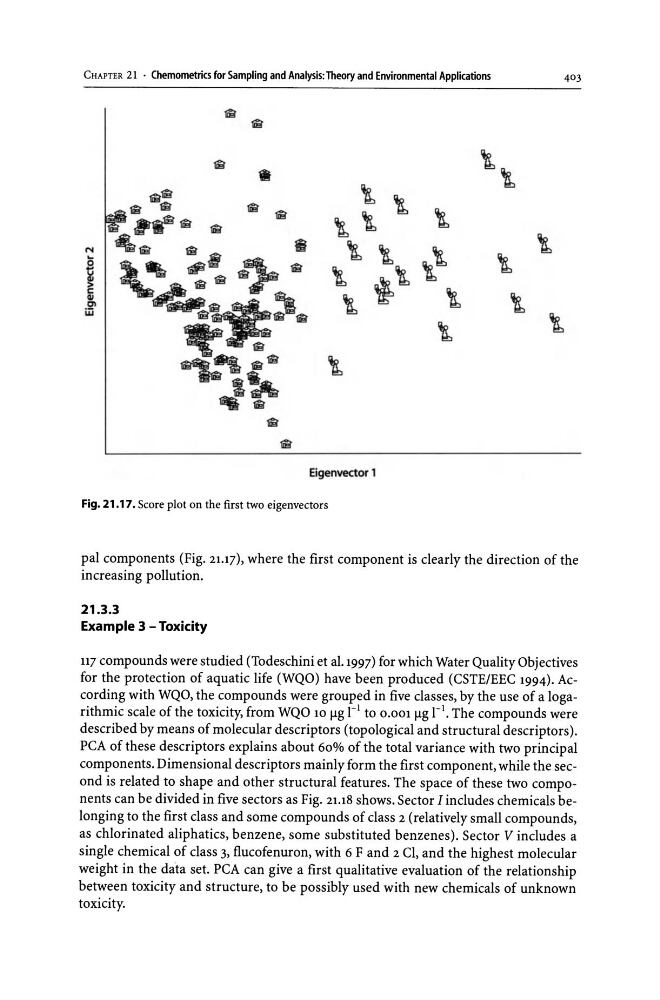
Fig. 21.17. Score plot on the first two eigenvectors
pal components (Fig. 21.17), where the first component is clearly the direction of the
increasing pollution.
21.3.3
Example 3 - Toxicity
117 compounds were studied (Todeschini et al. 1997) for which Water Quality Objectives
for the protection of aquatic life (WQO) have been produced (CSTE/EEC 1994). According with WQO, the compounds were grouped in five classes, by the use of a logarithmic scale of the toxicity, from WQO 10 flg rl to 0.001 flg rl . The compounds were
described by means of molecular descriptors (topological and structural descriptors).
PCA of these descriptors explains about 60% of the total variance with two principal
components. Dimensional descriptors mainly form the first component, while the second is related to shape and other structural features. The space of these two components can be divided in five sectors as Fig. 21.18 shows. Sector I includes chemicals belonging to the first class and some compounds of class 2 (relatively small compounds,
as chlorinated aliphatics, benzene, some substituted benzenes). Sector V includes a
single chemical of class 3, tlucofenuron, with 6 F and 2 Cl, and the highest molecular
weight in the data set. PCA can give a first qualitative evaluation of the relationship
between toxicity and structure, to be possibly used with new chemicals of unknown
toxicity.
403
Q
~
~
•
\ \
\ \
~
~
~
~
\ \
\
~~~ ~
N
~~
~
~
\ \ \\
\
5
~' ~~ ~~
\
~
~~~
\ ~\ \
i;
\
\
QI
01
WIiJ.~) ..
iii
\
~~
\
\
,~
!i1IQ
~
~
Eigenvector 1
Fig. 21.17. Score plot on the first two eigenvectors
pal components (Fig. 21.17), where the first component is clearly the direction of the
increasing pollution.
21.3.3
Example 3 - Toxicity
117 compounds were studied (Todeschini et al. 1997) for which Water Quality Objectives
for the protection of aquatic life (WQO) have been produced (CSTE/EEC 1994). According with WQO, the compounds were grouped in five classes, by the use of a logarithmic scale of the toxicity, from WQO 10 flg rl to 0.001 flg rl . The compounds were
described by means of molecular descriptors (topological and structural descriptors).
PCA of these descriptors explains about 60% of the total variance with two principal
components. Dimensional descriptors mainly form the first component, while the second is related to shape and other structural features. The space of these two components can be divided in five sectors as Fig. 21.18 shows. Sector I includes chemicals belonging to the first class and some compounds of class 2 (relatively small compounds,
as chlorinated aliphatics, benzene, some substituted benzenes). Sector V includes a
single chemical of class 3, tlucofenuron, with 6 F and 2 Cl, and the highest molecular
weight in the data set. PCA can give a first qualitative evaluation of the relationship
between toxicity and structure, to be possibly used with new chemicals of unknown
toxicity.