

CHAPTER 21 • (hemometries for Sampling and Analysis: Theory and Environmental Applications
397
The main problems here are:
• the choice of the model,
• the design (number of experiments, values of the factors in each experiment) necessary to obtain the required information with a sufficient quality,
• the refinement of the regression model, and
• the validation of the model.
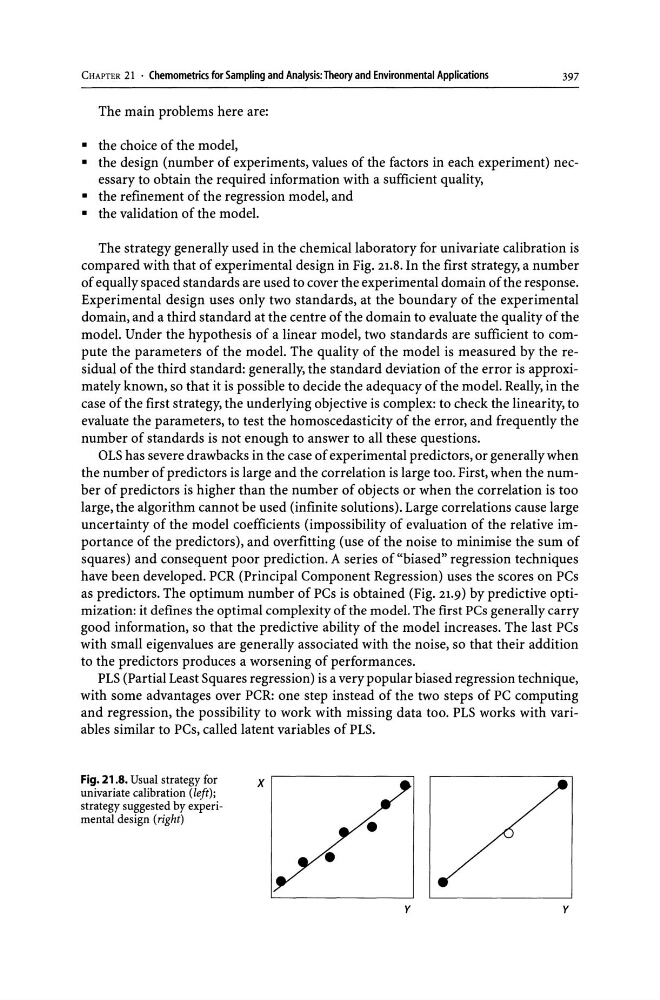
The strategy generally used in the chemical laboratory for univariate calibration is
compared with that of experimental design in Fig. 21.8. In the first strategy, a number
of equally spaced standards are used to cover the experimental domain of the response.
Experimental design uses only two standards, at the boundary of the experimental
domain, and a third standard at the centre of the domain to evaluate the quality of the
model. Under the hypothesis of a linear model, two standards are sufficient to compute the parameters of the model. The quality of the model is measured by the residual of the third standard: generally, the standard deviation of the error is approximately known, so that it is possible to decide the adequacy of the model. Really, in the
case of the first strategy, the underlying objective is complex: to check the linearity, to
evaluate the parameters, to test the homoscedasticity of the error, and frequently the
number of standards is not enough to answer to all these questions.
OLS has severe drawbacks in the case of experimental predictors, or generally when
the number of predictors is large and the correlation is large too. First, when the number of predictors is higher than the number of objects or when the correlation is too
large, the algorithm cannot be used (infinite solutions). Large correlations cause large
uncertainty of the model coefficients (impossibility of evaluation of the relative importance of the predictors), and overfitting (use of the noise to minimise the sum of
squares) and consequent poor prediction. A series of "biased" regression techniques
have been developed. PCR (Principal Component Regression) uses the scores on PCs
as predictors. The optimum number of PCs is obtained (Fig. 21.9) by predictive optimization: it defines the optimal complexity of the model. The first PCs generally carry
good information, so that the predictive ability of the model increases. The last PCs
with small eigenvalues are generally associated with the noise, so that their addition
to the predictors produces a worsening of performances.
PLS (Partial Least Squares regression) is a very popular biased regression technique,
with some advantages over PCR: one step instead of the two steps of PC computing
and regression, the possibility to work with missing data too. PLS works with variables similar to PCs, called latent variables of PLS.
Fig. 21.8. Usual strategy for
X
univariate calibration (left);
strategy suggested by experimental design (right)
y
y
397
The main problems here are:
• the choice of the model,
• the design (number of experiments, values of the factors in each experiment) necessary to obtain the required information with a sufficient quality,
• the refinement of the regression model, and
• the validation of the model.
The strategy generally used in the chemical laboratory for univariate calibration is
compared with that of experimental design in Fig. 21.8. In the first strategy, a number
of equally spaced standards are used to cover the experimental domain of the response.
Experimental design uses only two standards, at the boundary of the experimental
domain, and a third standard at the centre of the domain to evaluate the quality of the
model. Under the hypothesis of a linear model, two standards are sufficient to compute the parameters of the model. The quality of the model is measured by the residual of the third standard: generally, the standard deviation of the error is approximately known, so that it is possible to decide the adequacy of the model. Really, in the
case of the first strategy, the underlying objective is complex: to check the linearity, to
evaluate the parameters, to test the homoscedasticity of the error, and frequently the
number of standards is not enough to answer to all these questions.
OLS has severe drawbacks in the case of experimental predictors, or generally when
the number of predictors is large and the correlation is large too. First, when the number of predictors is higher than the number of objects or when the correlation is too
large, the algorithm cannot be used (infinite solutions). Large correlations cause large
uncertainty of the model coefficients (impossibility of evaluation of the relative importance of the predictors), and overfitting (use of the noise to minimise the sum of
squares) and consequent poor prediction. A series of "biased" regression techniques
have been developed. PCR (Principal Component Regression) uses the scores on PCs
as predictors. The optimum number of PCs is obtained (Fig. 21.9) by predictive optimization: it defines the optimal complexity of the model. The first PCs generally carry
good information, so that the predictive ability of the model increases. The last PCs
with small eigenvalues are generally associated with the noise, so that their addition
to the predictors produces a worsening of performances.
PLS (Partial Least Squares regression) is a very popular biased regression technique,
with some advantages over PCR: one step instead of the two steps of PC computing
and regression, the possibility to work with missing data too. PLS works with variables similar to PCs, called latent variables of PLS.
Fig. 21.8. Usual strategy for
X
univariate calibration (left);
strategy suggested by experimental design (right)
y
y