

396
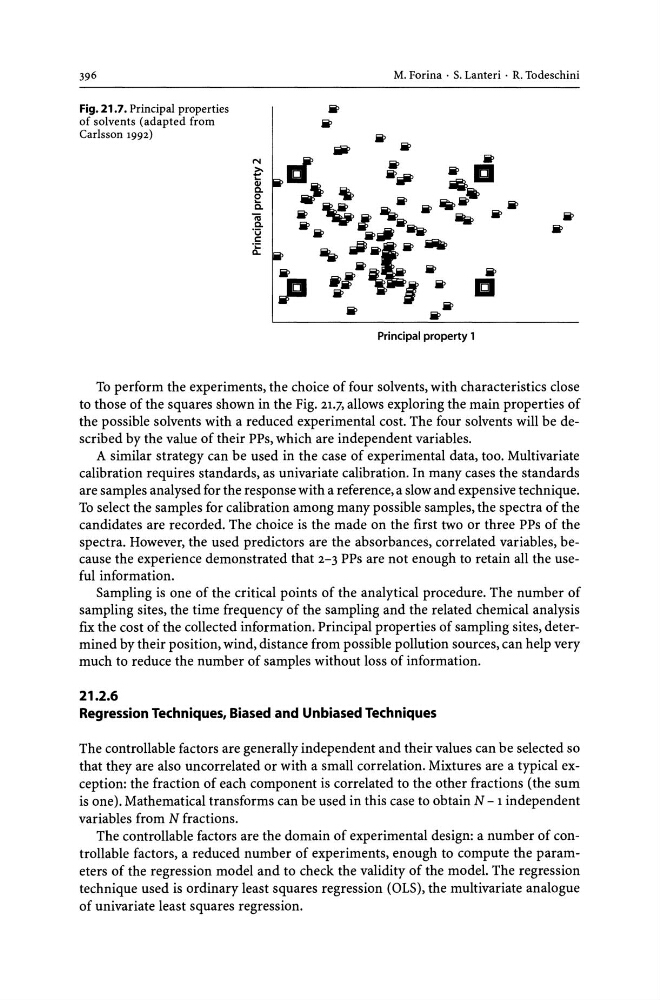
Fig. 21.7. Principal properties
of solvents (adapted from
Carlsson 1992)
N
~
8.
e Co
"[
·0
c
.;::
a..
M. Forina . S. Lanteri . R. Todeschini
~
a
Principal property 1
To perform the experiments, the choice of four solvents, with characteristics close
to those of the squares shown in the Fig. 21.7, allows exploring the main properties of
the possible solvents with a reduced experimental cost. The four solvents will be described by the value of their PPs, which are independent variables.
A similar strategy can be used in the case of experimental data, too. Multivariate
calibration requires standards, as univariate calibration. In many cases the standards
are samples analysed for the response with a reference, a slow and expensive technique.
To select the samples for calibration among many possible samples, the spectra of the
candidates are recorded. The choice is the made on the first two or three PPs of the
spectra. However, the used predictors are the absorbances, correlated variables, because the experience demonstrated that 2-3 PPs are not enough to retain all the useful information.
Sampling is one of the critical points of the analytical procedure. The number of
sampling sites, the time frequency of the sampling and the related chemical analysis
fix the cost of the collected information. Principal properties of sampling sites, determined by their position, wind, distance from possible pollution sources, can help very
much to reduce the number of samples without loss of information.
21.2.6
Regression Techniques, Biased and Unbiased Techniques
The controllable factors are generally independent and their values can be selected so
that they are also un correlated or with a small correlation. Mixtures are a typical exception: the fraction of each component is correlated to the other fractions (the sum
is one). Mathematical transforms can be used in this case to obtain N -1 independent
variables from N fractions.
The controllable factors are the domain of experimental design: a number of controllable factors, a reduced number of experiments, enough to compute the parameters of the regression model and to check the validity of the model. The regression
technique used is ordinary least squares regression (OLS), the multivariate analogue
of univariate least squares regression.
Fig. 21.7. Principal properties
of solvents (adapted from
Carlsson 1992)
N
~
8.
e Co
"[
·0
c
.;::
a..
M. Forina . S. Lanteri . R. Todeschini
~
a
Principal property 1
To perform the experiments, the choice of four solvents, with characteristics close
to those of the squares shown in the Fig. 21.7, allows exploring the main properties of
the possible solvents with a reduced experimental cost. The four solvents will be described by the value of their PPs, which are independent variables.
A similar strategy can be used in the case of experimental data, too. Multivariate
calibration requires standards, as univariate calibration. In many cases the standards
are samples analysed for the response with a reference, a slow and expensive technique.
To select the samples for calibration among many possible samples, the spectra of the
candidates are recorded. The choice is the made on the first two or three PPs of the
spectra. However, the used predictors are the absorbances, correlated variables, because the experience demonstrated that 2-3 PPs are not enough to retain all the useful information.
Sampling is one of the critical points of the analytical procedure. The number of
sampling sites, the time frequency of the sampling and the related chemical analysis
fix the cost of the collected information. Principal properties of sampling sites, determined by their position, wind, distance from possible pollution sources, can help very
much to reduce the number of samples without loss of information.
21.2.6
Regression Techniques, Biased and Unbiased Techniques
The controllable factors are generally independent and their values can be selected so
that they are also un correlated or with a small correlation. Mixtures are a typical exception: the fraction of each component is correlated to the other fractions (the sum
is one). Mathematical transforms can be used in this case to obtain N -1 independent
variables from N fractions.
The controllable factors are the domain of experimental design: a number of controllable factors, a reduced number of experiments, enough to compute the parameters of the regression model and to check the validity of the model. The regression
technique used is ordinary least squares regression (OLS), the multivariate analogue
of univariate least squares regression.