

374
V. Zelano . M. Gulmini
corresponding counterparts in solution, with a so-called surface complexation model
(SCM) (Stumm et a1.1976; Davis et a1.1978; Schindler 1981; Davis and Kent 1990; Stumm
1992 ).
According to this model, reaction between solutes and functional groups on the
solid surface are coordination reactions, which undergo the same concepts and mathematics of complexation reactions among solutes. All the surface ligand sites of
the same type are considered identical, and the surface- and solution-phase interactions can be described by means of a set of linked equations, one for each reaction
that takes place at the solid-solution interface. (Lekie 1988; Morel and Hering 1993;
Stumm 1998)
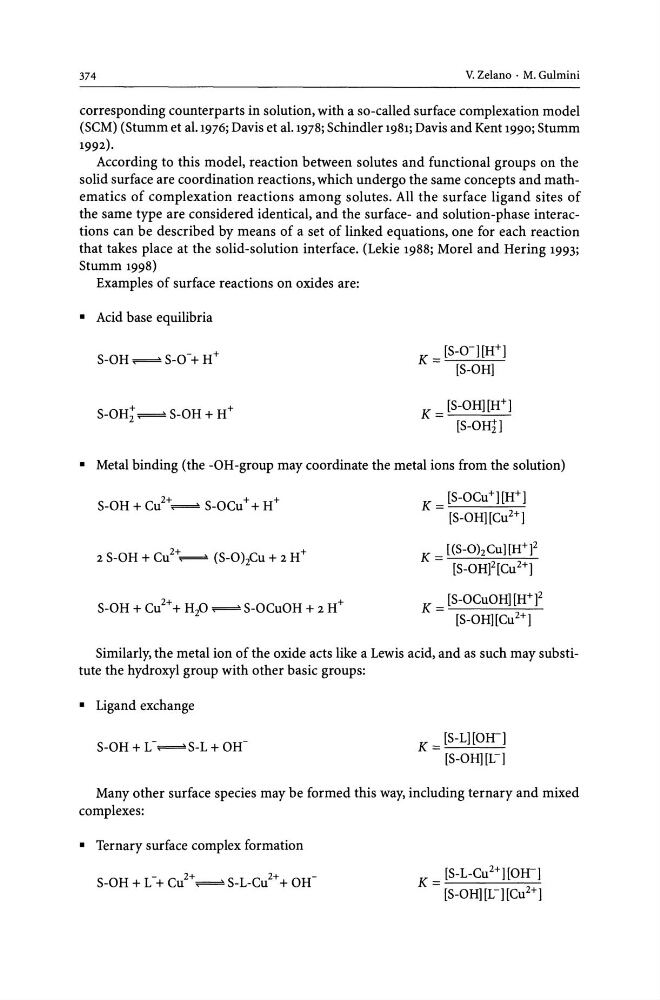
Examples of surface reactions on oxides are:
• Acid base equilibria
K = [S-OH] [H+]
[S-OH!]
• Metal binding (the -OH-group may coordinate the metal ions from the solution)
S-OH + Cu2+"...--2. S-OCu + + H+
2 S-OH + Cu 2 +"...--2. (S-OhCu + 2 H+
2+
+
S-OH + Cu + Hp ~ S-OCuOH + 2 H
K = [S-OCu+] [H+]
[S-OH] [Cu 2 +]
K = [(S-OhCu][H+f
[S-OHf[Cu 2 +]
K = [S-OCuOH] [H+f
[S-OH][Cu 2 +]
Similarly, the metal ion of the oxide acts like a Lewis acid, and as such may substitute the hydroxyl group with other basic groups:
• Ligand exchange
K = [S-L][OIr]
[S-OH][n
Many other surface species may be formed this way, including ternary and mixed
complexes:
• Ternary surface complex formation
K = [S-L-Cu 2 +][OIr]
[S-OH] [n [Cu 2 +]
V. Zelano . M. Gulmini
corresponding counterparts in solution, with a so-called surface complexation model
(SCM) (Stumm et a1.1976; Davis et a1.1978; Schindler 1981; Davis and Kent 1990; Stumm
1992 ).
According to this model, reaction between solutes and functional groups on the
solid surface are coordination reactions, which undergo the same concepts and mathematics of complexation reactions among solutes. All the surface ligand sites of
the same type are considered identical, and the surface- and solution-phase interactions can be described by means of a set of linked equations, one for each reaction
that takes place at the solid-solution interface. (Lekie 1988; Morel and Hering 1993;
Stumm 1998)
Examples of surface reactions on oxides are:
• Acid base equilibria
K = [S-OH] [H+]
[S-OH!]
• Metal binding (the -OH-group may coordinate the metal ions from the solution)
S-OH + Cu2+"...--2. S-OCu + + H+
2 S-OH + Cu 2 +"...--2. (S-OhCu + 2 H+
2+
+
S-OH + Cu + Hp ~ S-OCuOH + 2 H
K = [S-OCu+] [H+]
[S-OH] [Cu 2 +]
K = [(S-OhCu][H+f
[S-OHf[Cu 2 +]
K = [S-OCuOH] [H+f
[S-OH][Cu 2 +]
Similarly, the metal ion of the oxide acts like a Lewis acid, and as such may substitute the hydroxyl group with other basic groups:
• Ligand exchange
K = [S-L][OIr]
[S-OH][n
Many other surface species may be formed this way, including ternary and mixed
complexes:
• Ternary surface complex formation
K = [S-L-Cu 2 +][OIr]
[S-OH] [n [Cu 2 +]