

CHAPTER 20 . Potentiometry for the Study of Acid-Base Properties of Sediments
373
sults in a three-dimensional, flexible structure of aliphatic, peptide and polysaccharide chains, containing a wide variety of oxygen, sulfur and nitrogen functional groups.
These large, polyfunctional compounds are then adsorbed onto inorganic particles
such as clays, oxides or carbonates.
In fact, a clear distinction between inorganic and organic particle components does
not really exist, because of the close interactions that develop among the various sediment phases: for instance, a bit of silica covered with a thin film of humic material is
considered essentially inorganic, but its properties will be those of the organic cover.
20.3
The Solid-Water Interface
The sediment particles are therefore covered with active sites that may adsorb protons, hydroxide ions, metal ions and ligands of the water column.
Until recently the adsorption phenomena were described using adsorption isotherms (Langmuir, Freundlich and other more complex ones), which give a useful indication of the capacity of retention of the surfaces, but the ideas upon which they
were based did not permit the extension of their application to experimental situations which differed from the original ones (Davis and Kent 1990). For example, the
Langmuir approach for adsorption of solute C onto surface S, develops as follows
(Detenbeck and Brezonic 1991): taking into consideration the generic adsorption reaction
S+C~SC
(S is a superficial adsorbent site) the mass law is expressed as
[SC]
( L1G~ds
[S)[C] = Kads = exp -Rr-)
and the molar balance for the superficial sites is
[Shot ~ [S] + [SC]
By combining the two equations, we obtain
[SC] = [S]
Kads[C]
Tot 1 + Kads[C]
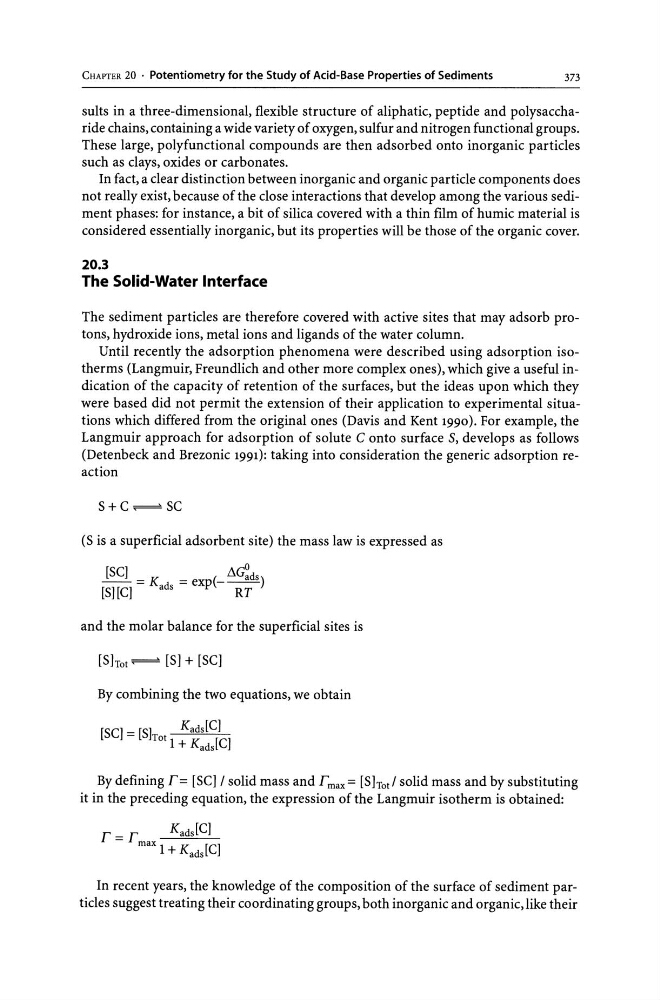
By defining r = [SC] / solid mass and r max = [S hot / solid mass and by substituting
it in the preceding equation, the expression of the Langmuir isotherm is obtained:
In recent years, the knowledge of the composition of the surface of sediment particles suggest treating their coordinating groups, both inorganic and organic, like their
373
sults in a three-dimensional, flexible structure of aliphatic, peptide and polysaccharide chains, containing a wide variety of oxygen, sulfur and nitrogen functional groups.
These large, polyfunctional compounds are then adsorbed onto inorganic particles
such as clays, oxides or carbonates.
In fact, a clear distinction between inorganic and organic particle components does
not really exist, because of the close interactions that develop among the various sediment phases: for instance, a bit of silica covered with a thin film of humic material is
considered essentially inorganic, but its properties will be those of the organic cover.
20.3
The Solid-Water Interface
The sediment particles are therefore covered with active sites that may adsorb protons, hydroxide ions, metal ions and ligands of the water column.
Until recently the adsorption phenomena were described using adsorption isotherms (Langmuir, Freundlich and other more complex ones), which give a useful indication of the capacity of retention of the surfaces, but the ideas upon which they
were based did not permit the extension of their application to experimental situations which differed from the original ones (Davis and Kent 1990). For example, the
Langmuir approach for adsorption of solute C onto surface S, develops as follows
(Detenbeck and Brezonic 1991): taking into consideration the generic adsorption reaction
S+C~SC
(S is a superficial adsorbent site) the mass law is expressed as
[SC]
( L1G~ds
[S)[C] = Kads = exp -Rr-)
and the molar balance for the superficial sites is
[Shot ~ [S] + [SC]
By combining the two equations, we obtain
[SC] = [S]
Kads[C]
Tot 1 + Kads[C]
By defining r = [SC] / solid mass and r max = [S hot / solid mass and by substituting
it in the preceding equation, the expression of the Langmuir isotherm is obtained:
In recent years, the knowledge of the composition of the surface of sediment particles suggest treating their coordinating groups, both inorganic and organic, like their