

CHAPTER 20 . Potentiometry for the Study of Acid-Base Properties of Sediments
375
Although the surfaces of aquatic particles contain functional groups whose acidbase or metal binding properties are similar to those of their counterparts in dissolved
ligands, their behaviour toward coordinative properties can be different and difficult
to understand due to the geometric restrictions imposed by the solid nature of surface. We can picture the functional groups on the sediment particle as if they were part
of a flat, impenetrable surface, that can show an electrical charge due to chemical reactions or crystalline defects or adsorption of ionic surfactants. The electrical status
of the surface may influence the reactions that can take place on the surface and, as a
consequence, the related equilibrium constants. As such, the previously indicated constants should take into consideration a further term to take into account this electrostatic effect. Such a corrective term is expressed by considering the surface charge as
a double electrical layer: the first stratum is modelled as a fixed charge on the particle
surface, while the second one is diffused in the solution upon the surface (GouyChapman Model) (Leckie 1988; Lumsdon and Evans 1995).
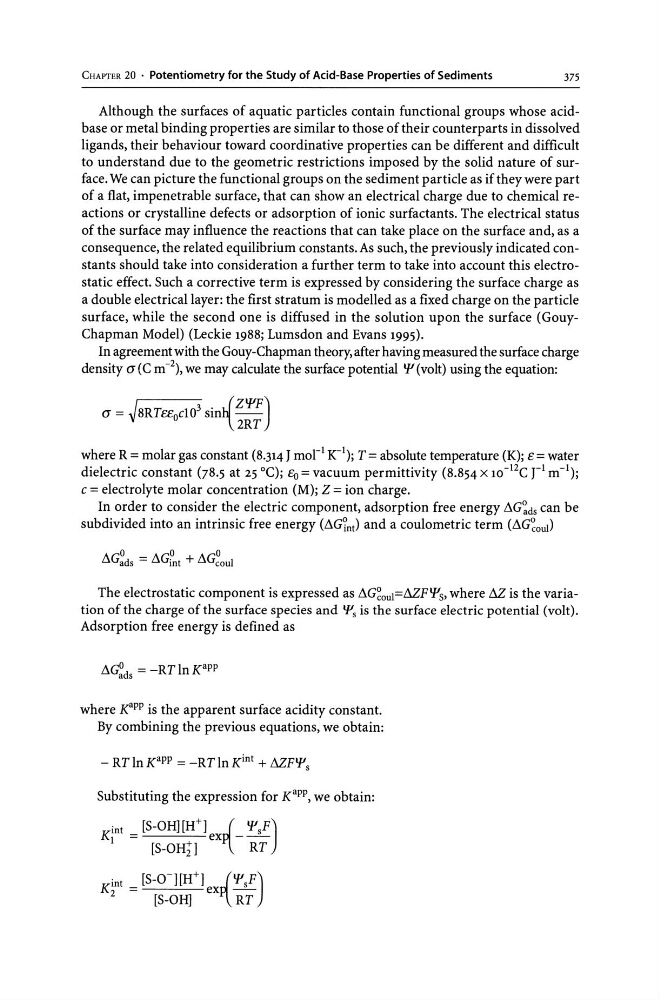
In agreement with the Gouy-Chapman theory, after having measured the surface charge
density cr(C m- 2 ), we may calculate the surface potential P (volt) using the equation:
where R = molar gas constant (8.314 J mor l K- I ); T = absolute temperature (K); £ = water
dielectric constant (78.5 at 25°C); £0 = vacuum permittivity (8.854 x 1O-12C rl m- I );
c = electrolyte molar concentration (M); Z = ion charge.
In order to consider the electric component, adsorption free energy LlG~ds can be
subdivided into an intrinsic free energy (LlG7nt) and a coulometric term (LlG~oul)
The electrostatic component is expressed as LlG~oul=LlZFPs, where LlZ is the variation of the charge of the surface species and tps is the surface electric potential (volt).
Adsorption free energy is defined as
where ]("pp is the apparent surface acidity constant.
By combining the previous equations, we obtain:
- RTlnKapp = -RTlnKint + LlZFP s
Substituting the expression for KaPP, we obtain:
375
Although the surfaces of aquatic particles contain functional groups whose acidbase or metal binding properties are similar to those of their counterparts in dissolved
ligands, their behaviour toward coordinative properties can be different and difficult
to understand due to the geometric restrictions imposed by the solid nature of surface. We can picture the functional groups on the sediment particle as if they were part
of a flat, impenetrable surface, that can show an electrical charge due to chemical reactions or crystalline defects or adsorption of ionic surfactants. The electrical status
of the surface may influence the reactions that can take place on the surface and, as a
consequence, the related equilibrium constants. As such, the previously indicated constants should take into consideration a further term to take into account this electrostatic effect. Such a corrective term is expressed by considering the surface charge as
a double electrical layer: the first stratum is modelled as a fixed charge on the particle
surface, while the second one is diffused in the solution upon the surface (GouyChapman Model) (Leckie 1988; Lumsdon and Evans 1995).
In agreement with the Gouy-Chapman theory, after having measured the surface charge
density cr(C m- 2 ), we may calculate the surface potential P (volt) using the equation:
where R = molar gas constant (8.314 J mor l K- I ); T = absolute temperature (K); £ = water
dielectric constant (78.5 at 25°C); £0 = vacuum permittivity (8.854 x 1O-12C rl m- I );
c = electrolyte molar concentration (M); Z = ion charge.
In order to consider the electric component, adsorption free energy LlG~ds can be
subdivided into an intrinsic free energy (LlG7nt) and a coulometric term (LlG~oul)
The electrostatic component is expressed as LlG~oul=LlZFPs, where LlZ is the variation of the charge of the surface species and tps is the surface electric potential (volt).
Adsorption free energy is defined as
where ]("pp is the apparent surface acidity constant.
By combining the previous equations, we obtain:
- RTlnKapp = -RTlnKint + LlZFP s
Substituting the expression for KaPP, we obtain: