

CHAPTER 17 • Characterization of Marine Toxins with LC-ESI-MS
327
poor instrument performance, since MS-MS experiments generally allow higher SIN
ratio than single MS mode, due to dramatic reduction of the chemical noise. Satisfactory performance of the MS-MS approach was confirmed by the lower detection limits obtained from this method (IS ppb on the extract) (Draisci et al.1998b) than in the
single MS mode (Pleasance et al. 1992b). Quantitation of DSP toxins was executed either by external calibration (Draisci et al. 1998b) or with a synthesized internal standard (7-0-acetyl-OA) (Quilliam 1995).
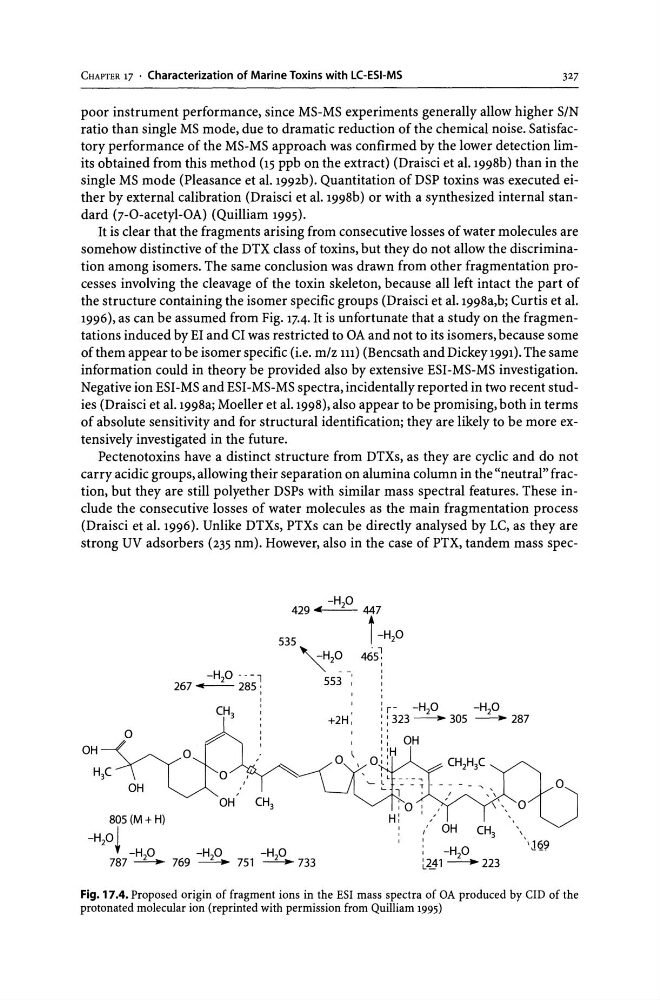
It is clear that the fragments arising from consecutive losses of water molecules are
somehow distinctive of the DTX class of toxins, but they do not allow the discrimination among isomers. The same conclusion was drawn from other fragmentation processes involving the cleavage of the toxin skeleton, because all left intact the part of
the structure containing the isomer specific groups (Draisci et al. 1998a,b; Curtis et al.
1996), as can be assumed from Fig. 17-4- It is unfortunate that a study on the fragmentations induced by EI and CI was restricted to OA and not to its isomers, because some
of them appear to be isomer specific (Le. mlz m) (Bencsath and Dickey 1991). The same
information could in theory be provided also by extensive ESI-MS-MS investigation.
Negative ion ESI-MS and ESI-MS-MS spectra, incidentally reported in two recent studies (Draisci et al. 1998a; Moeller et al.1998), also appear to be promising, both in terms
of absolute sensitivity and for structural identification; they are likely to be more extensively investigated in the future.
Pectenotoxins have a distinct structure from DTXs, as they are cyclic and do not
carry acidic groups, allowing their separation on alumina column in the "neutral" fraction, but they are still polyether DSPs with similar mass spectral features. These include the consecutive losses of water molecules as the main fragmentation process
(Draisci et al. 1996). Unlike DTXs, PTXs can be directly analysed by LC, as they are
strong Uv adsorbers (235 nm). However, also in the case of PTX, tandem mass spec-H 0
429.c---.L- 447
535
267~i85~ ,
o:~o~,!
3
V
dH 00~
OH' CH 3
805 (M+H)
-H20!
~H2~_
553 :
-HO
-HO
-HO
787 ~ 769 ~ 751 ~ 733
t -H20
465:
r- -H 2 0
-Hp
:323-305 - 2 8 7
,
;
-H 2 0
~~1-223
Fig. 17.4. Proposed origin of fragment ions in the ESI mass spectra of OA produced by cm of the
protonated molecular ion (reprinted with permission from Qui1liam 1995)
327
poor instrument performance, since MS-MS experiments generally allow higher SIN
ratio than single MS mode, due to dramatic reduction of the chemical noise. Satisfactory performance of the MS-MS approach was confirmed by the lower detection limits obtained from this method (IS ppb on the extract) (Draisci et al.1998b) than in the
single MS mode (Pleasance et al. 1992b). Quantitation of DSP toxins was executed either by external calibration (Draisci et al. 1998b) or with a synthesized internal standard (7-0-acetyl-OA) (Quilliam 1995).
It is clear that the fragments arising from consecutive losses of water molecules are
somehow distinctive of the DTX class of toxins, but they do not allow the discrimination among isomers. The same conclusion was drawn from other fragmentation processes involving the cleavage of the toxin skeleton, because all left intact the part of
the structure containing the isomer specific groups (Draisci et al. 1998a,b; Curtis et al.
1996), as can be assumed from Fig. 17-4- It is unfortunate that a study on the fragmentations induced by EI and CI was restricted to OA and not to its isomers, because some
of them appear to be isomer specific (Le. mlz m) (Bencsath and Dickey 1991). The same
information could in theory be provided also by extensive ESI-MS-MS investigation.
Negative ion ESI-MS and ESI-MS-MS spectra, incidentally reported in two recent studies (Draisci et al. 1998a; Moeller et al.1998), also appear to be promising, both in terms
of absolute sensitivity and for structural identification; they are likely to be more extensively investigated in the future.
Pectenotoxins have a distinct structure from DTXs, as they are cyclic and do not
carry acidic groups, allowing their separation on alumina column in the "neutral" fraction, but they are still polyether DSPs with similar mass spectral features. These include the consecutive losses of water molecules as the main fragmentation process
(Draisci et al. 1996). Unlike DTXs, PTXs can be directly analysed by LC, as they are
strong Uv adsorbers (235 nm). However, also in the case of PTX, tandem mass spec-H 0
429.c---.L- 447
535
267~i85~ ,
o:~o~,!
3
V
dH 00~
OH' CH 3
805 (M+H)
-H20!
~H2~_
553 :
-HO
-HO
-HO
787 ~ 769 ~ 751 ~ 733
t -H20
465:
r- -H 2 0
-Hp
:323-305 - 2 8 7
,
;
-H 2 0
~~1-223
Fig. 17.4. Proposed origin of fragment ions in the ESI mass spectra of OA produced by cm of the
protonated molecular ion (reprinted with permission from Qui1liam 1995)