

32 6
M. Vincenti . A. Irico
et all 1995; Draisci et al. 1998a) and m/z 1 015, 1 041, 1 043, 1 057, 1 069 for DTX-3 (a mixture of fatty acid esters of OA and DTX-1, possibly produced by shellfish as toxin metabolites) (Marr et all 1992). Various degrees of fragmentation could be obtained by
collision induced dissociation either by raising the voltage of the skimmer without
preliminary parent ion selection (Quilliam 1995) or by introducing an inert gas in the
central quadrupole of a triple quadrupole instrument, running in the MS-MS mode.
In the first case, the masses of some fragment ions could be added to the SIM mass
sequence in order to confirm the toxin determination, ruling out the chance of false
positive identification. A higher degree of selectivity was obtained by tandem mass
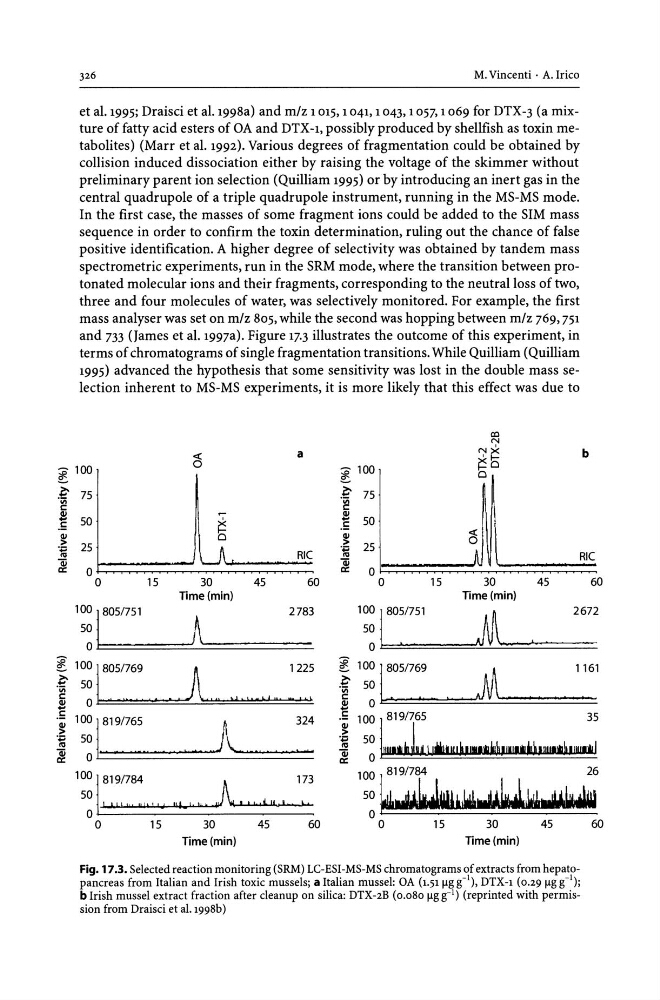
spectrometric experiments, run in the SRM mode, where the transition between protonated molecular ions and their fragments, corresponding to the neutral loss of two,
three and four molecules of water, was selectively monitored. For example, the first
mass analyser was set on m/z 805, while the second was hopping between m/z 769,751
and 733 (James et all 1997a). Figure 17.3 illustrates the outcome of this experiment, in
terms of chromatograms of single fragmentation transitions. While Quilliam (Quilliam
1995) advanced the hypothesis that some sensitivity was lost in the double mass selection inherent to MS-MS experiments, it is more likely that this effect was due to
a:l
N
a
b
C5
~g
~loo
~ 100
Q
.~ 75
.~ 75
'"
'"
c
c
!! 50
g
!! 50
.5
.5
~
.~
C5
.~
25
RIC
25
~
~
RIC
0
0
0
15
30
45
60
0
15
30
45
60
Time (min)
Time (min)
1~: j805/751
2783
1~: j80~/751
JJ\
2672
A
~ ,00 1 8051769
"A
1225
~ 100 1
8051769
JJ\
1161
'0;;
50
'0;;
50
jj 0
I . .
) J . ,
LI"
• ,! l
jj O '
t
. 5
.~
III
~
'~ I"W765
324
.5 100 t: 91765
35
)lOOt
~
...
III
5~'kJU Ui'I!I~,"'.UJI'III'ikhl'II*~llIugJ
~
'~I ::~~~"" ·
173
1 00 819/784
26
,1\, II ~"
5~~1~~
"'
Il'b
.. ""
0
15
30
45
60
0
15
30
45
60
Time (min)
Time (min)
Fig. 17.3. Selected reaction monitoring (SRM) LC-ESI-MS-MS chromatograms of extracts from hepatopancreas from Italian and Irish toxic mussels; a Italian mussel: OA (1.51 flgg- 1 ), DTX-1 (0.29 flgg- 1 );
b Irish mussel extract fraction after cleanup on silica: DTX-2B (0.080 flg g-l) (reprinted with permission from Draisci et al.1998b)
M. Vincenti . A. Irico
et all 1995; Draisci et al. 1998a) and m/z 1 015, 1 041, 1 043, 1 057, 1 069 for DTX-3 (a mixture of fatty acid esters of OA and DTX-1, possibly produced by shellfish as toxin metabolites) (Marr et all 1992). Various degrees of fragmentation could be obtained by
collision induced dissociation either by raising the voltage of the skimmer without
preliminary parent ion selection (Quilliam 1995) or by introducing an inert gas in the
central quadrupole of a triple quadrupole instrument, running in the MS-MS mode.
In the first case, the masses of some fragment ions could be added to the SIM mass
sequence in order to confirm the toxin determination, ruling out the chance of false
positive identification. A higher degree of selectivity was obtained by tandem mass
spectrometric experiments, run in the SRM mode, where the transition between protonated molecular ions and their fragments, corresponding to the neutral loss of two,
three and four molecules of water, was selectively monitored. For example, the first
mass analyser was set on m/z 805, while the second was hopping between m/z 769,751
and 733 (James et all 1997a). Figure 17.3 illustrates the outcome of this experiment, in
terms of chromatograms of single fragmentation transitions. While Quilliam (Quilliam
1995) advanced the hypothesis that some sensitivity was lost in the double mass selection inherent to MS-MS experiments, it is more likely that this effect was due to
a:l
N
a
b
C5
~g
~loo
~ 100
Q
.~ 75
.~ 75
'"
'"
c
c
!! 50
g
!! 50
.5
.5
~
.~
C5
.~
25
RIC
25
~
~
RIC
0
0
0
15
30
45
60
0
15
30
45
60
Time (min)
Time (min)
1~: j805/751
2783
1~: j80~/751
JJ\
2672
A
~ ,00 1 8051769
"A
1225
~ 100 1
8051769
JJ\
1161
'0;;
50
'0;;
50
jj 0
I . .
) J . ,
LI"
• ,! l
jj O '
t
. 5
.~
III
~
'~ I"W765
324
.5 100 t: 91765
35
)lOOt
~
...
III
5~'kJU Ui'I!I~,"'.UJI'III'ikhl'II*~llIugJ
~
'~I ::~~~"" ·
173
1 00 819/784
26
,1\, II ~"
5~~1~~
"'
Il'b
.. ""
0
15
30
45
60
0
15
30
45
60
Time (min)
Time (min)
Fig. 17.3. Selected reaction monitoring (SRM) LC-ESI-MS-MS chromatograms of extracts from hepatopancreas from Italian and Irish toxic mussels; a Italian mussel: OA (1.51 flgg- 1 ), DTX-1 (0.29 flgg- 1 );
b Irish mussel extract fraction after cleanup on silica: DTX-2B (0.080 flg g-l) (reprinted with permission from Draisci et al.1998b)