

328
M. Vincenti . A. Irico
trometry proved much superior to uv -spectrophotometry in terms of sensitivity and
selectivity.
17.3
Brevetoxins
Other cyclic polyether toxins are brevetoxins, which are produced by the marine dinoflagellate Gymnodinium breve, a toxicogenic single-cell organism whose uncontrolled growth (or bloom) produces a calamitous phenomenon called "red tide"
(Yasumoto 1990). Brevetoxins are the toxic agents of these red tides, which cause massive fish kills, shellfish contamination and various health effects on mammals and
humans, including severe respiratory problems and eye and skin irritation. At least
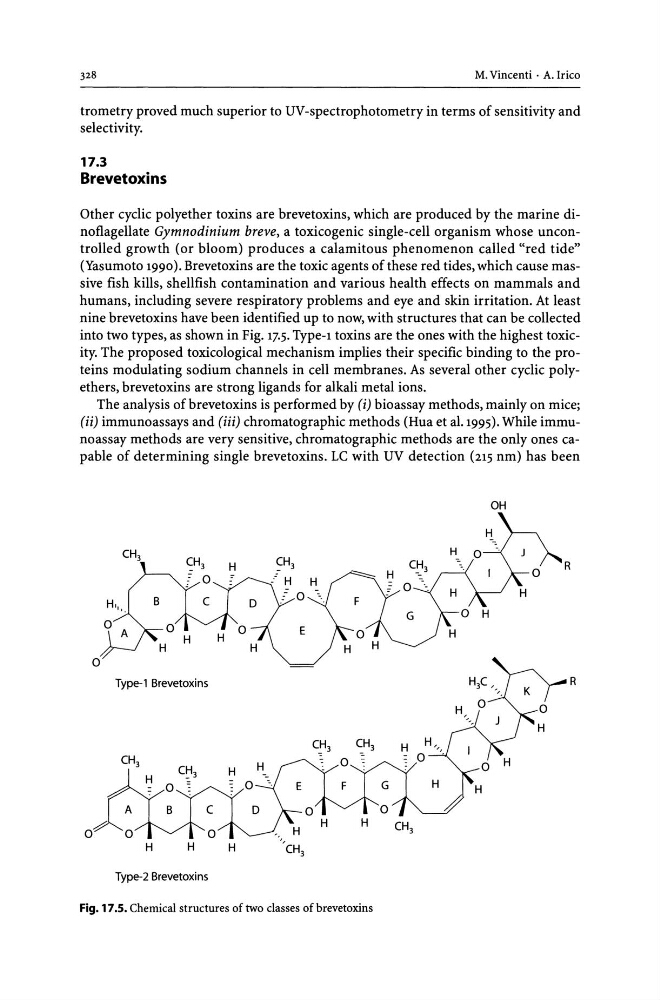
nine brevetoxins have been identified up to now, with structures that can be collected
into two types, as shown in Fig. 17.5. Type-1 toxins are the ones with the highest toxicity. The proposed toxicological mechanism implies their specific binding to the proteins modulating sodium channels in cell membranes. As several other cyclic polyethers, brevetoxins are strong ligands for alkali metal ions.
The analysis of brevetoxins is performed by (i) bioassay methods, mainly on mice;
(ii) immunoassays and (iii) chromatographic methods (Hua et al. 1995). While immunoassay methods are very sensitive, chromatographic methods are the only ones capable of determining single brevetoxins. LC with UV detection (215 nm) has been
OH
R
Type-l Brevetoxins
R
H
H
H
Type-2 Brevetoxins
Fig. 17.5. Chemical structures of two classes of brevetoxins
M. Vincenti . A. Irico
trometry proved much superior to uv -spectrophotometry in terms of sensitivity and
selectivity.
17.3
Brevetoxins
Other cyclic polyether toxins are brevetoxins, which are produced by the marine dinoflagellate Gymnodinium breve, a toxicogenic single-cell organism whose uncontrolled growth (or bloom) produces a calamitous phenomenon called "red tide"
(Yasumoto 1990). Brevetoxins are the toxic agents of these red tides, which cause massive fish kills, shellfish contamination and various health effects on mammals and
humans, including severe respiratory problems and eye and skin irritation. At least
nine brevetoxins have been identified up to now, with structures that can be collected
into two types, as shown in Fig. 17.5. Type-1 toxins are the ones with the highest toxicity. The proposed toxicological mechanism implies their specific binding to the proteins modulating sodium channels in cell membranes. As several other cyclic polyethers, brevetoxins are strong ligands for alkali metal ions.
The analysis of brevetoxins is performed by (i) bioassay methods, mainly on mice;
(ii) immunoassays and (iii) chromatographic methods (Hua et al. 1995). While immunoassay methods are very sensitive, chromatographic methods are the only ones capable of determining single brevetoxins. LC with UV detection (215 nm) has been
OH
R
Type-l Brevetoxins
R
H
H
H
Type-2 Brevetoxins
Fig. 17.5. Chemical structures of two classes of brevetoxins