

CHAPTER 10 • Occurence, Pathways and Bioaccumulation of Organometallic Compounds
203
Table 10.1. Acute toxicity values of tributyltin oxide (TBTO) for non target organism (from UNEP 1988,
modified)
Test organism
TBTO concentration in water (lJg r')
Effect
Algae
Ske/etonema costatum
0.1
No growth
Mollusks (bivalves)
Crassostrea gigas (larvae)
1.6
48-h LCSO
Crassostrea gigas (adult)
1800
48-h LCSO
Myti/us edu/is(larvae)
2.3
48-h LCSO
Myti/us edu/is (adult)
300
48-h LCSO
Crustaceans
Acanthomysis scu/pta (juveniles)
0.42
96-h LCSO
Arcantia tonsa (adult)
1.1
48-h LCSO
Crangon crangon (adult)
41
96-h LCSO
Fish
So/ea so/ea (larvae)
8.5
48-h LCSO
So/ea so/ea (adult)
88
48-h LCSO
atmosphere
5n4+
water
sediment
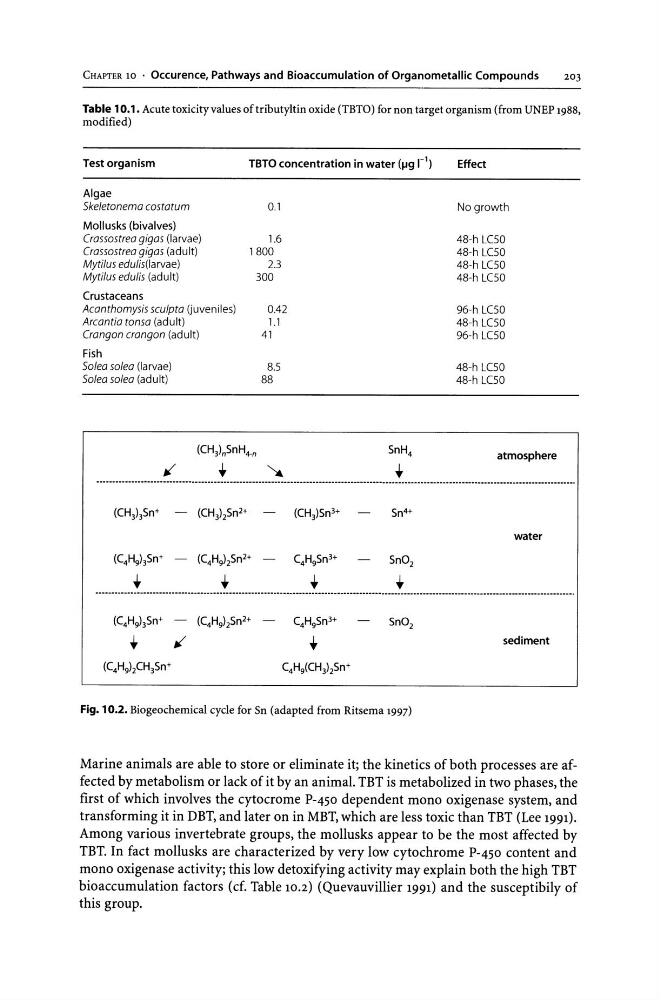
Fig. 10.2. Biogeochemical cycle for Sn (adapted from Ritsema 1997)
Marine animals are able to store or eliminate it; the kinetics of both processes are affected by metabolism or lack of it by an animal. TBT is metabolized in two phases, the
first of which involves the cytocrome P-450 dependent mono oxigenase system, and
transforming it in DBT, and later on in MBT, which are less toxic than TBT (Lee 1991).
Among various invertebrate groups, the mollusks appear to be the most affected by
TBT. In fact mollusks are characterized by very low cytochrome P-450 content and
mono oxigenase activity; this low detoxifying activity may explain both the high TBT
bioaccumulation factors (cf. Table 10.2) (Quevauvillier 1991) and the susceptibily of
this group.
203
Table 10.1. Acute toxicity values of tributyltin oxide (TBTO) for non target organism (from UNEP 1988,
modified)
Test organism
TBTO concentration in water (lJg r')
Effect
Algae
Ske/etonema costatum
0.1
No growth
Mollusks (bivalves)
Crassostrea gigas (larvae)
1.6
48-h LCSO
Crassostrea gigas (adult)
1800
48-h LCSO
Myti/us edu/is(larvae)
2.3
48-h LCSO
Myti/us edu/is (adult)
300
48-h LCSO
Crustaceans
Acanthomysis scu/pta (juveniles)
0.42
96-h LCSO
Arcantia tonsa (adult)
1.1
48-h LCSO
Crangon crangon (adult)
41
96-h LCSO
Fish
So/ea so/ea (larvae)
8.5
48-h LCSO
So/ea so/ea (adult)
88
48-h LCSO
atmosphere
5n4+
water
sediment
Fig. 10.2. Biogeochemical cycle for Sn (adapted from Ritsema 1997)
Marine animals are able to store or eliminate it; the kinetics of both processes are affected by metabolism or lack of it by an animal. TBT is metabolized in two phases, the
first of which involves the cytocrome P-450 dependent mono oxigenase system, and
transforming it in DBT, and later on in MBT, which are less toxic than TBT (Lee 1991).
Among various invertebrate groups, the mollusks appear to be the most affected by
TBT. In fact mollusks are characterized by very low cytochrome P-450 content and
mono oxigenase activity; this low detoxifying activity may explain both the high TBT
bioaccumulation factors (cf. Table 10.2) (Quevauvillier 1991) and the susceptibily of
this group.