

202
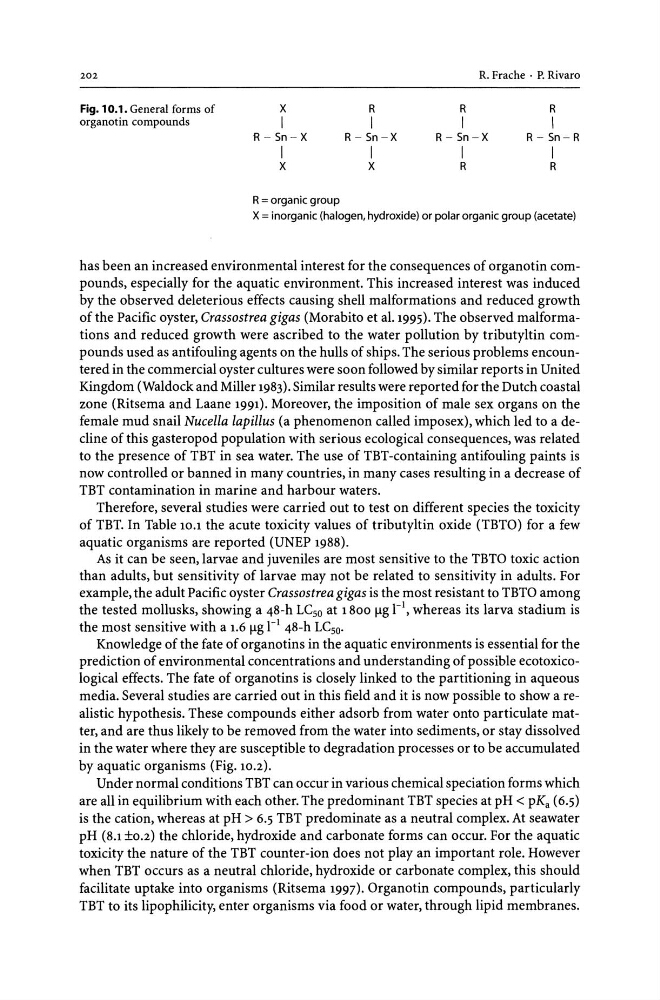
Fig. 10.1. General forms of
organotin compounds
x
I
R-Sn-X
I
X
R = organic group
R
I
R - Sn-X
I
X
R. Frache . P. Rivaro
R
I
R-Sn-X
I
R
R
I
R - Sn- R
I
R
X = inorganic (halogen, hydroxide) or polar organic group (acetate)
has been an increased environmental interest for the consequences of organotin compounds, especially for the aquatic environment. This increased interest was induced
by the observed deleterious effects causing shell malformations and reduced growth
of the Pacific oyster, Crassostrea gigas (Morabito et al. 1995). The observed malformations and reduced growth were ascribed to the water pollution by tributyltin compounds used as antifouling agents on the hulls of ships. The serious problems encountered in the commercial oyster cultures were soon followed by similar reports in United
Kingdom (Waldock and Miller 19B3). Similar results were reported for the Dutch coastal
zone (Ritsema and Laane 1991). Moreover, the imposition of male sex organs on the
female mud snail Nucella lapillus (a phenomenon called imposex), which led to a decline of this gasteropod population with serious ecological consequences, was related
to the presence of TBT in sea water. The use of TBT-containing antifouling paints is
now controlled or banned in many countries, in many cases resulting in a decrease of
TBT contamination in marine and harbour waters.
Therefore, several studies were carried out to test on different species the toxicity
of TBT. In Table 10.1 the acute toxicity values of tributyltin oxide (TBTO) for a few
aquatic organisms are reported (UNEP 19BB).
As it can be seen, larvae and juveniles are most sensitive to the TBTO toxic action
than adults, but sensitivity of larvae may not be related to sensitivity in adults. For
example, the adult Pacific oyster Crassostrea gigas is the most resistant to TBTO among
the tested mollusks, showing a 4B-h LCso at 1 Boo flg rl, whereas its larva stadium is
the most sensitive with a 1.6 flg rl 4B-h LC so •
Knowledge of the fate of organotins in the aquatic environments is essential for the
prediction of environmental concentrations and understanding of possible ecotoxicological effects. The fate of organotins is closely linked to the partitioning in aqueous
media. Several studies are carried out in this field and it is now possible to show a realistic hypothesis. These compounds either adsorb from water onto particulate matter, and are thus likely to be removed from the water into sediments, or stay dissolved
in the water where they are susceptible to degradation processes or to be accumulated
by aquatic organisms (Fig. 10.2).
Under normal conditions TBT can occur in various chemical speciation forms which
are all in equilibrium with each other. The predominant TBT species at pH < pKa (6.5)
is the cation, whereas at pH > 6.5 TBT predominate as a neutral complex. At seawater
pH (B.1 ±0.2) the chloride, hydroxide and carbonate forms can occur. For the aquatic
toxicity the nature of the TBT counter-ion does not play an important role. However
when TBT occurs as a neutral chloride, hydroxide or carbonate complex, this should
facilitate uptake into organisms (Ritsema 1997). Organotin compounds, particularly
TBT to its lipophilicity, enter organisms via food or water, through lipid membranes.
Fig. 10.1. General forms of
organotin compounds
x
I
R-Sn-X
I
X
R = organic group
R
I
R - Sn-X
I
X
R. Frache . P. Rivaro
R
I
R-Sn-X
I
R
R
I
R - Sn- R
I
R
X = inorganic (halogen, hydroxide) or polar organic group (acetate)
has been an increased environmental interest for the consequences of organotin compounds, especially for the aquatic environment. This increased interest was induced
by the observed deleterious effects causing shell malformations and reduced growth
of the Pacific oyster, Crassostrea gigas (Morabito et al. 1995). The observed malformations and reduced growth were ascribed to the water pollution by tributyltin compounds used as antifouling agents on the hulls of ships. The serious problems encountered in the commercial oyster cultures were soon followed by similar reports in United
Kingdom (Waldock and Miller 19B3). Similar results were reported for the Dutch coastal
zone (Ritsema and Laane 1991). Moreover, the imposition of male sex organs on the
female mud snail Nucella lapillus (a phenomenon called imposex), which led to a decline of this gasteropod population with serious ecological consequences, was related
to the presence of TBT in sea water. The use of TBT-containing antifouling paints is
now controlled or banned in many countries, in many cases resulting in a decrease of
TBT contamination in marine and harbour waters.
Therefore, several studies were carried out to test on different species the toxicity
of TBT. In Table 10.1 the acute toxicity values of tributyltin oxide (TBTO) for a few
aquatic organisms are reported (UNEP 19BB).
As it can be seen, larvae and juveniles are most sensitive to the TBTO toxic action
than adults, but sensitivity of larvae may not be related to sensitivity in adults. For
example, the adult Pacific oyster Crassostrea gigas is the most resistant to TBTO among
the tested mollusks, showing a 4B-h LCso at 1 Boo flg rl, whereas its larva stadium is
the most sensitive with a 1.6 flg rl 4B-h LC so •
Knowledge of the fate of organotins in the aquatic environments is essential for the
prediction of environmental concentrations and understanding of possible ecotoxicological effects. The fate of organotins is closely linked to the partitioning in aqueous
media. Several studies are carried out in this field and it is now possible to show a realistic hypothesis. These compounds either adsorb from water onto particulate matter, and are thus likely to be removed from the water into sediments, or stay dissolved
in the water where they are susceptible to degradation processes or to be accumulated
by aquatic organisms (Fig. 10.2).
Under normal conditions TBT can occur in various chemical speciation forms which
are all in equilibrium with each other. The predominant TBT species at pH < pKa (6.5)
is the cation, whereas at pH > 6.5 TBT predominate as a neutral complex. At seawater
pH (B.1 ±0.2) the chloride, hydroxide and carbonate forms can occur. For the aquatic
toxicity the nature of the TBT counter-ion does not play an important role. However
when TBT occurs as a neutral chloride, hydroxide or carbonate complex, this should
facilitate uptake into organisms (Ritsema 1997). Organotin compounds, particularly
TBT to its lipophilicity, enter organisms via food or water, through lipid membranes.