

204
R. Frache . P. Rivaro
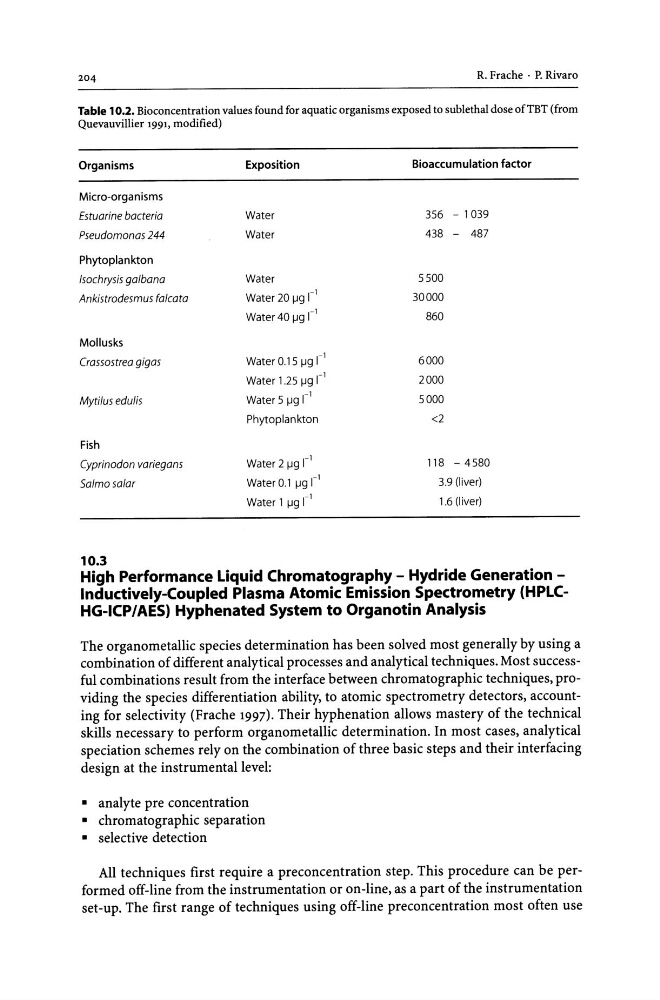
Table 10.2. Bioconcentration values found for aquatic organisms exposed to sublethal dose of TBT (from
Quevauvillier 1991, modified)
Organisms
Exposition
Bioaccumulation factor
Micro-organisms
Estuarine bacteria
Water
356 - 1039
Pseudomonas 244
Water
438 - 487
Phytoplankton
/sochrysis ga/bana
Water
5500
Ankistrodesmus fa/cata
Water 20 \J9 1- 1
30000
Water 40 \J9 1- 1
860
Mollusks
Crassostrea gigas
Water 0.15 \J9 1- 1
6000
Water 1.25 \J9 1- 1
2000
Myti/us edu/is
Water 5 \J9 1"-1
5000
Phytoplankton
<2
Fish
Cyprinodon variegans
Water 2 \J9 1- 1
118 - 4580
Sa/mosa/ar
Water 0.1 \J91-1
3.9 (liver)
Water 1 \J91-1
1.6 (liver)
10.3
High Performance Liquid Chromatography - Hydride Generation -
Inductively-Coupled Plasma Atomic Emission Spectrometry (HPLCHG-ICP/AES) Hyphenated System to Organotin Analysis
The organometallic species determination has been solved most generally by using a
combination of different analytical processes and analytical techniques. Most successful combinations result from the interface between chromatographic techniques, providing the species differentiation ability, to atomic spectrometry detectors, accounting for selectivity (Frache 1997). Their hyphenation allows mastery of the technical
skills necessary to perform organometallic determination. In most cases, analytical
speciation schemes rely on the combination of three basic steps and their interfacing
design at the instrumental level:
• analyte pre concentration
• chromatographic separation
• selective detection
All techniques first require a pre concentration step. This procedure can be performed off-line from the instrumentation or on-line, as a part of the instrumentation
set-up. The first range of techniques using off-line preconcentration most often use
R. Frache . P. Rivaro
Table 10.2. Bioconcentration values found for aquatic organisms exposed to sublethal dose of TBT (from
Quevauvillier 1991, modified)
Organisms
Exposition
Bioaccumulation factor
Micro-organisms
Estuarine bacteria
Water
356 - 1039
Pseudomonas 244
Water
438 - 487
Phytoplankton
/sochrysis ga/bana
Water
5500
Ankistrodesmus fa/cata
Water 20 \J9 1- 1
30000
Water 40 \J9 1- 1
860
Mollusks
Crassostrea gigas
Water 0.15 \J9 1- 1
6000
Water 1.25 \J9 1- 1
2000
Myti/us edu/is
Water 5 \J9 1"-1
5000
Phytoplankton
<2
Fish
Cyprinodon variegans
Water 2 \J9 1- 1
118 - 4580
Sa/mosa/ar
Water 0.1 \J91-1
3.9 (liver)
Water 1 \J91-1
1.6 (liver)
10.3
High Performance Liquid Chromatography - Hydride Generation -
Inductively-Coupled Plasma Atomic Emission Spectrometry (HPLCHG-ICP/AES) Hyphenated System to Organotin Analysis
The organometallic species determination has been solved most generally by using a
combination of different analytical processes and analytical techniques. Most successful combinations result from the interface between chromatographic techniques, providing the species differentiation ability, to atomic spectrometry detectors, accounting for selectivity (Frache 1997). Their hyphenation allows mastery of the technical
skills necessary to perform organometallic determination. In most cases, analytical
speciation schemes rely on the combination of three basic steps and their interfacing
design at the instrumental level:
• analyte pre concentration
• chromatographic separation
• selective detection
All techniques first require a pre concentration step. This procedure can be performed off-line from the instrumentation or on-line, as a part of the instrumentation
set-up. The first range of techniques using off-line preconcentration most often use