

C.M.G. van den Berg
This correction can be made by using iterative calculations, i.e. by first calculating
the complexation of a metal by the ligand using the total ligand concentration for [L']
and thereafter repeating this after substitution of [L t ] - [ML] for [L']. Alternatively the
correction can be made mathematically as shown in the section here.
The conditional stability constant is used to obtain a relationship with the free metal
ion concentration:
Substitution into the mass balance equations, and solving for [L'] gives
Here the free ligand concentration [L'] is calculated. This is substituted into Eq. 9.8
to obtain the value for aML:
Substitution into the mass balance of the metal (Eq. 9.10) and rearranging gives a
quadratic equation for [Mn+]:
The free metal ion concentration is then calculated from
where
• a = aM,KML
• b = aM + KMdLt] - KMdMt]
• C = -[Mt ]
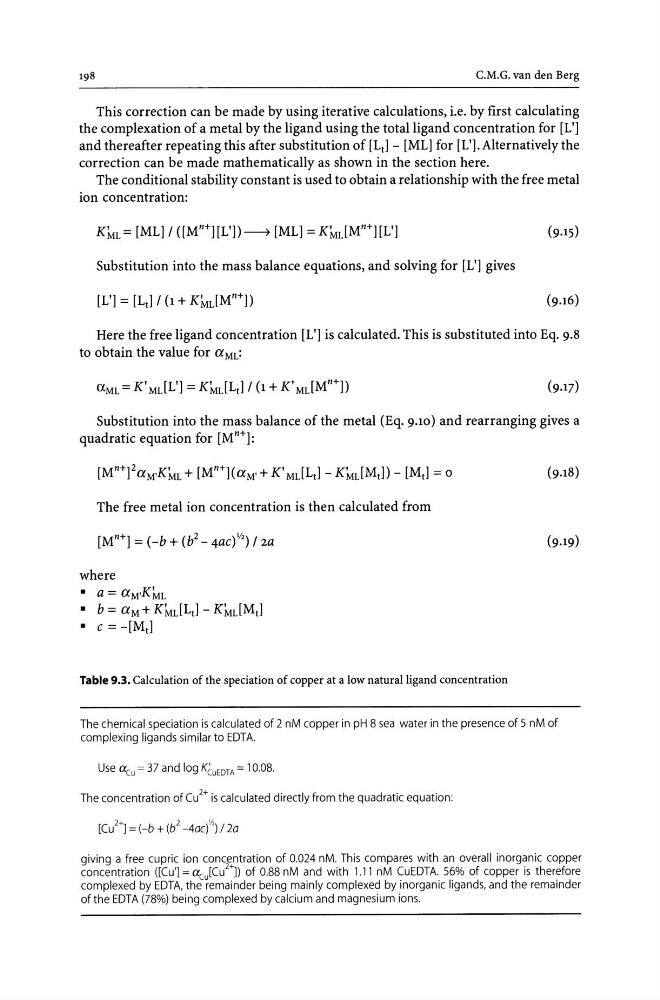
Table 9.3. Calculation of the speciation of copper at a low natural ligand concentration
The chemical speciation is calculated of 2 nM copper in pH 8 sea water in the presence of 5 nM of
complexing ligands similar to EDTA.
Use acu = 37 and log KCuEDTA = 10.08.
The concentration of Cu 2 + is calculated directly from the quadratic equation:
[Cu 2 +] = (-b + (b 2 -40d') / 20
giving a free cupric ion concentration of 0.024 nM. This compares with an overall inorganic copper
concentration ([Cu'] = a c )Cu 2 +]) of 0.88 nM and with 1.11 nM CuEDTA. 56% of copper is therefore
complexed by EDTA, the remainder being mainly complexed by inorganic ligands, and the remainder
of the EDTA (78%) being complexed by calcium and magnesium ions.
This correction can be made by using iterative calculations, i.e. by first calculating
the complexation of a metal by the ligand using the total ligand concentration for [L']
and thereafter repeating this after substitution of [L t ] - [ML] for [L']. Alternatively the
correction can be made mathematically as shown in the section here.
The conditional stability constant is used to obtain a relationship with the free metal
ion concentration:
Substitution into the mass balance equations, and solving for [L'] gives
Here the free ligand concentration [L'] is calculated. This is substituted into Eq. 9.8
to obtain the value for aML:
Substitution into the mass balance of the metal (Eq. 9.10) and rearranging gives a
quadratic equation for [Mn+]:
The free metal ion concentration is then calculated from
where
• a = aM,KML
• b = aM + KMdLt] - KMdMt]
• C = -[Mt ]
Table 9.3. Calculation of the speciation of copper at a low natural ligand concentration
The chemical speciation is calculated of 2 nM copper in pH 8 sea water in the presence of 5 nM of
complexing ligands similar to EDTA.
Use acu = 37 and log KCuEDTA = 10.08.
The concentration of Cu 2 + is calculated directly from the quadratic equation:
[Cu 2 +] = (-b + (b 2 -40d') / 20
giving a free cupric ion concentration of 0.024 nM. This compares with an overall inorganic copper
concentration ([Cu'] = a c )Cu 2 +]) of 0.88 nM and with 1.11 nM CuEDTA. 56% of copper is therefore
complexed by EDTA, the remainder being mainly complexed by inorganic ligands, and the remainder
of the EDTA (78%) being complexed by calcium and magnesium ions.