

CHAPTER 9 . Organic Complexation of Metals in Sea Water
199
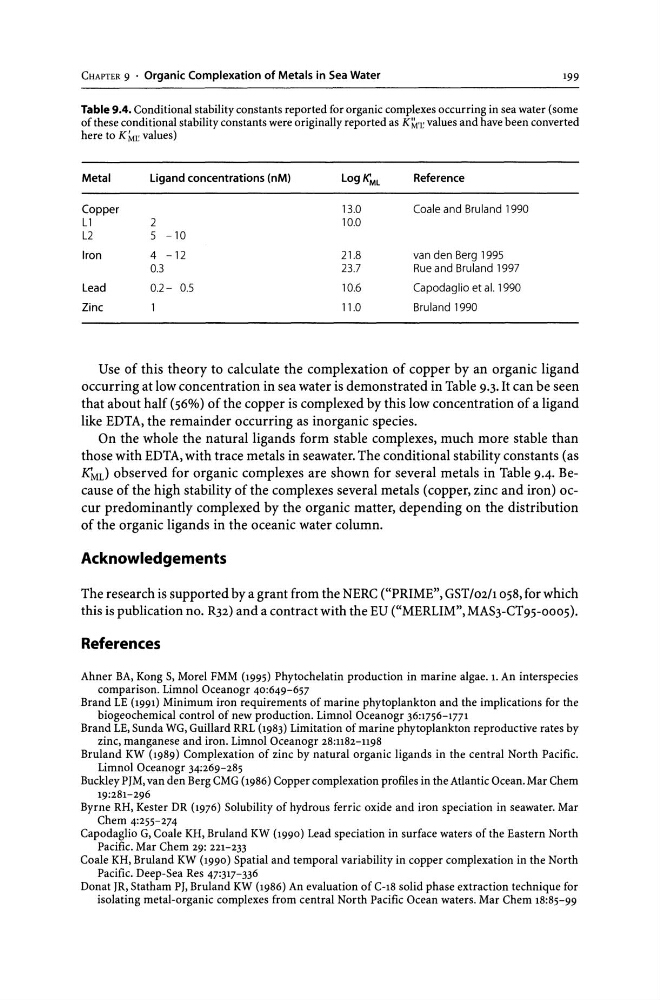
Table 9.4. Conditional stability constants reported for organic complexes occurring in sea water (some
of these conditional stability constants were originally reported as KJ:I'I! values and have been converted
here to K MC values)
Metal
Ligand concentrations (nM)
logK'ML
Reference
Copper
13.0
Coale and Bruland 1990
L1
2
10.0
L2
5 -10
Iron
4 -12
21.8
van den Berg 1995
0.3
23.7
Rue and Bruland 1997
lead
0.2- 0.5
10.6
Capodaglio et al. 1990
Zinc
11.0
Bruland 1990
Use of this theory to calculate the complexation of copper by an organic ligand
occurring at low concentration in sea water is demonstrated in Table 9.3. It can be seen
that about half (56%) of the copper is complexed by this low concentration of a ligand
like EDTA, the remainder occurring as inorganic species.
On the whole the natural ligands form stable complexes, much more stable than
those with EDTA, with trace metals in seawater. The conditional stability constants (as
K'ML) observed for organic complexes are shown for several metals in Table 9-4- Because of the high stability of the complexes several metals (copper, zinc and iron) occur predominantly complexed by the organic matter, depending on the distribution
of the organic ligands in the oceanic water column.
Acknowledgements
The research is supported by a grant from the NERC ("PRIME", GST /02/1 058, for which
this is publication no. R32) and a contract with the EU ("MERLIM", MAS3-CT95-0005).
References
Ahner BA, Kong S, Morel FMM (1995) Phytochelatin production in marine algae. 1. An interspecies
comparison. Limnol Oceanogr 40:649-657
Brand LE (1991) Minimum iron requirements of marine phytoplankton and the implications for the
biogeochemical control of new production. Limnol Oceanogr 36:1756-1771
Brand LE, Sunda WG, Guillard RRL (1983) Limitation of marine phytoplankton reproductive rates by
zinc, manganese and iron. Limnol Oceanogr 28:1182-1198
Bruland KW (1989) Complexation of zinc by natural organic ligands in the central North Pacific.
Limnol Oceanogr 34:269-285
Buckley PJM, van den Berg CMG (1986) Copper complexation profiles in the Atlantic Ocean. Mar Chern
19:281-296
Byrne RH, Kester DR (1976) Solubility of hydrous ferric oxide and iron speciation in seawater. Mar
Chern 4:255-274
Capodaglio G, Coale KH, Bruland KW (1990) Lead speciation in surface waters of the Eastern North
Pacific. Mar Chern 29: 221-233
Coale KH, Bruland KW (1990) Spatial and temporal variability in copper complexation in the North
Pacific. Deep-Sea Res 47:317-336
Donat JR, Statham PJ, Bruland KW (1986) An evaluation of C-18 solid phase extraction technique for
isolating metal-organic complexes from central North Pacific Ocean waters. Mar Chern 18:85-99
199
Table 9.4. Conditional stability constants reported for organic complexes occurring in sea water (some
of these conditional stability constants were originally reported as KJ:I'I! values and have been converted
here to K MC values)
Metal
Ligand concentrations (nM)
logK'ML
Reference
Copper
13.0
Coale and Bruland 1990
L1
2
10.0
L2
5 -10
Iron
4 -12
21.8
van den Berg 1995
0.3
23.7
Rue and Bruland 1997
lead
0.2- 0.5
10.6
Capodaglio et al. 1990
Zinc
11.0
Bruland 1990
Use of this theory to calculate the complexation of copper by an organic ligand
occurring at low concentration in sea water is demonstrated in Table 9.3. It can be seen
that about half (56%) of the copper is complexed by this low concentration of a ligand
like EDTA, the remainder occurring as inorganic species.
On the whole the natural ligands form stable complexes, much more stable than
those with EDTA, with trace metals in seawater. The conditional stability constants (as
K'ML) observed for organic complexes are shown for several metals in Table 9-4- Because of the high stability of the complexes several metals (copper, zinc and iron) occur predominantly complexed by the organic matter, depending on the distribution
of the organic ligands in the oceanic water column.
Acknowledgements
The research is supported by a grant from the NERC ("PRIME", GST /02/1 058, for which
this is publication no. R32) and a contract with the EU ("MERLIM", MAS3-CT95-0005).
References
Ahner BA, Kong S, Morel FMM (1995) Phytochelatin production in marine algae. 1. An interspecies
comparison. Limnol Oceanogr 40:649-657
Brand LE (1991) Minimum iron requirements of marine phytoplankton and the implications for the
biogeochemical control of new production. Limnol Oceanogr 36:1756-1771
Brand LE, Sunda WG, Guillard RRL (1983) Limitation of marine phytoplankton reproductive rates by
zinc, manganese and iron. Limnol Oceanogr 28:1182-1198
Bruland KW (1989) Complexation of zinc by natural organic ligands in the central North Pacific.
Limnol Oceanogr 34:269-285
Buckley PJM, van den Berg CMG (1986) Copper complexation profiles in the Atlantic Ocean. Mar Chern
19:281-296
Byrne RH, Kester DR (1976) Solubility of hydrous ferric oxide and iron speciation in seawater. Mar
Chern 4:255-274
Capodaglio G, Coale KH, Bruland KW (1990) Lead speciation in surface waters of the Eastern North
Pacific. Mar Chern 29: 221-233
Coale KH, Bruland KW (1990) Spatial and temporal variability in copper complexation in the North
Pacific. Deep-Sea Res 47:317-336
Donat JR, Statham PJ, Bruland KW (1986) An evaluation of C-18 solid phase extraction technique for
isolating metal-organic complexes from central North Pacific Ocean waters. Mar Chern 18:85-99