

CHAPTER 9 • Organic Complexation of Metals in Sea Water
197
and can be readily calculated. The concentration of M n + in the sea water is then calculated from
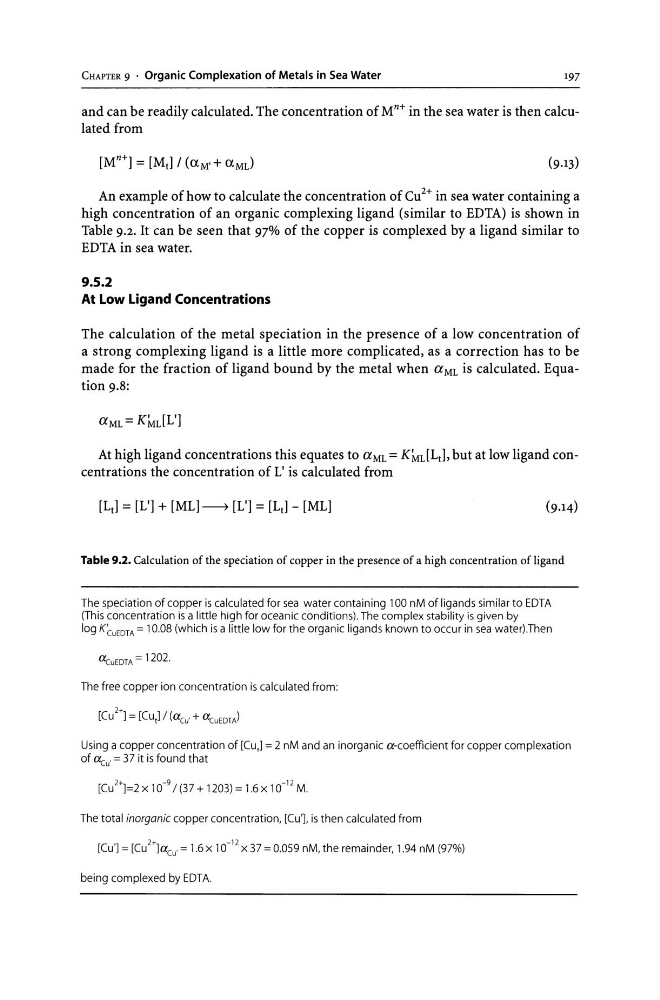
An example of how to calculate the concentration of Cu 2 + in sea water containing a
high concentration of an organic complexing ligand (similar to EDTA) is shown in
Table 9.2. It can be seen that 97% of the copper is complexed by a ligand similar to
EDTA in sea water.
9.5.2
At Low Ligand Concentrations
The calculation of the metal speciation in the presence of a low concentration of
a strong complexing ligand is a little more complicated, as a correction has to be
made for the fraction of ligand bound by the metal when aML is calculated. Equation 9.8:
At high ligand concentrations this equates to aML = KMdLt], but at low ligand concentrations the concentration of L' is calculated from
[Ltl = [L'] + [ML] ~ [L'] = [Lt ] - [ML]
Table 9.2. Calculation of the speciation of copper in the presence of a high concentration of ligand
The speciation of copper is calculated for sea water containing 100 nM of ligands similar to EDTA
(This concentration is a little high for oceanic conditions). The complex stability is given by
log K~uEDTA = 10.08 (which is a little low for the organic ligands known to occur in sea water).Then
acuEDTA = 1202.
The free copper ion concentration is calculated from:
Using a copper concentration of [Cu,] = 2 nM and an inorganic a-coefficient for copper complexation
of acu' = 37 it is found that
[Cu 2 +]=2 x 10- 9 / (37 + 1203) = 1.6 x 10- 12 M.
The total inorganic copper concentration, [Cul, is then calculated from
[Cu'] = [Cu 2 +]acu' = 1.6 xl 0- 12 x 37 = 0.059 nM, the remainder, 1.94 nM (97%)
being complexed by EDTA.
197
and can be readily calculated. The concentration of M n + in the sea water is then calculated from
An example of how to calculate the concentration of Cu 2 + in sea water containing a
high concentration of an organic complexing ligand (similar to EDTA) is shown in
Table 9.2. It can be seen that 97% of the copper is complexed by a ligand similar to
EDTA in sea water.
9.5.2
At Low Ligand Concentrations
The calculation of the metal speciation in the presence of a low concentration of
a strong complexing ligand is a little more complicated, as a correction has to be
made for the fraction of ligand bound by the metal when aML is calculated. Equation 9.8:
At high ligand concentrations this equates to aML = KMdLt], but at low ligand concentrations the concentration of L' is calculated from
[Ltl = [L'] + [ML] ~ [L'] = [Lt ] - [ML]
Table 9.2. Calculation of the speciation of copper in the presence of a high concentration of ligand
The speciation of copper is calculated for sea water containing 100 nM of ligands similar to EDTA
(This concentration is a little high for oceanic conditions). The complex stability is given by
log K~uEDTA = 10.08 (which is a little low for the organic ligands known to occur in sea water).Then
acuEDTA = 1202.
The free copper ion concentration is calculated from:
Using a copper concentration of [Cu,] = 2 nM and an inorganic a-coefficient for copper complexation
of acu' = 37 it is found that
[Cu 2 +]=2 x 10- 9 / (37 + 1203) = 1.6 x 10- 12 M.
The total inorganic copper concentration, [Cul, is then calculated from
[Cu'] = [Cu 2 +]acu' = 1.6 xl 0- 12 x 37 = 0.059 nM, the remainder, 1.94 nM (97%)
being complexed by EDTA.