

CHAPTER 9 . Organic Complexation of Metals in Sea Water
191
Fe and L(nM)
0
2
4
6
8
0
•
.." 't>
0
500
•
•
o
:g
1000
•
o
..r:. 1500
c..
•
o
OJ
Cl 2000
•
o
Fe
L
2500
•
0
a
3000
10
o
o
:g
..r:. .... c. OJ
Cl
o
Fe, L 1 and L2 (nM)
2
3
O-t--o~rr-~--.rr-~------j
.... 'Y!b L1
","
L2
. 0 " ,
500
•
' "
Fe
1000
•
' "
1500
2000
•
' "
b
2500
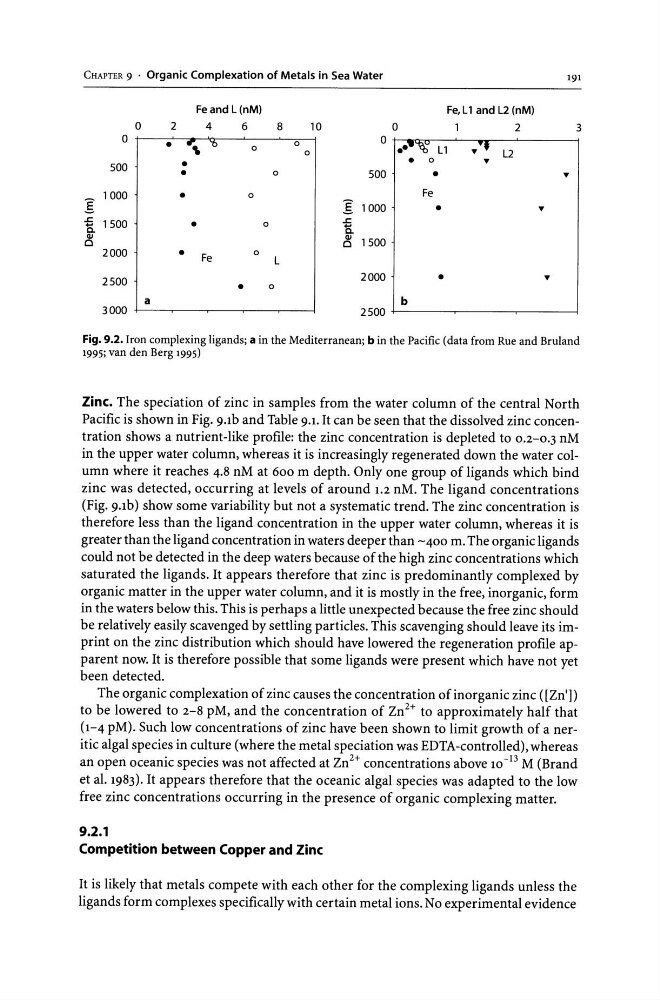
Fig. 9.2. Iron complexing ligands; a in the Mediterranean; b in the Pacific (data from Rue and Bruland
1995; van den Berg 1995)
Zinc. The speciation of zinc in samples from the water column of the central North
Pacific is shown in Fig. 9.1b and Table 9.1. It can be seen that the dissolved zinc concentration shows a nutrient-like profile: the zinc concentration is depleted to 0.2-0.3 nM
in the upper water column, whereas it is increasingly regenerated down the water column where it reaches 4.8 nM at 600 m depth. Only one group of ligands which bind
zinc was detected, occurring at levels of around 1.2 nM. The ligand concentrations
(Fig. 9.1b) show some variability but not a systematic trend. The zinc concentration is
therefore less than the ligand concentration in the upper water column, whereas it is
greater than the ligand concentration in waters deeper than -400 m. The organic ligands
could not be detected in the deep waters because of the high zinc concentrations which
saturated the ligands. It appears therefore that zinc is predominantly complexed by
organic matter in the upper water column, and it is mostly in the free, inorganic, form
in the waters below this. This is perhaps a little unexpected because the free zinc should
be relatively easily scavenged by settling particles. This scavenging should leave its imprint on the zinc distribution which should have lowered the regeneration profile apparent now. It is therefore possible that some ligands were present which have not yet
been detected.
The organic complexation of zinc causes the concentration of inorganic zinc ([ Zn' I)
to be lowered to 2-8 pM, and the concentration of Zn 2 + to approximately half that
(1-4 pM). Such low concentrations of zinc have been shown to limit growth of a neritic algal species in culture (where the metal speciation was EDTA-controlled), whereas
an open oceanic species was not affected at Zn2+ concentrations above 10 -13 M (Brand
et al. 1983). It appears therefore that the oceanic algal species was adapted to the low
free zinc concentrations occurring in the presence of organic complexing matter.
9.2.1
Competition between Copper and Zinc
It is likely that metals compete with each other for the complexing ligands unless the
ligands form complexes specifically with certain metal ions. No experimental evidence
191
Fe and L(nM)
0
2
4
6
8
0
•
.." 't>
0
500
•
•
o
:g
1000
•
o
..r:. 1500
c..
•
o
OJ
Cl 2000
•
o
Fe
L
2500
•
0
a
3000
10
o
o
:g
..r:. .... c. OJ
Cl
o
Fe, L 1 and L2 (nM)
2
3
O-t--o~rr-~--.rr-~------j
.... 'Y!b L1
","
L2
. 0 " ,
500
•
' "
Fe
1000
•
' "
1500
2000
•
' "
b
2500
Fig. 9.2. Iron complexing ligands; a in the Mediterranean; b in the Pacific (data from Rue and Bruland
1995; van den Berg 1995)
Zinc. The speciation of zinc in samples from the water column of the central North
Pacific is shown in Fig. 9.1b and Table 9.1. It can be seen that the dissolved zinc concentration shows a nutrient-like profile: the zinc concentration is depleted to 0.2-0.3 nM
in the upper water column, whereas it is increasingly regenerated down the water column where it reaches 4.8 nM at 600 m depth. Only one group of ligands which bind
zinc was detected, occurring at levels of around 1.2 nM. The ligand concentrations
(Fig. 9.1b) show some variability but not a systematic trend. The zinc concentration is
therefore less than the ligand concentration in the upper water column, whereas it is
greater than the ligand concentration in waters deeper than -400 m. The organic ligands
could not be detected in the deep waters because of the high zinc concentrations which
saturated the ligands. It appears therefore that zinc is predominantly complexed by
organic matter in the upper water column, and it is mostly in the free, inorganic, form
in the waters below this. This is perhaps a little unexpected because the free zinc should
be relatively easily scavenged by settling particles. This scavenging should leave its imprint on the zinc distribution which should have lowered the regeneration profile apparent now. It is therefore possible that some ligands were present which have not yet
been detected.
The organic complexation of zinc causes the concentration of inorganic zinc ([ Zn' I)
to be lowered to 2-8 pM, and the concentration of Zn 2 + to approximately half that
(1-4 pM). Such low concentrations of zinc have been shown to limit growth of a neritic algal species in culture (where the metal speciation was EDTA-controlled), whereas
an open oceanic species was not affected at Zn2+ concentrations above 10 -13 M (Brand
et al. 1983). It appears therefore that the oceanic algal species was adapted to the low
free zinc concentrations occurring in the presence of organic complexing matter.
9.2.1
Competition between Copper and Zinc
It is likely that metals compete with each other for the complexing ligands unless the
ligands form complexes specifically with certain metal ions. No experimental evidence