

192
C.M.G. van den Berg
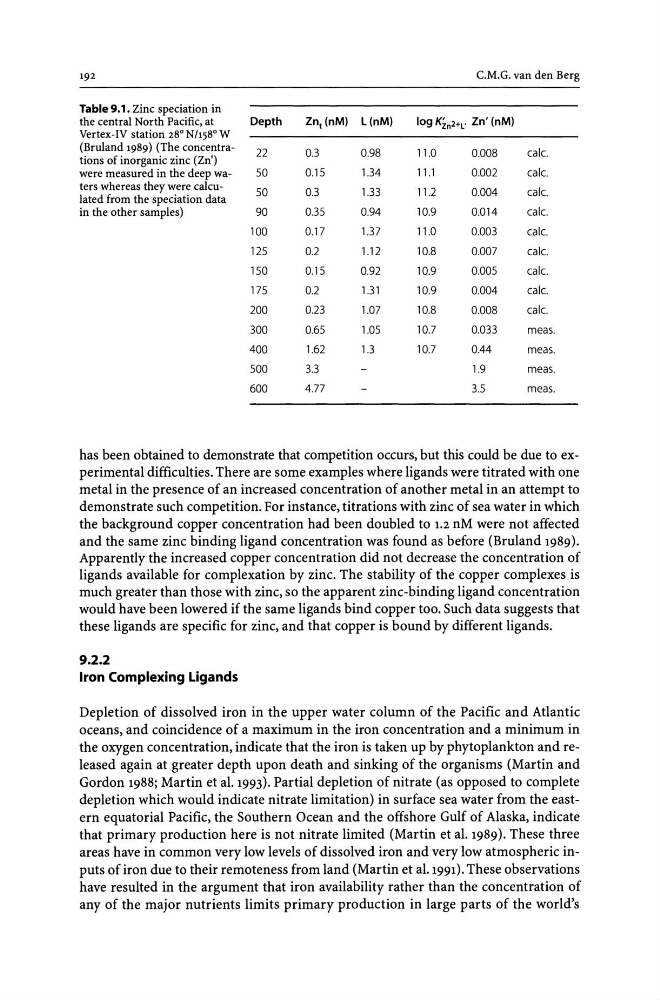
Table 9.1. Zinc speciation in
the central North Pacific, at
Depth
Znt(nM) l(nM)
log Kzn2+ L ' Zn' (nM)
Vertex-IV station 28°Nh58°W
(Bruland 1989) (The concentra22
OJ
0,98
11.0
0.008
calc.
tions of inorganic zinc (Zn')
were measured in the deep wa50
0.15
1.34
11.1
0.002
calc.
ters whereas they were calcu50
OJ
1.33
11.2
0.004
calc.
lated from the speciation data
in the other samples)
90
0035
0.94
10.9
0.014
calc.
100
0.17
1.37
11.0
0.003
calc.
125
0.2
1.12
10.8
0.007
calc.
150
0.15
0.92
10.9
0.005
calc.
175
0.2
1.31
10.9
0.004
calc.
200
0.23
1.07
10.8
0.008
calc.
300
0.65
1.05
10.7
0.033
meas.
400
1.62
1.3
10.7
0.44
meas.
500
303
1.9
meas.
600
4.77
3.5
meas.
has been obtained to demonstrate that competition occurs, but this could be due to experimental difficulties. There are some examples where ligands were titrated with one
metal in the presence of an increased concentration of another metal in an attempt to
demonstrate such competition. For instance, titrations with zinc of sea water in which
the background copper concentration had been doubled to 1.2 nM were not affected
and the same zinc binding ligand concentration was found as before (Bruland 1989).
Apparently the increased copper concentration did not decrease the concentration of
ligands available for complexation by zinc. The stability of the copper complexes is
much greater than those with zinc, so the apparent zinc-binding ligand concentration
would have been lowered if the same ligands bind copper too. Such data suggests that
these ligands are specific for zinc, and that copper is bound by different ligands.
9.2.2
Iron Complexing Ligands
Depletion of dissolved iron in the upper water column of the Pacific and Atlantic
oceans, and coincidence of a maximum in the iron concentration and a minimum in
the oxygen concentration, indicate that the iron is taken up by phytoplankton and released again at greater depth upon death and sinking of the organisms (Martin and
Gordon 1988; Martin et al. 1993). Partial depletion of nitrate (as opposed to complete
depletion which would indicate nitrate limitation) in surface sea water from the eastern equatorial Pacific, the Southern Ocean and the offshore Gulf of Alaska, indicate
that primary production here is not nitrate limited (Martin et al. 1989). These three
areas have in common very low levels of dissolved iron and very low atmospheric inputs of iron due to their remoteness from land (Martin et al.1991). These observations
have resulted in the argument that iron availability rather than the concentration of
any of the major nutrients limits primary production in large parts of the world's
C.M.G. van den Berg
Table 9.1. Zinc speciation in
the central North Pacific, at
Depth
Znt(nM) l(nM)
log Kzn2+ L ' Zn' (nM)
Vertex-IV station 28°Nh58°W
(Bruland 1989) (The concentra22
OJ
0,98
11.0
0.008
calc.
tions of inorganic zinc (Zn')
were measured in the deep wa50
0.15
1.34
11.1
0.002
calc.
ters whereas they were calcu50
OJ
1.33
11.2
0.004
calc.
lated from the speciation data
in the other samples)
90
0035
0.94
10.9
0.014
calc.
100
0.17
1.37
11.0
0.003
calc.
125
0.2
1.12
10.8
0.007
calc.
150
0.15
0.92
10.9
0.005
calc.
175
0.2
1.31
10.9
0.004
calc.
200
0.23
1.07
10.8
0.008
calc.
300
0.65
1.05
10.7
0.033
meas.
400
1.62
1.3
10.7
0.44
meas.
500
303
1.9
meas.
600
4.77
3.5
meas.
has been obtained to demonstrate that competition occurs, but this could be due to experimental difficulties. There are some examples where ligands were titrated with one
metal in the presence of an increased concentration of another metal in an attempt to
demonstrate such competition. For instance, titrations with zinc of sea water in which
the background copper concentration had been doubled to 1.2 nM were not affected
and the same zinc binding ligand concentration was found as before (Bruland 1989).
Apparently the increased copper concentration did not decrease the concentration of
ligands available for complexation by zinc. The stability of the copper complexes is
much greater than those with zinc, so the apparent zinc-binding ligand concentration
would have been lowered if the same ligands bind copper too. Such data suggests that
these ligands are specific for zinc, and that copper is bound by different ligands.
9.2.2
Iron Complexing Ligands
Depletion of dissolved iron in the upper water column of the Pacific and Atlantic
oceans, and coincidence of a maximum in the iron concentration and a minimum in
the oxygen concentration, indicate that the iron is taken up by phytoplankton and released again at greater depth upon death and sinking of the organisms (Martin and
Gordon 1988; Martin et al. 1993). Partial depletion of nitrate (as opposed to complete
depletion which would indicate nitrate limitation) in surface sea water from the eastern equatorial Pacific, the Southern Ocean and the offshore Gulf of Alaska, indicate
that primary production here is not nitrate limited (Martin et al. 1989). These three
areas have in common very low levels of dissolved iron and very low atmospheric inputs of iron due to their remoteness from land (Martin et al.1991). These observations
have resulted in the argument that iron availability rather than the concentration of
any of the major nutrients limits primary production in large parts of the world's