

CHAPTER 8 . Determination of Organic Complexation
177
metal complexes in addition to the free metal. The non-labile fraction is formed by
the more inert organic metal complexes. Therefore, using ASV the concentrations of
lead and cadmium can be subdivided into labile and non-labile species. This may be
sufficient for the purpose of your speciation study.
8.4
Principle of Adsorptive Cathodic Stripping Voltammetry
In cathodic stripping voltammetry (CSV) the element is reduced, instead of oxidized
as in ASV, during the potential scan. The pre concentration step typically involves adsorption of the element after complexation with a specific complexing ligand causing
the formation of a complex with adsorptive properties. Several ligands are available
for the pre concentration step including 8-hydroxyquinoline (van den Berg 1986), catechol (van den Berg 1984a), pyrrolidine dithiocarbamate (van den Berg 1984b) and
others, and some twenty elements can be determined by this technique (van den Berg
1991).
Prior to the metal determination a specific ligand is added (such as salicylaldoxime
for copper or iron, or nitrosonaphthol for iron (Yokoi and van den Berg 1992; Campos
and van den Berg 1994; Rue and Bruland 1995» which forms a complex with reactive
metal ions. The complex is allowed to adsorb on the electrode (usually a mercury drop
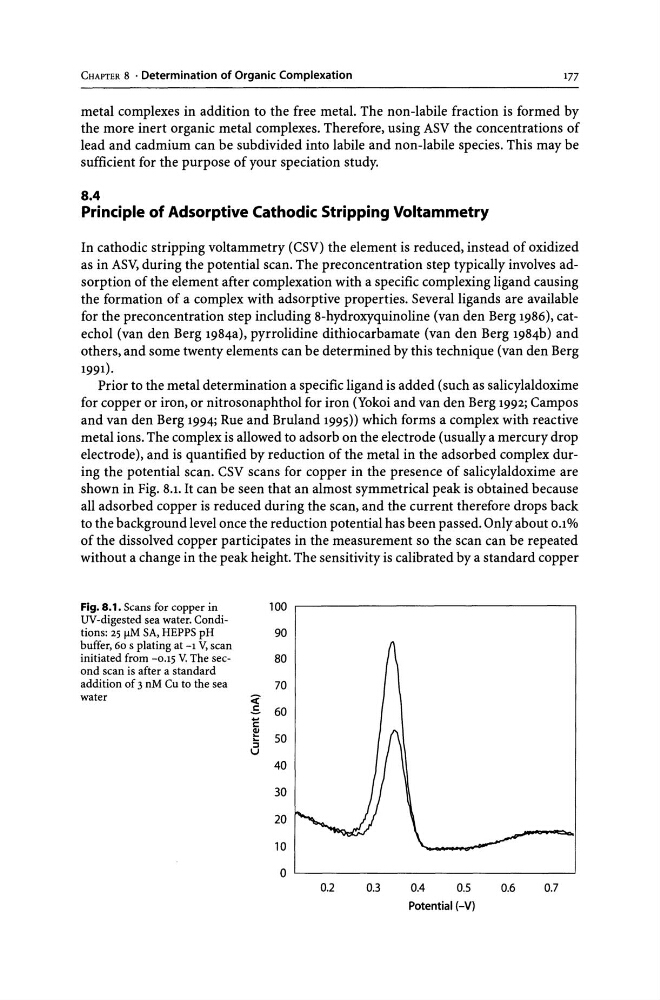
electrode), and is quantified by reduction of the metal in the adsorbed complex during the potential scan. CSV scans for copper in the presence of salicylaldoxime are
shown in Fig. 8.1. It can be seen that an almost symmetrical peak is obtained because
all adsorbed copper is reduced during the scan, and the current therefore drops back
to the background level once the reduction potential has been passed. Only about 0.1 %
of the dissolved copper participates in the measurement so the scan can be repeated
without a change in the peak height. The sensitivity is calibrated by a standard copper
Fig. 8.1. Scans for copper in
UV-digested sea water. Conditions: 25 11M SA, HEPPS pH
buffer, 60 s plating at -1 V, scan
initiated from -0.15 V. The second scan is after a standard
addition of 3 nM Cu to the sea
water
< oS ... c
~
....
:::I
U
100
90
80
70
60
50
40
30
20
10
0
0.2
0.3
0.4
0.5
0.6
0.7
Potential (-V)
177
metal complexes in addition to the free metal. The non-labile fraction is formed by
the more inert organic metal complexes. Therefore, using ASV the concentrations of
lead and cadmium can be subdivided into labile and non-labile species. This may be
sufficient for the purpose of your speciation study.
8.4
Principle of Adsorptive Cathodic Stripping Voltammetry
In cathodic stripping voltammetry (CSV) the element is reduced, instead of oxidized
as in ASV, during the potential scan. The pre concentration step typically involves adsorption of the element after complexation with a specific complexing ligand causing
the formation of a complex with adsorptive properties. Several ligands are available
for the pre concentration step including 8-hydroxyquinoline (van den Berg 1986), catechol (van den Berg 1984a), pyrrolidine dithiocarbamate (van den Berg 1984b) and
others, and some twenty elements can be determined by this technique (van den Berg
1991).
Prior to the metal determination a specific ligand is added (such as salicylaldoxime
for copper or iron, or nitrosonaphthol for iron (Yokoi and van den Berg 1992; Campos
and van den Berg 1994; Rue and Bruland 1995» which forms a complex with reactive
metal ions. The complex is allowed to adsorb on the electrode (usually a mercury drop
electrode), and is quantified by reduction of the metal in the adsorbed complex during the potential scan. CSV scans for copper in the presence of salicylaldoxime are
shown in Fig. 8.1. It can be seen that an almost symmetrical peak is obtained because
all adsorbed copper is reduced during the scan, and the current therefore drops back
to the background level once the reduction potential has been passed. Only about 0.1 %
of the dissolved copper participates in the measurement so the scan can be repeated
without a change in the peak height. The sensitivity is calibrated by a standard copper
Fig. 8.1. Scans for copper in
UV-digested sea water. Conditions: 25 11M SA, HEPPS pH
buffer, 60 s plating at -1 V, scan
initiated from -0.15 V. The second scan is after a standard
addition of 3 nM Cu to the sea
water
< oS ... c
~
....
:::I
U
100
90
80
70
60
50
40
30
20
10
0
0.2
0.3
0.4
0.5
0.6
0.7
Potential (-V)