

C.M.G. van den Berg
addition (in this case 3 nM was added) to the sample, followed by a repeat of the measurement.
The sensitivity of CSV is very high, allowing the determination of some twenty elements directly in sea water. For some metals (iron and cobalt for instance (Yokoi and
van den Berg 1992; Vega and van den Berg 1997» the sensitivity is enhanced using
catalysis: an oxidant is added to the seawater which reoxidizes the metal which is being reduced at the electrode, thus allowing a catalytic cycle to develop. Catalytic CSV
has detection limits at low pM to sub-pM levels for some metals.
8.5
Principle of Ligand Competition
Metals complexed by natural complexing ligands can be detected by adding a
complexing ligand (AL) which competes for the metal ions. The ligand addition causes
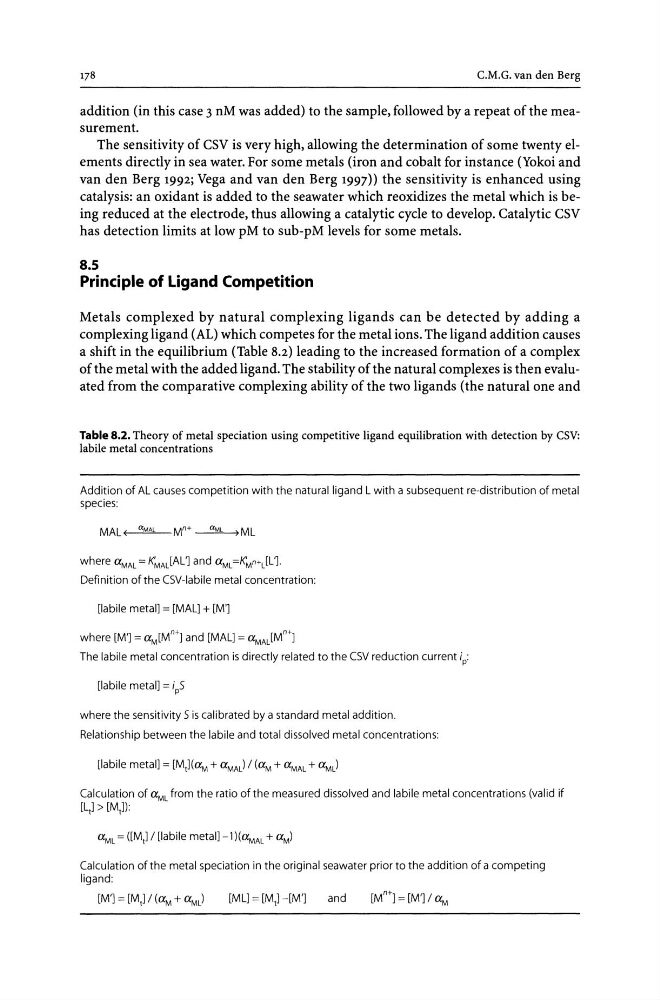
a shift in the equilibrium (Table 8.2) leading to the increased formation of a complex
of the metal with tlIe added ligand. The stability of the natural complexes is then evaluated from the comparative complexing ability of the two ligands (the natural one and
Table 8.2. Theory of metal speciation using competitive ligand equilibration with detection by CSV:
labile metal concentrations
Addition of AL causes competition with the natural ligand L with a subsequent re-distribution of metal
species:
where a MAl = K'MAl[AL'] and ~l=K'Mn+l[L'].
Definition ofthe CSV-Iabile metal concentration:
[labile metal] = [MAL] + [M']
where [M'] = aM[M n +] and [MAL] = aMAl[Mn+]
The labile metal concentration is directly related to the CSV reduction current ip:
[labile metal] = ipS
where the sensitivity S is calibrated by a standard metal addition.
Relationship between the labile and total dissolved metal concentrations:
Calculation of a Ml from the ratio ofthe measured dissolved and labile metal concentrations (valid if
[~]>[Mt]):
a Ml = ([M t ] / [labile metal] -1 )(aMAl + ~)
Calculation of the metal speciation in the original seawater prior to the addition of a competing
ligand:
[M1 = [M t ] / (aM + a Ml )
[ML] = [Mt]-[M'] and
[M n +] = [M'] / aM
addition (in this case 3 nM was added) to the sample, followed by a repeat of the measurement.
The sensitivity of CSV is very high, allowing the determination of some twenty elements directly in sea water. For some metals (iron and cobalt for instance (Yokoi and
van den Berg 1992; Vega and van den Berg 1997» the sensitivity is enhanced using
catalysis: an oxidant is added to the seawater which reoxidizes the metal which is being reduced at the electrode, thus allowing a catalytic cycle to develop. Catalytic CSV
has detection limits at low pM to sub-pM levels for some metals.
8.5
Principle of Ligand Competition
Metals complexed by natural complexing ligands can be detected by adding a
complexing ligand (AL) which competes for the metal ions. The ligand addition causes
a shift in the equilibrium (Table 8.2) leading to the increased formation of a complex
of the metal with tlIe added ligand. The stability of the natural complexes is then evaluated from the comparative complexing ability of the two ligands (the natural one and
Table 8.2. Theory of metal speciation using competitive ligand equilibration with detection by CSV:
labile metal concentrations
Addition of AL causes competition with the natural ligand L with a subsequent re-distribution of metal
species:
where a MAl = K'MAl[AL'] and ~l=K'Mn+l[L'].
Definition ofthe CSV-Iabile metal concentration:
[labile metal] = [MAL] + [M']
where [M'] = aM[M n +] and [MAL] = aMAl[Mn+]
The labile metal concentration is directly related to the CSV reduction current ip:
[labile metal] = ipS
where the sensitivity S is calibrated by a standard metal addition.
Relationship between the labile and total dissolved metal concentrations:
Calculation of a Ml from the ratio ofthe measured dissolved and labile metal concentrations (valid if
[~]>[Mt]):
a Ml = ([M t ] / [labile metal] -1 )(aMAl + ~)
Calculation of the metal speciation in the original seawater prior to the addition of a competing
ligand:
[M1 = [M t ] / (aM + a Ml )
[ML] = [Mt]-[M'] and
[M n +] = [M'] / aM