

C.M.G. van den Berg
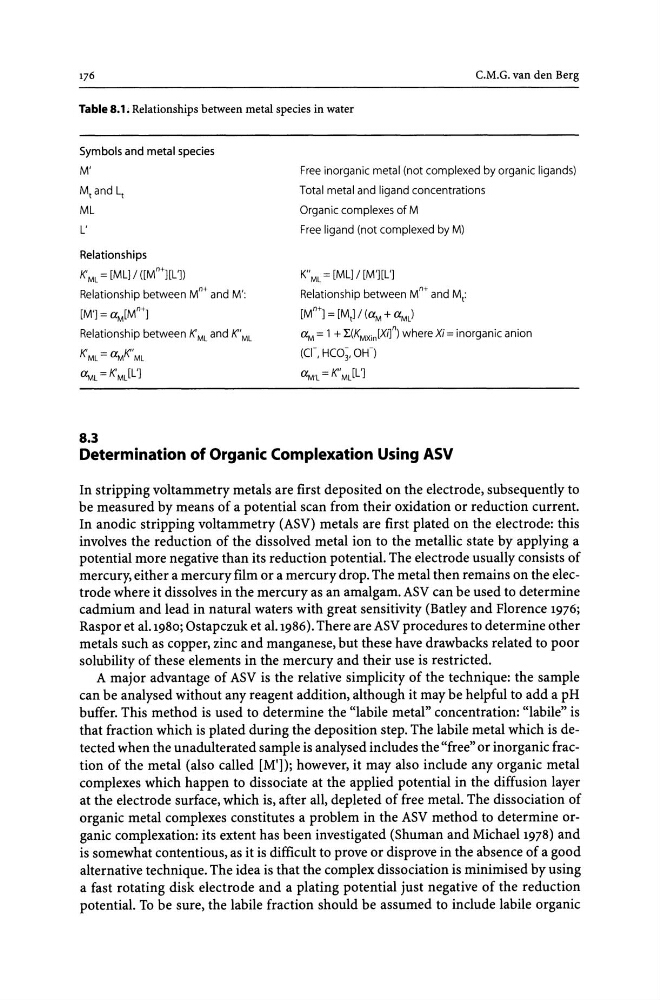
Table 8.1. Relationships between metal species in water
Symbols and metal species
M'
Mtand It
Ml
l'
Relationships
K'ML = [Ml] / ([MM] [l'])
Relationship between M n + and M':
[M'] = aM[M n +]
Relationship between K'ML and K"ML
K'ML = aMK" ML
a ML =K'ML[ll
8.3
Free inorganic metal (not complexed by organic ligands)
Total metal and ligand concentrations
Organic complexes of M
Free ligand (not complexed by M)
K"ML = [Ml] / [M'][l']
Relationship between M n + and M t :
[M n +] = [M t ] / (aM + aM)
aM = 1 + I(KMxin[Xnn) where Xi = inorganic anion
((1-, HCO;, OH-)
aM'L = K" ML [l']
Determination of Organic Complexation Using ASV
In stripping voltammetry metals are first deposited on the electrode, subsequently to
be measured by means of a potential scan from their oxidation or reduction current.
In anodic stripping voltammetry (ASV) metals are first plated on the electrode: this
involves the reduction of the dissolved metal ion to the metallic state by applying a
potential more negative than its reduction potential. The electrode usually consists of
mercury, either a mercury film or a mercury drop. The metal then remains on the electrode where it dissolves in the mercury as an amalgam. ASV can be used to determine
cadmium and lead in natural waters with great sensitivity (Batley and Florence 1976;
Raspor et al.1980; Ostapczuk et al.1986). There are ASV procedures to determine other
metals such as copper, zinc and manganese, but these have drawbacks related to poor
solubility of these elements in the mercury and their use is restricted.
A major advantage of ASV is the relative simplicity of the technique: the sample
can be analysed without any reagent addition, although it may be helpful to add a pH
buffer. This method is used to determine the "labile metal" concentration: "labile" is
that fraction which is plated during the deposition step. The labile metal which is detected when the unadulterated sample is analysed includes the "free" or inorganic fraction of the metal (also called [M'D; however, it may also include any organic metal
complexes which happen to dissociate at the applied potential in the diffusion layer
at the electrode surface, which is, after all, depleted of free metal. The dissociation of
organic metal complexes constitutes a problem in the ASV method to determine organic complexation: its extent has been investigated (Shuman and Michael 1978) and
is somewhat contentious, as it is difficult to prove or disprove in the absence of a good
alternative technique. The idea is that the complex dissociation is minimised by using
a fast rotating disk electrode and a plating potential just negative of the reduction
potential. To be sure, the labile fraction should be assumed to include labile organic
Table 8.1. Relationships between metal species in water
Symbols and metal species
M'
Mtand It
Ml
l'
Relationships
K'ML = [Ml] / ([MM] [l'])
Relationship between M n + and M':
[M'] = aM[M n +]
Relationship between K'ML and K"ML
K'ML = aMK" ML
a ML =K'ML[ll
8.3
Free inorganic metal (not complexed by organic ligands)
Total metal and ligand concentrations
Organic complexes of M
Free ligand (not complexed by M)
K"ML = [Ml] / [M'][l']
Relationship between M n + and M t :
[M n +] = [M t ] / (aM + aM)
aM = 1 + I(KMxin[Xnn) where Xi = inorganic anion
((1-, HCO;, OH-)
aM'L = K" ML [l']
Determination of Organic Complexation Using ASV
In stripping voltammetry metals are first deposited on the electrode, subsequently to
be measured by means of a potential scan from their oxidation or reduction current.
In anodic stripping voltammetry (ASV) metals are first plated on the electrode: this
involves the reduction of the dissolved metal ion to the metallic state by applying a
potential more negative than its reduction potential. The electrode usually consists of
mercury, either a mercury film or a mercury drop. The metal then remains on the electrode where it dissolves in the mercury as an amalgam. ASV can be used to determine
cadmium and lead in natural waters with great sensitivity (Batley and Florence 1976;
Raspor et al.1980; Ostapczuk et al.1986). There are ASV procedures to determine other
metals such as copper, zinc and manganese, but these have drawbacks related to poor
solubility of these elements in the mercury and their use is restricted.
A major advantage of ASV is the relative simplicity of the technique: the sample
can be analysed without any reagent addition, although it may be helpful to add a pH
buffer. This method is used to determine the "labile metal" concentration: "labile" is
that fraction which is plated during the deposition step. The labile metal which is detected when the unadulterated sample is analysed includes the "free" or inorganic fraction of the metal (also called [M'D; however, it may also include any organic metal
complexes which happen to dissociate at the applied potential in the diffusion layer
at the electrode surface, which is, after all, depleted of free metal. The dissociation of
organic metal complexes constitutes a problem in the ASV method to determine organic complexation: its extent has been investigated (Shuman and Michael 1978) and
is somewhat contentious, as it is difficult to prove or disprove in the absence of a good
alternative technique. The idea is that the complex dissociation is minimised by using
a fast rotating disk electrode and a plating potential just negative of the reduction
potential. To be sure, the labile fraction should be assumed to include labile organic