

162
M.R. Preston
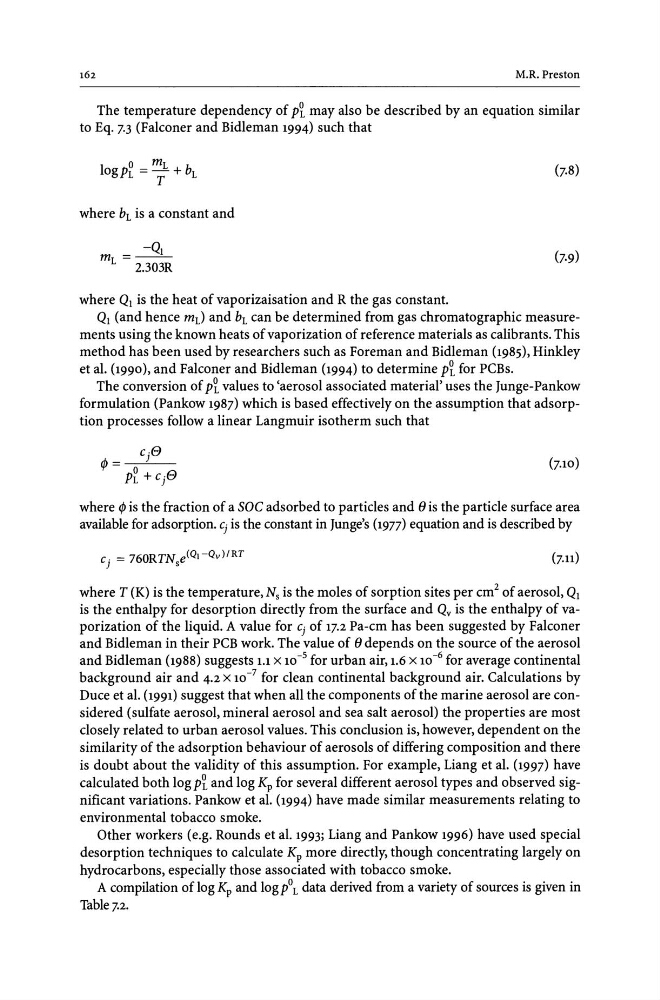
The temperature dependency of p~ may also be described by an equation similar
to Eq. 7.3 (Falconer and Bidleman 1994) such that
where bL is a constant and
-QJ
m - - -
L - 2.303R
where QJ is the heat of vaporizaisation and R the gas constant.
QJ (and hence mL) and bL can be determined from gas chromatographic measurements using the known heats of vaporization of reference materials as calibrants. This
method has been used by researchers such as Foreman and Bidleman (1985), Hinkley
et al. (1990), and Falconer and Bidleman (1994) to determine p~ for PCBs.
The conversion of p~ values to 'aerosol associated material' uses the Junge-Pankow
formulation (Pankow 1987) which is based effectively on the assumption that adsorption processes follow a linear Langmuir isotherm such that
c·B
cfJ =
J
p~ + cjB
where cfJ is the fraction of a SOC adsorbed to particles and (J is the particle surface area
available for adsorption. Cj is the constant in Junge's (1977) equation and is described by
where T (K) is the temperature, Ns is the moles of sorption sites per cm 2 of aerosol, QJ
is the enthalpy for desorption directly from the surface and Qv is the enthalpy of vaporization of the liquid. A value for Cj of 17.2 Pa-cm has been suggested by Falconer
and Bidleman in their PCB work. The value of (J depends on the source of the aerosol
and Bidleman (1988) suggests 1.1 x 10- 5 for urban air, 1.6 x 10- 6 for average continental
background air and 4.2 x 10- 7 for clean continental background air. Calculations by
Duce et al. (1991) suggest that when all the components of the marine aerosol are considered (sulfate aerosol, mineral aerosol and sea salt aerosol) the properties are most
closely related to urban aerosol values. This conclusion is, however, dependent on the
similarity of the adsorption behaviour of aerosols of differing composition and there
is doubt about the validity of this assumption. For example, Liang et al. (1997) have
calculated both logp~ and log Kp for several different aerosol types and observed significant variations. Pankow et al. (1994) have made similar measurements relating to
environmental tobacco smoke.
Other workers (e.g. Rounds et al. 1993; Liang and Pankow 1996) have used special
desorption techniques to calculate Kp more directly, though concentrating largely on
hydrocarbons, especially those associated with tobacco smoke.
A compilation of log Kp and log l L data derived from a variety of sources is given in
Table 7.2.
M.R. Preston
The temperature dependency of p~ may also be described by an equation similar
to Eq. 7.3 (Falconer and Bidleman 1994) such that
where bL is a constant and
-QJ
m - - -
L - 2.303R
where QJ is the heat of vaporizaisation and R the gas constant.
QJ (and hence mL) and bL can be determined from gas chromatographic measurements using the known heats of vaporization of reference materials as calibrants. This
method has been used by researchers such as Foreman and Bidleman (1985), Hinkley
et al. (1990), and Falconer and Bidleman (1994) to determine p~ for PCBs.
The conversion of p~ values to 'aerosol associated material' uses the Junge-Pankow
formulation (Pankow 1987) which is based effectively on the assumption that adsorption processes follow a linear Langmuir isotherm such that
c·B
cfJ =
J
p~ + cjB
where cfJ is the fraction of a SOC adsorbed to particles and (J is the particle surface area
available for adsorption. Cj is the constant in Junge's (1977) equation and is described by
where T (K) is the temperature, Ns is the moles of sorption sites per cm 2 of aerosol, QJ
is the enthalpy for desorption directly from the surface and Qv is the enthalpy of vaporization of the liquid. A value for Cj of 17.2 Pa-cm has been suggested by Falconer
and Bidleman in their PCB work. The value of (J depends on the source of the aerosol
and Bidleman (1988) suggests 1.1 x 10- 5 for urban air, 1.6 x 10- 6 for average continental
background air and 4.2 x 10- 7 for clean continental background air. Calculations by
Duce et al. (1991) suggest that when all the components of the marine aerosol are considered (sulfate aerosol, mineral aerosol and sea salt aerosol) the properties are most
closely related to urban aerosol values. This conclusion is, however, dependent on the
similarity of the adsorption behaviour of aerosols of differing composition and there
is doubt about the validity of this assumption. For example, Liang et al. (1997) have
calculated both logp~ and log Kp for several different aerosol types and observed significant variations. Pankow et al. (1994) have made similar measurements relating to
environmental tobacco smoke.
Other workers (e.g. Rounds et al. 1993; Liang and Pankow 1996) have used special
desorption techniques to calculate Kp more directly, though concentrating largely on
hydrocarbons, especially those associated with tobacco smoke.
A compilation of log Kp and log l L data derived from a variety of sources is given in
Table 7.2.