

CHAPTER 7 . Vapour·Particie Phase Interactions of Organic Pollutants in the Marine Atmosphere
161
nochlorines (pesticides and PCBs). Chen (1997) has calculated ranges of mr and br of
-0.671 to -1.186 and -3.209 to -7.658 respectively for a variety of structurally related
azaarene species.
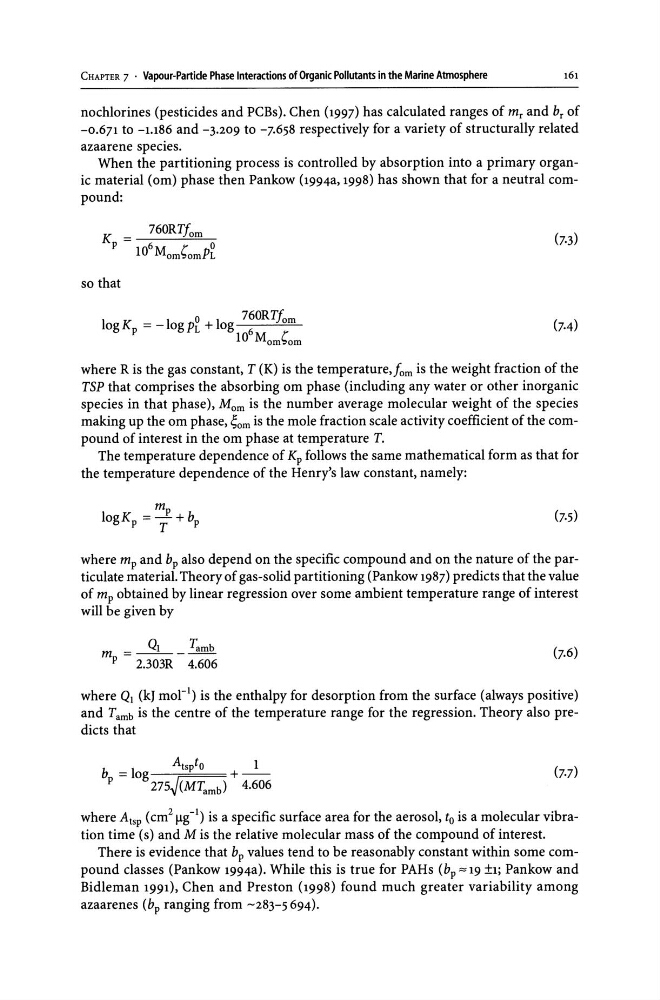
When the partitioning process is controlled by absorption into a primary organic material (om) phase then Pankow (1994a, 1998) has shown that for a neutral compound:
so that
760RTj.
logKp = -logp~ +log 6
om
10 MomS-om
where R is the gas constant, T (K) is the temperature,fom is the weight fraction of the
TSP that comprises the absorbing om phase (including any water or other inorganic
species in that phase), Mom is the number average molecular weight of the species
making up the om phase, ~om is the mole fraction scale activity coefficient of the compound of interest in the om phase at temperature T.
The temperature dependence of Kp follows the same mathematical form as that for
the temperature dependence of the Henry's law constant, namely:
where mp and b p also depend on the specific compound and on the nature of the particulate material. Theory of gas-solid partitioning (Pankow 1987) predicts that the value
of mp obtained by linear regression over some ambient temperature range of interest
will be given by
Q1
Tamb
m = - - - - -
p 2.303R 4.606
where Q1 (kJ mor l ) is the enthalpy for desorption from the surface (always positive)
and Tamb is the centre of the temperature range for the regression. Theory also predicts that
where A tsp (cm2Ilg-l) is a specific surface area for the aerosol, to is a molecular vibration time (s) and M is the relative molecular mass of the compound of interest.
There is evidence that b p values tend to be reasonably constant within some compound classes (Pankow 1994a). While this is true for PAHs (b p z 19 ±1; Pankow and
Bidleman 1991), Chen and Preston (1998) found much greater variability among
azaarenes (b p ranging from -283-5694).
161
nochlorines (pesticides and PCBs). Chen (1997) has calculated ranges of mr and br of
-0.671 to -1.186 and -3.209 to -7.658 respectively for a variety of structurally related
azaarene species.
When the partitioning process is controlled by absorption into a primary organic material (om) phase then Pankow (1994a, 1998) has shown that for a neutral compound:
so that
760RTj.
logKp = -logp~ +log 6
om
10 MomS-om
where R is the gas constant, T (K) is the temperature,fom is the weight fraction of the
TSP that comprises the absorbing om phase (including any water or other inorganic
species in that phase), Mom is the number average molecular weight of the species
making up the om phase, ~om is the mole fraction scale activity coefficient of the compound of interest in the om phase at temperature T.
The temperature dependence of Kp follows the same mathematical form as that for
the temperature dependence of the Henry's law constant, namely:
where mp and b p also depend on the specific compound and on the nature of the particulate material. Theory of gas-solid partitioning (Pankow 1987) predicts that the value
of mp obtained by linear regression over some ambient temperature range of interest
will be given by
Q1
Tamb
m = - - - - -
p 2.303R 4.606
where Q1 (kJ mor l ) is the enthalpy for desorption from the surface (always positive)
and Tamb is the centre of the temperature range for the regression. Theory also predicts that
where A tsp (cm2Ilg-l) is a specific surface area for the aerosol, to is a molecular vibration time (s) and M is the relative molecular mass of the compound of interest.
There is evidence that b p values tend to be reasonably constant within some compound classes (Pankow 1994a). While this is true for PAHs (b p z 19 ±1; Pankow and
Bidleman 1991), Chen and Preston (1998) found much greater variability among
azaarenes (b p ranging from -283-5694).