

CHAPTER 7 . Vapour-Particle Phase Interactions of Organic Pollutants in the Marine Atmosphere
7.2.2
Gas-Liquid Interactions
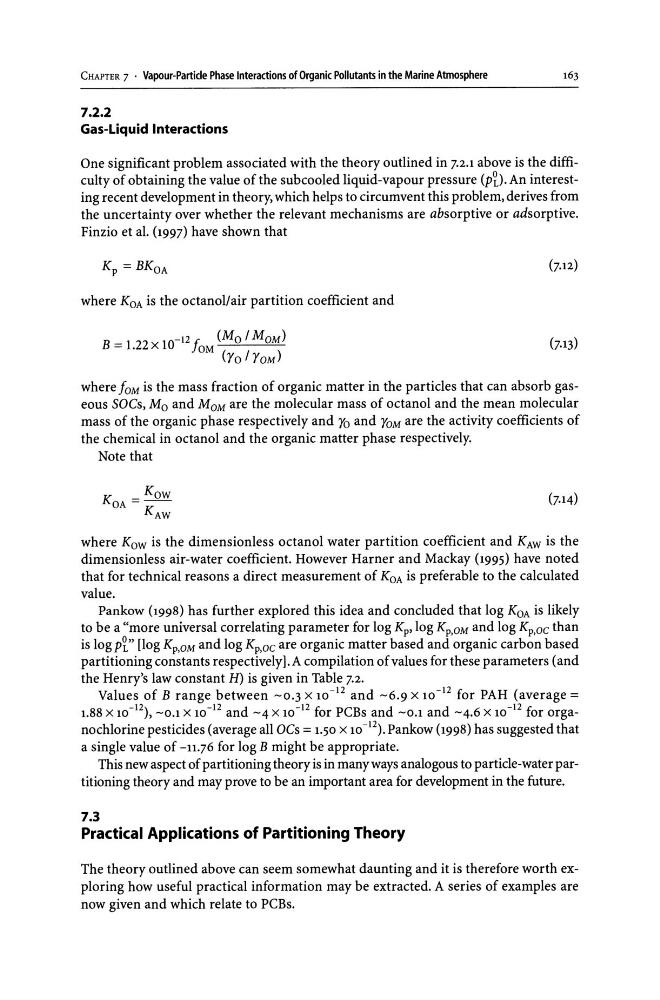
One significant problem associated with the theory outlined in 7.2.1 above is the difficulty of obtaining the value of the subcooled liquid-vapour pressure (p~). An interesting recent development in theory, which helps to circumvent this problem, derives from
the uncertainty over whether the relevant mechanisms are absorptive or adsorptive.
Finzio et al. (1997) have shown that
where KOA is the octanollair partition coefficient and
where JaM is the mass fraction of organic matter in the particles that can absorb gaseous SOCs, Mo and MOM are the molecular mass of octanol and the mean molecular
mass of the organic phase respectively and Yo and YOM are the activity coefficients of
the chemical in octanol and the organic matter phase respectively.
Note that
where Kow is the dimensionless octanol water partition coefficient and KAW is the
dimensionless air-water coefficient. However Harner and Mackay (1995) have noted
that for technical reasons a direct measurement of KOA is preferable to the calculated
value.
Pankow (1998) has further explored this idea and concluded that log KOA is likely
to be a "more universal correlating parameter for log Kp, log Kp,OM and log Kp,oc than
is logp~" [log Kp,OM and log Kp,oc are organic matter based and organic carbon based
partitioning constants respectively J. A compilation of values for these parameters (and
the Henry's law constant H) is given in Table 7-2.
Values of B range between -0.3 x 10- 12 and -6.9 x 10- 12 for PAH (average =
1.88 x 10- 12 ), -0.1 x 10- 12 and -4 x 10- 12 for PCBs and -0.1 and -4.6 x 10- 12 for organochlorine pesticides (average all OCs = 1.50 x 10- 12 ). Pankow (1998) has suggested that
a single value of -11.76 for log B might be appropriate.
This new aspect of partitioning theory is in many ways analogous to particle-water partitioning theory and may prove to be an important area for development in the future.
7.3
Practical Applications of Partitioning Theory
The theory outlined above can seem somewhat daunting and it is therefore worth exploring how useful practical information may be extracted. A series of examples are
now given and which relate to PCBs.
7.2.2
Gas-Liquid Interactions
One significant problem associated with the theory outlined in 7.2.1 above is the difficulty of obtaining the value of the subcooled liquid-vapour pressure (p~). An interesting recent development in theory, which helps to circumvent this problem, derives from
the uncertainty over whether the relevant mechanisms are absorptive or adsorptive.
Finzio et al. (1997) have shown that
where KOA is the octanollair partition coefficient and
where JaM is the mass fraction of organic matter in the particles that can absorb gaseous SOCs, Mo and MOM are the molecular mass of octanol and the mean molecular
mass of the organic phase respectively and Yo and YOM are the activity coefficients of
the chemical in octanol and the organic matter phase respectively.
Note that
where Kow is the dimensionless octanol water partition coefficient and KAW is the
dimensionless air-water coefficient. However Harner and Mackay (1995) have noted
that for technical reasons a direct measurement of KOA is preferable to the calculated
value.
Pankow (1998) has further explored this idea and concluded that log KOA is likely
to be a "more universal correlating parameter for log Kp, log Kp,OM and log Kp,oc than
is logp~" [log Kp,OM and log Kp,oc are organic matter based and organic carbon based
partitioning constants respectively J. A compilation of values for these parameters (and
the Henry's law constant H) is given in Table 7-2.
Values of B range between -0.3 x 10- 12 and -6.9 x 10- 12 for PAH (average =
1.88 x 10- 12 ), -0.1 x 10- 12 and -4 x 10- 12 for PCBs and -0.1 and -4.6 x 10- 12 for organochlorine pesticides (average all OCs = 1.50 x 10- 12 ). Pankow (1998) has suggested that
a single value of -11.76 for log B might be appropriate.
This new aspect of partitioning theory is in many ways analogous to particle-water partitioning theory and may prove to be an important area for development in the future.
7.3
Practical Applications of Partitioning Theory
The theory outlined above can seem somewhat daunting and it is therefore worth exploring how useful practical information may be extracted. A series of examples are
now given and which relate to PCBs.