

154
S. Pantoja
as the dominant product, with subsequent hydrolysis to LYA-ala after 600 h (Fig. 6.12d-g).
All end up with the amino acid attached to the tag, which remains in sea water. However, a natural peptide will produce amino acids that are taken up by microorganisms.
In this case, we are isolating one reaction because the peptide analogs undergo hydrolysis by ecto- and exo-enzymes because of the size of the fluorescent tag (no incorporation).
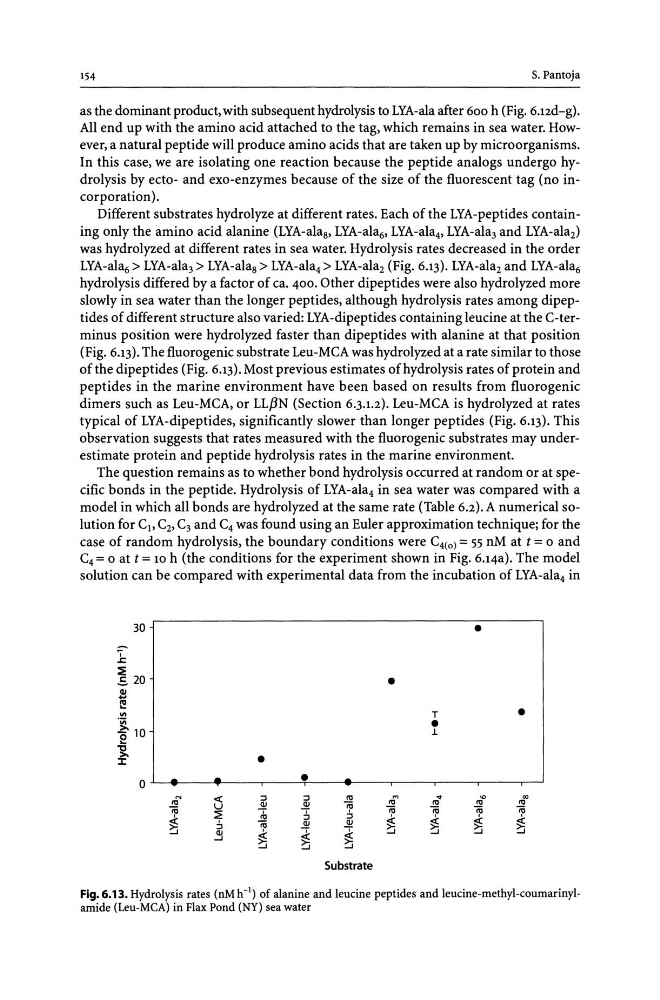
Different substrates hydrolyze at different rates. Each of the LYA-peptides containing only the amino acid alanine (LYA-alas, LYA-ala6' LYA-ala4, LYA-ala3 and LYA-ala2)
was hydrolyzed at different rates in sea water. Hydrolysis rates decreased in the order
LYA-ala6> LYA-ala3 > LYA-alas > LYA-ala4 > LYA-ala2 (Fig. 6.13). LYA-ala2 and LYA-ala6
hydrolysis differed by a factor of ca. 400. Other dipeptides were also hydrolyzed more
slowly in sea water than the longer peptides, although hydrolysis rates among dipeptides of different structure also varied: LYA-dipeptides containing leucine at the C-terminus position were hydrolyzed faster than dipeptides with alanine at that position
(Fig. 6.13). The fluorogenic substrate Leu-MCA was hydrolyzed at a rate similar to those
of the dipeptides (Fig. 6.13). Most previous estimates of hydrolysis rates of protein and
peptides in the marine environment have been based on results from fluorogenic
dimers such as Leu-MCA, or LL/3N (Section 6.3.1.2). Leu-MCA is hydrolyzed at rates
typical of LYA-dipeptides, significantly slower than longer peptides (Fig. 6.13). This
observation suggests that rates measured with the fluorogenic substrates may underestimate protein and peptide hydrolysis rates in the marine environment.
The question remains as to whether bond hydrolysis occurred at random or at specific bonds in the peptide. Hydrolysis of LYA-ala4 in sea water was compared with a
model in which all bonds are hydrolyzed at the same rate (Table 6.2). A numerical solution for C" C2, C3 and C4 was found using an Euler approximation technique; for the
case of random hydrolysis, the boundary conditions were C4(o) = 55 nM at t = 0 and
C4 = 0 at t = 10 h (the conditions for the experiment shown in Fig. 6.14a). The model
solution can be compared with experimental data from the incubation of LYA-ala4 in
30
•
'i
.z:.
:E
.5. 20
•
!
I!
•
.!!!
T
'"
•
~ 10
.1
e
'i.
•
J:
0
...
•
N
«
::;,
::;,
"'
'"
...
'"
.,
"'
"'
"'
"'
"'
'iji
U
"'T
~
'iji
n;
'iji
n;
::2:
"'
::;,
~
~
~
::.
'iji
~
~
~
~
~
:..J
:..J
:..J
:..J
Substrate
Fig. 6.13. Hydrolysis rates (nMh- 1 ) of alanine and leucine peptides and leucine-methyl-coumarinylamide (leu-MeA) in Flax Pond (NY) sea water
S. Pantoja
as the dominant product, with subsequent hydrolysis to LYA-ala after 600 h (Fig. 6.12d-g).
All end up with the amino acid attached to the tag, which remains in sea water. However, a natural peptide will produce amino acids that are taken up by microorganisms.
In this case, we are isolating one reaction because the peptide analogs undergo hydrolysis by ecto- and exo-enzymes because of the size of the fluorescent tag (no incorporation).
Different substrates hydrolyze at different rates. Each of the LYA-peptides containing only the amino acid alanine (LYA-alas, LYA-ala6' LYA-ala4, LYA-ala3 and LYA-ala2)
was hydrolyzed at different rates in sea water. Hydrolysis rates decreased in the order
LYA-ala6> LYA-ala3 > LYA-alas > LYA-ala4 > LYA-ala2 (Fig. 6.13). LYA-ala2 and LYA-ala6
hydrolysis differed by a factor of ca. 400. Other dipeptides were also hydrolyzed more
slowly in sea water than the longer peptides, although hydrolysis rates among dipeptides of different structure also varied: LYA-dipeptides containing leucine at the C-terminus position were hydrolyzed faster than dipeptides with alanine at that position
(Fig. 6.13). The fluorogenic substrate Leu-MCA was hydrolyzed at a rate similar to those
of the dipeptides (Fig. 6.13). Most previous estimates of hydrolysis rates of protein and
peptides in the marine environment have been based on results from fluorogenic
dimers such as Leu-MCA, or LL/3N (Section 6.3.1.2). Leu-MCA is hydrolyzed at rates
typical of LYA-dipeptides, significantly slower than longer peptides (Fig. 6.13). This
observation suggests that rates measured with the fluorogenic substrates may underestimate protein and peptide hydrolysis rates in the marine environment.
The question remains as to whether bond hydrolysis occurred at random or at specific bonds in the peptide. Hydrolysis of LYA-ala4 in sea water was compared with a
model in which all bonds are hydrolyzed at the same rate (Table 6.2). A numerical solution for C" C2, C3 and C4 was found using an Euler approximation technique; for the
case of random hydrolysis, the boundary conditions were C4(o) = 55 nM at t = 0 and
C4 = 0 at t = 10 h (the conditions for the experiment shown in Fig. 6.14a). The model
solution can be compared with experimental data from the incubation of LYA-ala4 in
30
•
'i
.z:.
:E
.5. 20
•
!
I!
•
.!!!
T
'"
•
~ 10
.1
e
'i.
•
J:
0
...
•
N
«
::;,
::;,
"'
'"
...
'"
.,
"'
"'
"'
"'
"'
'iji
U
"'T
~
'iji
n;
'iji
n;
::2:
"'
::;,
~
~
~
::.
'iji
~
~
~
~
~
:..J
:..J
:..J
:..J
Substrate
Fig. 6.13. Hydrolysis rates (nMh- 1 ) of alanine and leucine peptides and leucine-methyl-coumarinylamide (leu-MeA) in Flax Pond (NY) sea water