

CHAPTER 6 • Organic Chemical Reaction Rates in the Ocean:
100
75
50
25
,.----------,5,------------,
LYA-ala a
a
LYA-ala a
b 100
o
"
"
"
4
75
3
~
j::r_6.-----2 l~-·*·········.'*.
, .... . ............ .
20
~.
' .
'*.
Cb_ 0- - - t:.: :::~ -.•.
40
o 50
LYA-ala 6
d
~
~
%~.A---------I!.
\.ir""
~
1
/:
t····
Il. •••••••••.. A ........................ ~
100 150
o
300
(:> .. _-.. <>
~A ()I"'/
e
~~
I
\ !
I I
II
II
A LYA-ala 6
1\
I I
I I
I I
I
I
.. ____ .. ¢ A ......
LYA-ala a
600
o
20
40
o 300 600 900 1 200
o
~'
"
LYA-ala 3
,..1:>- - -6.- - - - -20
40
f
o
Time (h)
I:J.-/
/
/
/
f,.
300
'~
g
\
\
\
\
\
\
l.
LYA-ala 3
---
600
900
153
c
900
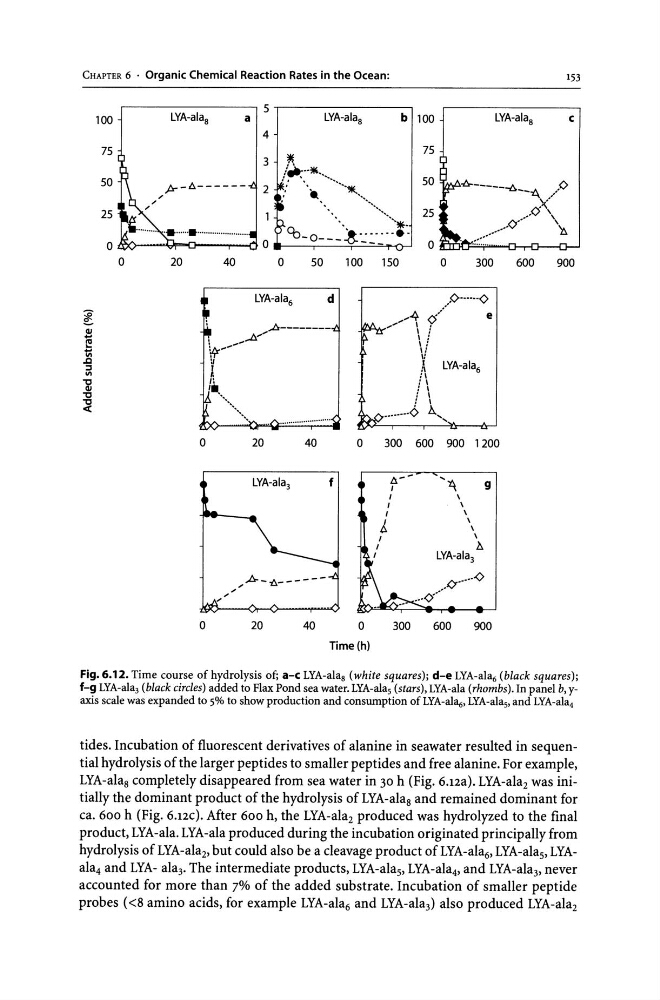
Fig. 6.12. Time course of hydrolysis of; a-c LYA-alaa (white squares); d-e LYA-ala6 (black squares);
f-g LYA-ala3 (black circles) added to Flax Pond sea water. LYA-alas (stars), LYA-ala (rhombs). In panel b, yaxis scale was expanded to 5% to show production and consumption of LYA-ala6' LYA-alas, and LYA-ala4
tides. Incubation of fluorescent derivatives of alanine in seawater resulted in sequential hydrolysis of the larger pep tides to smaller pep tides and free alanine. For example,
LYA-alag completely disappeared from sea water in 30 h (Fig. 6.12a). LYA-ala2 was initially the dominant product of the hydrolysis of LYA-alag and remained dominant for
ca. 600 h (Fig. 6.12C). After 600 h, the LYA-ala2 produced was hydrolyzed to the final
product, LYA-ala. LYA-ala produced during the incubation originated principally from
hydrolysis of LYA-ala2' but could also be a cleavage product of LYA-ala6' LYA-alas, LYAala4 and LYA- ala3' The intermediate products, LYA-alas, LYA-ala4' and LYA-ala3' never
accounted for more than iYo of the added substrate. Incubation of smaller peptide
probes (<8 amino acids, for example LYA-ala6 and LYA-ala3) also produced LYA-ala2
100
75
50
25
,.----------,5,------------,
LYA-ala a
a
LYA-ala a
b 100
o
"
"
"
4
75
3
~
j::r_6.-----2 l~-·*·········.'*.
, .... . ............ .
20
~.
' .
'*.
Cb_ 0- - - t:.: :::~ -.•.
40
o 50
LYA-ala 6
d
~
~
%~.A---------I!.
\.ir""
~
1
/:
t····
Il. •••••••••.. A ........................ ~
100 150
o
300
(:> .. _-.. <>
~A ()I"'/
e
~~
I
\ !
I I
II
II
A LYA-ala 6
1\
I I
I I
I I
I
I
.. ____ .. ¢ A ......
LYA-ala a
600
o
20
40
o 300 600 900 1 200
o
~'
"
LYA-ala 3
,..1:>- - -6.- - - - -20
40
f
o
Time (h)
I:J.-/
/
/
/
f,.
300
'~
g
\
\
\
\
\
\
l.
LYA-ala 3
---
600
900
153
c
900
Fig. 6.12. Time course of hydrolysis of; a-c LYA-alaa (white squares); d-e LYA-ala6 (black squares);
f-g LYA-ala3 (black circles) added to Flax Pond sea water. LYA-alas (stars), LYA-ala (rhombs). In panel b, yaxis scale was expanded to 5% to show production and consumption of LYA-ala6' LYA-alas, and LYA-ala4
tides. Incubation of fluorescent derivatives of alanine in seawater resulted in sequential hydrolysis of the larger pep tides to smaller pep tides and free alanine. For example,
LYA-alag completely disappeared from sea water in 30 h (Fig. 6.12a). LYA-ala2 was initially the dominant product of the hydrolysis of LYA-alag and remained dominant for
ca. 600 h (Fig. 6.12C). After 600 h, the LYA-ala2 produced was hydrolyzed to the final
product, LYA-ala. LYA-ala produced during the incubation originated principally from
hydrolysis of LYA-ala2' but could also be a cleavage product of LYA-ala6' LYA-alas, LYAala4 and LYA- ala3' The intermediate products, LYA-alas, LYA-ala4' and LYA-ala3' never
accounted for more than iYo of the added substrate. Incubation of smaller peptide
probes (<8 amino acids, for example LYA-ala6 and LYA-ala3) also produced LYA-ala2