

152
S. Pantoja
(1 )
(3)
ro~HO H °
H r _~ 1-!-~-N I II
-(-(-0
H2N ~ ~
I
I
- ° (H3
(H 3
K0 3 S
H
(1 )
(2)
(2)
>.
OO~HO
....
'Vi
c:
!
H r _~ 1-!-~-0
.!:
cu v
c:
H2N ~ ~
I
cu v VI
- ° (H3
2!
(4)
:::I
K0 3 S
H
0
c;::
cu
>
....
10
Qj
a:
(3)
K0 3 S
H
~HO HO
HO
H r _~ N-!-~-NH-~-~-NH-~-~-O
H2N ~ ~
I
I
I
- ° (H3 (H3
(H3
K0 3 S
H
."...,
(4)
I
I
I
I
I
0
5
10
15
20
25
30
OO~HO
Time (min)
H ° H ° H °
H r _~ 1-!-~-N I II
I II
I II
-(-(-N -(-(-N -(-(-0
H2N ~ ~
I
I
I
I
- ° (H3
(H 3
(H 3
(H 3
K0 3 S
H
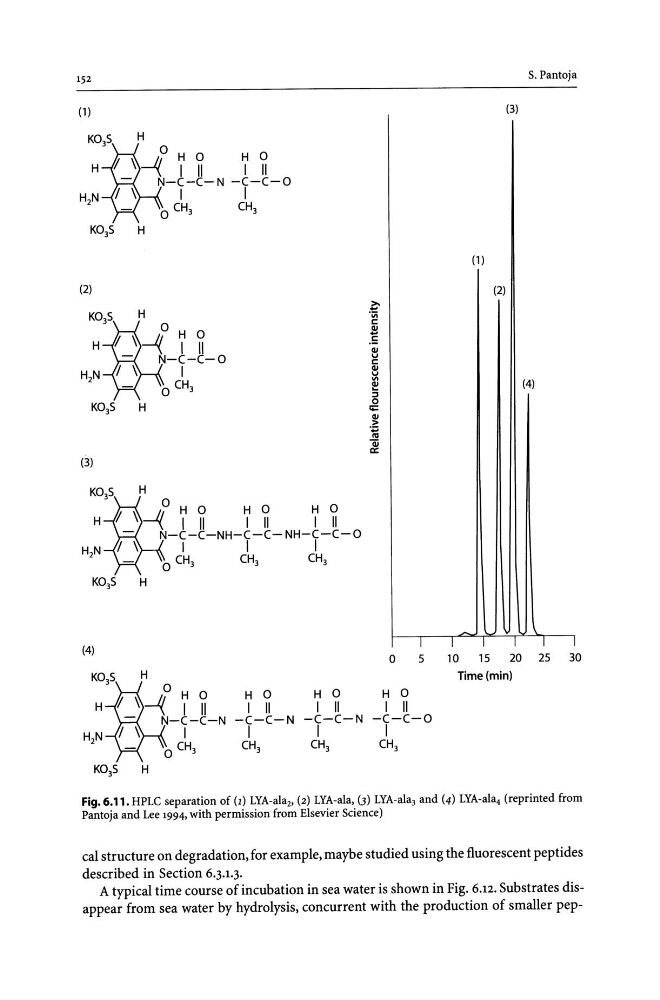
Fig. 6.11. HPLC separation of (1) LYA-ala2, (2) LYA-ala, (3) LYA-ala3 and (4) LYA-ala4 (reprinted from
Pantoja and Lee 1994, with permission from Elsevier Science)
cal structure on degradation, for example, maybe studied using the fluorescent pep tides
described in Section 6.3.1.3.
A typical time course of incubation in sea water is shown in Fig. 6.12. Substrates disappear from sea water by hydrolysis, concurrent with the production of smaller pep-
S. Pantoja
(1 )
(3)
ro~HO H °
H r _~ 1-!-~-N I II
-(-(-0
H2N ~ ~
I
I
- ° (H3
(H 3
K0 3 S
H
(1 )
(2)
(2)
>.
OO~HO
....
'Vi
c:
!
H r _~ 1-!-~-0
.!:
cu v
c:
H2N ~ ~
I
cu v VI
- ° (H3
2!
(4)
:::I
K0 3 S
H
0
c;::
cu
>
....
10
Qj
a:
(3)
K0 3 S
H
~HO HO
HO
H r _~ N-!-~-NH-~-~-NH-~-~-O
H2N ~ ~
I
I
I
- ° (H3 (H3
(H3
K0 3 S
H
."...,
(4)
I
I
I
I
I
0
5
10
15
20
25
30
OO~HO
Time (min)
H ° H ° H °
H r _~ 1-!-~-N I II
I II
I II
-(-(-N -(-(-N -(-(-0
H2N ~ ~
I
I
I
I
- ° (H3
(H 3
(H 3
(H 3
K0 3 S
H
Fig. 6.11. HPLC separation of (1) LYA-ala2, (2) LYA-ala, (3) LYA-ala3 and (4) LYA-ala4 (reprinted from
Pantoja and Lee 1994, with permission from Elsevier Science)
cal structure on degradation, for example, maybe studied using the fluorescent pep tides
described in Section 6.3.1.3.
A typical time course of incubation in sea water is shown in Fig. 6.12. Substrates disappear from sea water by hydrolysis, concurrent with the production of smaller pep-